Speaking at the opening of the Metropolitan Museum of Art’s Costume Institute spring exhibition in New York, Anna Wintour described the first Monday in May as her “favourite day of the year, and also my most terrifying one”.
This particular Monday may be more high-stakes than previous years, with Monday night’s Met Gala for the exhibition’s launch mired in controversy, owing to Jeff Bezos and Lauren Sánchez Bezos’s sponsorship of the event. It is also the inaugural exhibition for the Costume Institute’s new home: a 12,000 sq ft space, named the Condé M Nast Galleries, that puts the museum’s fashion exhibitions in a considerably more high-profile spot, right off its Great Hall.
Three times the size of the institute’s previous basement home, the gallery acknowledges the popularity of fashion exhibitions, which are frequently among the Met’s most visited shows, and puts them in the same crowd-pleasing category as ancient Egyptian artefacts.
Titled Costume Art, the exhibition pairs 200 garments and accessories with 200 artworks from the Met’s collection. The idea, said the lead curator, Andrew Bolton, is to invite us to “reconsider longstanding hierarchies” and consider art in the context of the fashion pieces in the show, rather than the other way round. It was inspired by the idea that “the dressed body” is one aspect that is present the Met’s enormous collection.
All of that extra space gave Bolton the leeway to explore his subject in depth, which he did by grouping the show into 13 “thematic body types”, beginning with the human body undressed. The show opens with an area devoted to the Naked and Nude body, where a Walter van Beirendonck spandex top and leggings with trompe l’oeil male musculature and genitalia is paired with a Marcantonio Raimondi engraving of Adam and Eve, and statues are placed next to draped, classically-inspired gowns by contemporary designers Y/Project and Di Petsa.
The next hall is the showstopper, focusing on the kind of bodies, Bolton said, that have been undercelebrated in fashion and western culture. Among them, a selection titled the Abstracted Body features three Comme des Garçons dresses in which the shape of the body is distended and conceptualised into unexpected silhouettes, paired with curvaceous sculptures by Max Weber, Jean Arp and Henry Moore.
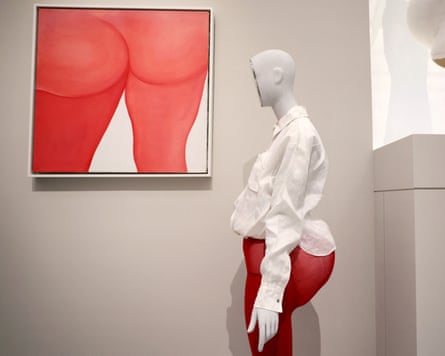
A section on the Corpulent Body features ensembles by Michaela Stark, the Australian designer whose corsets and bound garments deliberately accentuate bulges of fat and flesh, paired with a Cycladic marble female figure from 4500-4000 BCE. Another of Stark’s works is paired with Niki de Saint Phalle’s Nana and Serpent sculpture.
Representations of the Disabled Body include a mannequin styled after the campaigner Sinéad Burke, wearing a Burberry trenchcoat modified to fit her small stature by the photographer Tim Walker, including a crown made from the excess fabric chopped off the sleeve.
All of the mannequins in this section of the show, designed to foreground diversity, are arranged on high podiums or, as Bolton put it, deliberately “pedestalised”. Seeing a true diversity of bodies in a fashion museum setting feels far more refreshing than it should – and so much more interesting.
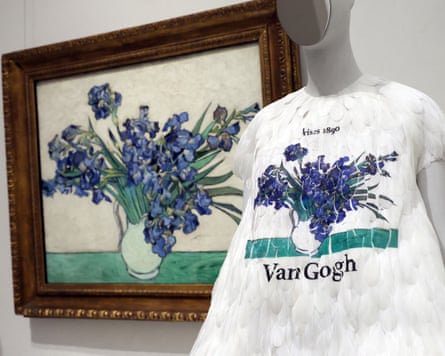
Though the exhibition features many straightforwardly beautiful works of art – an Yves Saint Laurent 1988 silk organza jacket decorated with a design of Van Gogh’s Irises paired with the 1889 painting, for example – the overall emphasis of the show is of strangeness and surprise.
Dresses with embroidered anatomical body parts and sculptures and garments resembling skeletons featured heavily in a section on the Mortal Body; in a section on the Aging Body a Batsheva jumper emblazoned with the word Hag beside The Old Duchess, a 1905 painting by George Luks; a Vetements hoodie declaring “I’m retired” next to a Diane Arbus photograph of retirees; a Sarah Lucas sculpture next to a piece of wearable art made of what Bolton described as “Nora Batty-like stockings” by the British designer Harry Pontefract.
The show’s press preview is also the precursor to Monday’s Met Gala. Sánchez Bezos was there, wearing a shimmering bronze dress. In remarks that will not appeal to the protesters papering the city with posters urging for a boycott of the event, Wintour underlined the necessity of funding for art for a successful city, and described Sánchez Bezos as a “force for joy, a force for generosity”. The Met Gala, she said, has a ripple effect across New York, driving trade to many local businesses, including “God knows how many hairdressers”.
Disclaimer : This story is auto aggregated by a computer programme and has not been created or edited by DOWNTHENEWS. Publisher: theguardian.com