Meta is doubling down on smart glasses and artificial intelligence even as concerns mount that wearable technology is being used to violate people’s privacy.
On Wednesday, the company said it’s releasing $1,299 virtual reality glasses that buyers can use to watch movies, play games and browse the internet. The parent company of Facebook and Instagram also announced a new lineup of smart glasses including a $349 pair without cameras.
The company plans to add an AI agent called Muse to its smart glasses which users can use to book appointments, find flights and do other tasks. And it’s been working on a gadget with its AI agent that fits on a keychain that’s still in development but the company plans to ship in December.
The release of new wearables underscores how one of the world’s largest tech companies is barreling forward in the AI race even as tech workers and politicians call for the industry to slow down.
“It’s no secret that people in the industry have a wide range of views about how the future is going to go. But at Meta, we are optimists because we believe in people,” said Meta Chief Executive Mark Zuckerberg during a keynote speech at the company’s conference.
The path to a safe future, he said, is to “distribute this technology widely and create the right checks and balances, rather than concentrating it in the hands of just a few.”
The company, which has been criticized for its collection of people’s social media data, has faced backlash from people who have called its high-tech eyewear “pervert glasses” because some buyers modified them to secretly record people.
More than 70 people who bought, owned or were recorded with smart glasses have sued the company, alleging in one lawsuit filed this year that intimate images were exposed to contract workers tasked with training artificial intelligence. Meta has denied the allegations in the lawsuit and says it has taken “steps to filter this data to help remove identifying information and to protect people’s privacy.”
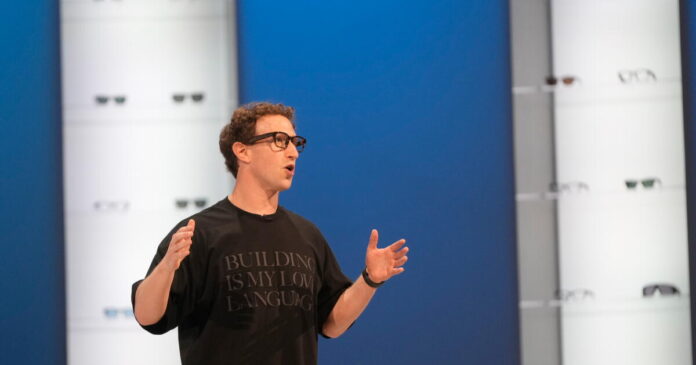
Zuckerberg said the company is releasing more privacy protections that would prevent anyone including Meta from accessing people’s data when they use certain AI features on their glasses. Wearing a black shirt that said “building is my love language,” Zuckerberg stood on stage in front of shelves filled with the company’s smart glasses.
Meta’s new wearables also come at a sensitive moment for the tech industry. Concerns that humans will lose control of AI surged this month after former Anthropic safety researcher Jacob Coxon resigned and posted on social media site X “that people building AI earnestly believe that it could kill us all by the end of the decade.”
Politicians have been trying to place more guardrails around the technology. Last week, Gov. Gavin Newsom issued an executive order to expand oversight of AI companies and speed up the development of a “kill switch” for AI models.
Some politicians and tech executives say concerns about AI’s existential risk are overblown.
Zuckerberg said in a post on X that companies such as Meta have incentives “to move at the pace required to train its models safely.” He said Meta delayed the release of its Muse AI agent “for several months to focus on safety and security.”
The app that people use to access the Muse AI agent topped Apple’s charts for free productivity apps, surpassing OpenAI’s ChatGPT, Google Gemini and Anthropic’s Claude.
The app also prompted pushback from Amazon, which blocked Muse from shopping on the e-commerce site.
At Meta’s campus, crowds lined up outside for the keynote speech as people snapped photos with a furry mascot called Jolly for the company’s AI agent Muse. Meta has said Muse includes privacy protections and the AI agent can’t see people’s passwords or payment methods.
Meta has been working on advancing artificial intelligence efforts for more than a decade. The company has also been improving its virtual reality headsets and smart glasses, partnering with celebrities such as Kylie Jenner and brands like Ray-Ban and Oakley to market them.
Taking on tech giants such as Apple, it’s also been expanding its retail footprint by opening stores including a flagship one in West Hollywood in 2025.
Meta makes most of its money from advertising but it’s been investing heavily in building new AI hardware and data centers.
Meta’s reality labs division, which includes its wearable devices, lost $4.6 billion in the second quarter. But the company still has deep pockets to experiment with new wearables. It reported a net income of $15.8 billion during that quarter.
Meta’s foray into virtual reality products dates to 2014, when the company purchased Oculus VR. California entrepreneur Palmer Luckey co-founded the VR startup before starting defense tech company Anduril Industries.
Meta, which was formerly known as Facebook, has pushed this idea of the metaverse — digital spaces where people will work, socialize and play through virtual avatars.
At Meta’s headquarters, employees showcased its VR glasses, which includes its AI agent. The gadget, scheduled to go on sale in spring 2027, weighs 100 grams — the weight of a deck of cards — and easier to use compared to its Quest VR headsets and is less pricey than Apple’s $3,699 Vision Pro headset.
People can type on a digital keyboard, play games and immerse themselves in a concert or basketball game as they watch a massive screen through the glasses. But Meta doesn’t view the eyewear as a replacement for people’s television or going to in-person events.
“This is for those moments in which we’re looking for that kind of differentiated experience on the go,” said Brett Vogel, vice president of Meta’s Metaverse Business Group.
More to Read
Disclaimer : This story is auto aggregated by a computer programme and has not been created or edited by DOWNTHENEWS. Publisher: latimes.com