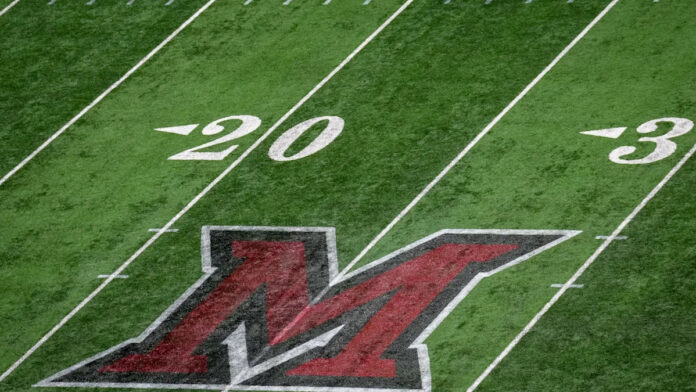
The Miami (Ohio) stadium operations department had a very clever idea for its rivalry clash with Ohio on Tuesday. Unfortunately, it was also very illegal.
The situation began at the end of the first half, when Ohio’s Brack Peacock missed a 34-yard field goal attempt, which would have put the Bobcats up 20-7 going into the locker room. However, the officials then intervened and said the following
“On the previous play, there were depictions of the field goal uprights on the scoreboard. That is a foul for unsportsmanlike conduct against Miami. Half the distance to the goal, automatic first down.”
Another look at the play, specifically from Peacock’s vantage point, shows what the officials were talking about. You can definitely see how this might not be considered sportsmanlike:
The penalty gave Ohio new life, but with only six seconds left on the clock. A pass from Magnus Haines to Evan Herrman on first-and-goal fell incomplete to end the first half. Undeterred by the penalty, Miami went on to score 27 unanswered points in the second half to win the “Battle of the Bricks,” 34-17.
Advertisement
Miami can’t be considered the originators of the video board subterfuge, though. That honor belongs to Oklahoma State, which pulled something similar during a field goal attempt in a 2020 game against Texas. In that case, however, the Cowboys lined the videoboard with a bunch of yellow vertical lines, rather than the extra shots of the goal posts the Redhawks used.
Texas head coach Tom Herman wasn’t happy about the tactic, contacting the Big 12 following the game. Months later, the NCAA announced a change to the rulebook in which “video board and lighting system operators have been included in those personnel who may not create any distraction that obstructs play.”
The NCAA’s current football rulebook lays out a couple of ways a team can incur an unsportsmanlike conduct penalty, so take your pick on what Miami violated:
“Persons subject to the rules, including bands and audio/video/lighting systems operators, shall not create any noise or distraction that prohibits a team from hearing its signals or obstructs play (Rule 1-1-6).”
“No equipment may be used to confuse opponents (Rule 1-4-2-d).
Miami isn’t even the first program to try this in spite of that rule change, as one Reddit user noticed Indiana using the same trick against UNT earlier this season and avoiding a penalty.
Advertisement
All of that is just the college ranks, as the New England Patriots appear to have been doing this chicanery for more than a decade. The NFL specifically banned the practice earlier this season, a few weeks after former NFL team analytics expert Ryan Paganetti called out what he described as “a diabolically clever piece of Patriots gamesmanship.“
Paganetti showed multiple field goal attempts at Gilette Stadium in which the Patriots put a rear angle of the kick on the videoboard, sneakily adding another pair of uprights to the kicker’s vision. Per Paganetti, he found dozens of examples and it was only done when the road team was kicking. He said the Philadelphia Eagles tried copying it but couldn’t due to the locations of the video boards at Lincoln Financial Field.
You can even see this on one of the most infamous plays in Baltimore Ravens history, Billy Cundiff’s missed 32-yarder in the 2012 AFC championship game that sent the Patriots to Super Bowl XLVI. Take a peep at the video board behind the goalposts.
Suffice to say, we are still learning ways in which Bill Belichick was finding marginal advantages.
Disclaimer : This story is auto aggregated by a computer programme and has not been created or edited by DOWNTHENEWS. Publisher: Sports.yahoo.com