
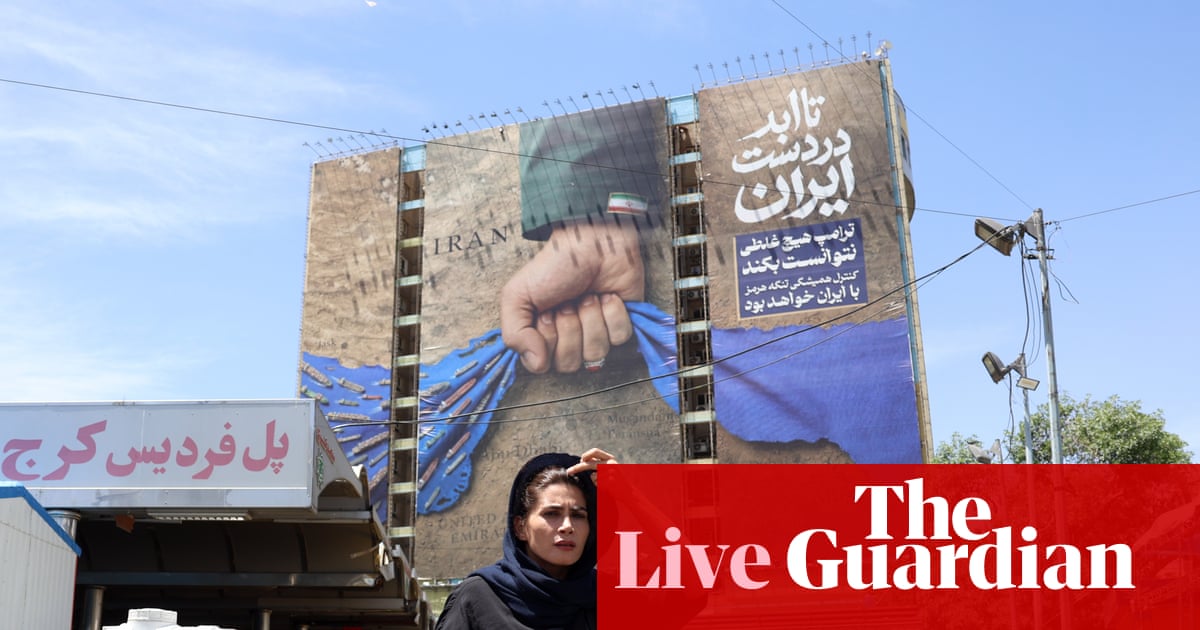
Iran’s top negotiator Mohammad Bagher Ghalibaf said on Wednesday that Washington was seeking Tehran’s surrender through various means, including a naval blockade.
“The enemy, in its new design, is seeking, through a naval blockade, economic pressure and media manipulation, to destroy the country’s cohesion in order to force us to surrender,” Ghalibaf said in a voice message published on his official Telegram channel.
The influential speaker of the Iranian parliament did not elaborate on the prospects for a peace plan with the United States, as Tehran continues to review elements of a US proposal.
Since users of the leading prediction market Polymarket have been able to wager on the outcomes of war, fears have been raised that those betting on bombs falling from the sky may be privy to non-public information about military strikes. There has been much reported about suspicions of insider trading on war, but who exactly is believed to be placing these bets has remained unclear.
In February, Israeli authorities charged two suspects with committing security offences, bribery and obstruction of justice, alleging they used classified information to bet on the timing of military operations on Polymarket.
The claims in the indictment follow reporting in the Guardian in January, which revealed a cluster of jointly funded Polymarket accounts wagering on strikes involving Iran and Israel between June 2025 and January 2026, generating profits of about $156,000, according to publicly available blockchain data.
Since then, there have been growing reports of possible insider trading on prediction markets – where traders can bet using crypto wallets, particularly around the Iran war, with suspicious accounts racking up millions of dollars in profits.
Now, after local journalists successfully appealed to narrow a gag order, Tel Aviv court documents allege more about the people who prosecutors say have profited by betting on lethal military strikes and how they received their information.
The United Arab Emirates said its ties and its international and defense partnerships were a “purely sovereign matter,” rejecting an earlier statement by Iran saying that Abu Dhabi’s cooperation with the US threatened Iran’s security and national interests.
The UAE’s foreign ministry said the Gulf country reserves its full sovereign, legal, diplomatic and military rights to address any “threat, allegation or hostile act”.
The dispute between the two countries come after the UAE reported being attacked in the past days by Iran after four weeks of relative calm since the ceasefire was announced by the US.
Tehran denied carrying out operations against the UAE in recent days, however it warned of a “crushing response” if any action was launched from the UAE against Iran.
A CMA CGM container ship was attacked while transiting the Strait of Hormuz, injuring crew members and damaging the vessel, while another vessel run by the French group exited the Gulf.
The San Antonio was hit on Tuesday, with injured seafarers evacuated for medical treatment, CMA CGM, the world’s third-largest container shipping line, said.
Another CMA CGM ship, the Saigon, was sailing along the coast of Oman south of the country’s capital Muscat, after tracking as being inside the Gulf up to Tuesday, vessel data showed.
The company confirmed the vessel had exited the Gulf, Reuters reports.
US president Donald Trump said the situation in Iran is “very much under control” after the president told the regime to accept a deal to end the war in the Middle East or face a new wave of US bombing “at a much higher level and intensity than it was before” in a post on Truth Social.
He also claimed Tehran wants to “make a deal very much”, while noting the ongoing naval blockade in the strait of Hormuz is “unbelievable”.
“[Iran is] not getting anything through one way or the other, so they’re out of business,” Trump said.
“We’ll see whether or not they are agreeing, and if they don’t agree, they’ll end up agreeing shortly thereafter.”
The president added 111 missiles had been fired by Iran at a US aircraft carrier and were all intercepted.
Israel’s military has carried out strikes in Beirut’s southern suburbs for the first time in weeks since the Israel-Lebanon truce went into force on 17 April.
Israeli prime minister Benjamin Netanyahu said the IDF was targeting the unnamed commander of Hezbollah’s Radwan force. In a joint statement with his defence minister Israel Katz, Netanyahu said:
The Israeli army has struck in Beirut to target the commander of Hezbollah’s Radwan force, in an attempt to neutralise him.
Radwan operatives, under his command, were responsible for firing at Israeli communities and for attacks on Israeli soldiers.
There was no immediate comment from Hezbollah.
Netanyahu said earlier that he will speak to Donald Trump later on Wednesday about the ongoing US-Iran negotiations to end the war.
Despite the ceasefire, Israel has continued to carry out extensive air and artillery attacks and raids in southern Lebanon, claiming it is targeting Hezbollah targets. Israel has killed dozens of people in these attacks and continues to force residents across the area to leave their homes and villages. Hezbollah says it has continued to strike back in retaliation for these “violations” of the truce.
Lebanon’s health ministry puts the total number of people killed since 2 March, when Israel launched its unprecedented offensive, at more than 2,700 people and over 8,300 wounded.
Lebanese parliament speaker Nabih Berri told Al Jazeera on Wednesday that any agreement with Israel needs to ensure guarantees, as Tel Aviv has “violated” the cessation of hostilities despite Hezbollah’s commitment to it.
Berri said that Iran’s foreign minister had confirmed that Lebanon would be part of any deal the US secures to end the war, adding that he hoped the US-Iran negotiations would reach a “positive conclusion soon”.
US Central Command has said that US forces in the Gulf of Oman “enforced blockade measures by disabling an Iranian-flagged unladen oil tanker” that was attempting to sail towards an Iranian port earlier on Wednesday.
Centcom said repeated warnings were given to the Iranian-flagged vessel and the crew failed to comply, so US forces shot at and disabled the vessel from a navy jet.
“US forces disabled the tanker’s rudder by firing several rounds from the 20mm cannon gun of a US Navy F/A-18 Super Hornet,” the statement said.
“Hasna is no longer transiting to Iran. The US blockade against ships attempting to enter or depart Iranian ports remains in full effect.”
-
The US president, Donald Trump, has issued a fresh ultimatum, telling Iran to accept a deal to end the war in the Middle East or face a new wave of US bombing “at a much higher level and intensity than it was before”. The social media announcement on Wednesday was the latest in a rapid series of dramatic and often contradictory changes in policy and came amid reports the US was claiming progress in stalled negotiations between Tehran and Washington.
-
Trump said that it was “too soon” to consider face-to-face talks with Tehran, according to an interview with the New York Post as the US waited for a response to its proposal to end the war. Trump posted earlier on social media that the war with Iran could soon end and oil and natural gas shipments could restart.
-
Ebrahim Rezaei, the spokesperson of the Iranian parliament’s national security and foreign policy commission, has poured cold water on the Axios report claiming the US and Iran were nearing a one-page memorandum to end the war, saying it was an “American wishlist [and] not a reality”. In a fiery statement on X, he said: “Americans will not gain in a lost war what they failed to achieve in face-to-face negotiations. Iran has its finger on the trigger and is ready; if they do not surrender and grant the necessary concessions, or if they or their lapdogs attempt any mischief, we will respond with a harsh and regrettable response.
-
Iran’s top negotiator Mohammad Bagher Ghalibaf said on Wednesday that Washington was seeking Tehran’s surrender through various means, including a naval blockade. “The enemy, in its new design, is seeking, through a naval blockade, economic pressure and media manipulation, to destroy the country’s cohesion in order to force us to surrender,” Ghalibaf said in a voice message published on his official Telegram channel.
-
More than 50 cargo ships have been turned back or returned to port as a result of the ongoing US naval blockade of Iran, the US military has said. The sanction remains in place despite Donald Trump pausing a naval mission to reopen the strait of Hormuz and free stranded vessels, given what he described as “great progress” towards an agreement to end the war with Tehran.
-
Iran’s Islamic Revolutionary Guard Corps (IRGC) navy has announced the strait of Hormuz could reopen following the end of “threats from aggressors”, Reuters reports, citing state media. The IRGC navy said the safe and stable transit through the key waterway could be possible. It follows Donald Trump’s remarks yesterday that he has paused his “Project Freedom” to open the strait of Hormuz due to “great progress” being made towards a “complete and final agreement” with Iran.
-
France’s Charles de Gaulle aircraft carrier group is moving into the Red Sea and Gulf of Aden as part of efforts by France and Britain to prepare for a future mission to help freedom of navigation on the strait of Hormuz, France’s military said on Wednesday. The French Armed Forces ministry said in a statement that the aircraft carrier group had crossed the Suez canal on Wednesday, en route to the south of the Red Sea.
-
The Israel Defense Forces (IDF) chief of the general staff, Eyal Zamir, said the military was prepared to launch a new offensive against Iran if needed. Speaking to troops today in the town of Khiam in southern Lebanon, where Israeli strikes have continued despite a ceasefire, Zamir said they have “no restrictions as to using force” and claimed the IDF has killed more than 2,000 Hezbollah operatives since the Iran war began, the Israeli Haaretz newspaper reported.
-
An Israeli strike in Lebanon’s eastern Bekaa valley on Wednesday killed four people, Lebanon’s health ministry said, with local media reporting the attack took place before the Israeli army issued a warning to evacuate the area along with 11 other towns. “An Israeli enemy raid on the town of Zellaya in West Bekaa resulted in four martyrs, including two women and an elderly man,” the ministry said.
-
Oil prices have continued to slide with the Brent crude global benchmark falling 9.2% to $99.79 a barrel – the first time it has been below $100 since 22 April. It follows reports that the US and Iran were closing in on an agreement to bring an end to the war. Iran has also reportedly announced that the strait of Hormuz could reopen after Donald Trump paused his so-called “Project Freedom” to guide commercial ships out of the economically vital waterway.
-
The Spanish prime minister, Pedro Sánchez, has asked the European Commission to activate its blocking statute to prevent compliance with US sanctions on the international criminal court (ICC) over its investigation into Israel’s actions in Gaza. The EU blocking statute is a legal mechanism that would effectively allow European companies to ignore the US sanctions.
-
The UN has called on Israel to immediately release two activists taken from a Gaza aid flotilla, and demanded an investigation into “disturbing accounts” they had been severely mistreated. Spanish national Saif Abu Keshek and Brazilian activist Thiago Avila were among dozens of activists on a flotilla attempting to transport aid to Gaza when it was intercepted by Israeli forces in international waters near Crete last Thursday. The two men are being held in a prison in Ashkelon in southern Israel.
Iran’s top negotiator Mohammad Bagher Ghalibaf said on Wednesday that Washington was seeking Tehran’s surrender through various means, including a naval blockade.
“The enemy, in its new design, is seeking, through a naval blockade, economic pressure and media manipulation, to destroy the country’s cohesion in order to force us to surrender,” Ghalibaf said in a voice message published on his official Telegram channel.
The influential speaker of the Iranian parliament did not elaborate on the prospects for a peace plan with the United States, as Tehran continues to review elements of a US proposal.
The US president, Donald Trump, has issued a fresh ultimatum, telling Iran to accept a deal to end the war in the Middle East or face a new wave of US bombing “at a much higher level and intensity than it was before”.
The social media announcement on Wednesday was the latest in a rapid series of dramatic and often contradictory changes in policy and came amid reports the US was claiming progress in stalled negotiations between Tehran and Washington.
“Assuming Iran agrees to give what has been agreed to, which is perhaps a big assumption, the already legendary Epic Fury will be at an end,” Trump posted on his Truth Social platform, referring to the military operation he launched with Israel against Iran in February.
“If they don’t agree, the bombing starts, and it will be, sadly, at a much higher level and intensity than it was before.”
Earlier on Wednesday Axios reported that Washington and Tehran were close to agreeing on a one-page memorandum of understanding to end the war.
The US-based news outlet reported that the US expects Iran to respond to several key points in the next 48 hours, and that while nothing has yet been agreed, this was the closest the parties had been to an agreement since the war began.
More than 50 cargo ships have been turned back or returned to port as a result of the ongoing US naval blockade of Iran, the US military has said.
The sanction remains in place despite Donald Trump pausing a naval mission to reopen the strait of Hormuz and free stranded vessels, given what he described as “great progress” towards an agreement to end the war with Tehran.
An update from US central command (Centcom), which oversees US military operations in the Middle East, said: “So far, 52 commercial vessels have been directed to turn around or return to port in order to comply.”
The US Department of Homeland Security has identified the US-Israeli war with Iran as a potential motive for the man accused of attempting to assassinate president Donald Trump and senior members of his administration at a White House reporters’ gala last month, according to an intelligence report sent to state and local law enforcement nationwide and other federal agencies.
The report, a preliminary assessment by the Department of Homeland Security’s Office of Intelligence and Analysis dated 27 April, assessed that the suspect Cole Allen had “multiple social and political grievances.”
It concluded that the Iran conflict “may have contributed to his decision to conduct the attack,” citing social media posts from Allen that criticized US actions in the war, Reuters reported.
The assessment sheds new light on the US government’s search for a motive in the foiled attack on the White House Correspondents’ Dinner on 25 April.
Its conclusions, while preliminary, offer the most definitive evidence to date that the Iran conflict, which has killed thousands in the Middle East and rattled the global economy, could have been a trigger.
Another day, another hairpin turn in the world of Donald Trump’s foreign policy.
The weekend was all about war and Trump insisting Iran had not yet “paid a big enough price”.
Tuesday was Project Freedom, styled as a grand “humanitarian gesture” to allow trapped ships and their crews to escape the Gulf, but which was also aimed at weakening Iran’s chokehold on the strait of Hormuz.
By the early hours of Wednesday we were back to peace. The president announced “Great Progress has been made toward a Complete and Final Agreement” so Project Freedom would be paused to give negotiations a chance.
All three approaches on three consecutive days do at least have something in common. They are all attempts to wrestle with the same set of hard facts: the regime in Iran is unlikely to collapse or surrender the right to enrich uranium no matter how many bombs are dropped on it. Tehran has shown its capacity to close the strait of Hormuz, and a total blockade hurts the US economy at the same time it is clearly crippling Iran.
Together, these hard facts make up the sides of a steel box in which the Trump administration, largely through its own actions, finds itself trapped. The repeated policy changes in recent days represent him flailing around inside this trap, pinging off the walls and looking for an exit other than humiliation or a forever war.
It remains too early to say whether Trump has now found the way out he has been looking for. His accompanying threat of bombardment “at a much higher level and intensity”, if Iran does not accept the initial terms, betrays his nervousness it will not work.
Before the war, Iran was offering a moratorium on uranium enrichment of five years, and the US was demanding 20. The reported new proposal suggests a compromise of 12 or 15 years. Any agreement should ultimately be assessed against the benchmark of the 2015 multilateral nuclear deal that Trump torpedoed in 2018. Under its terms, Iran had no highly enriched uranium but would have held on to a closely-monitored and strictly limited nuclear programme.
If he wants to declare victory, Trump could point to the fact that even the 2015 deal lacked the lengthy moratorium on enrichment that his diplomacy will provide.
But any such gains will have come at an awful price. There are over 5,000 dead, including the 120 primary school children killed on the first day in Minab, and counting the casualties in Lebanon.
Then there are all the indirect global costs – economic and environmental – that will take years to play out. Harder to calculate is whether the relentless bombing has shortened or lengthened the life of Iran’s regime. For now, it appears to have entrenched the military and the hardliners.
As things stand, there are more unknowns than knowns surrounding this possible breakthrough, and any progress will remain extremely fragile. But even if the war is brought to an end and Trump gets the peace plan which has been sketched out in today’s reports, this war seems certain to rank right up there on the list of history’s most pointless conflicts.
The Israel Defense Forces (IDF) chief of the general staff, Eyal Zamir, said the military was prepared to launch a new offensive against Iran if needed.
Speaking to troops today in the town of Khiam in southern Lebanon, where Israeli strikes have continued despite a ceasefire, Zamir said they have “no restrictions as to using force” and claimed the IDF has killed more than 2,000 Hezbollah operatives since the Iran war began, the Israeli Haaretz newspaper reported.
The military chief also said the IDF maintains a list of targets ready for an attack in Iran, in coordination with the US.
Disclaimer : This story is auto aggregated by a computer programme and has not been created or edited by DOWNTHENEWS. Publisher: theguardian.com



