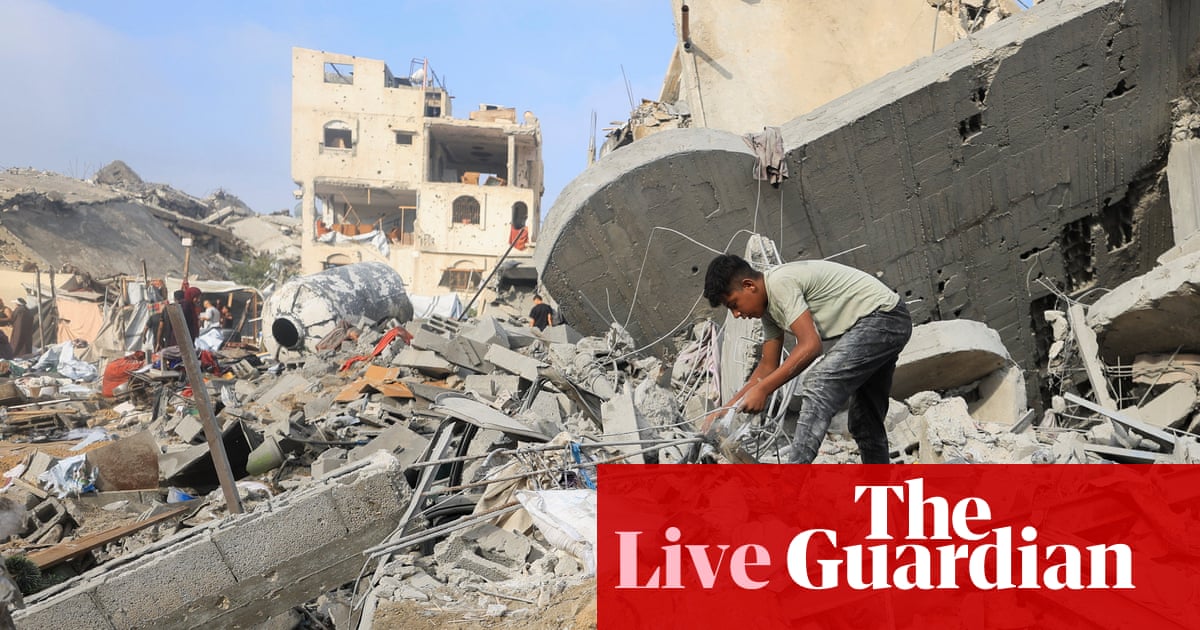
In further comments to Reuters, Ghazi Hamad said Hamas will hand over its weapons to the National Committee for the Administration of Gaza (NCAG), a new body established by the Board of Peace to oversee day-to-day affairs in the Palestinian territory.
He said disarmament will be contingent on the withdrawal of Israeli troops, and that the NCAG and international force must enter Gaza and dismantle Israeli-backed militias.
We are pausing this blog for the moment but our latest reporting can be found here:
-
On Thursday night, Donald Trump declared a breakthrough in negotiations over the disarmament of Hamas in Gaza and the withdrawal of Israeli forces, issues that have so far stalled the implementation of last October’s ceasefire, but Israel has yet to respond officially to the plan and government officials have voiced scepticism over the deal. In particular, there is confusion over what should happen first, Hamas to disarm or the IDF to withdraw.
-
Trump offered no clarity on the matter of the sequence of events at Friday’s cabinet meeting at Camp David. Asked if Israel was on board, Trump said: “We do have an understanding with Israel. Israel is very happy about it. They helped us and they’ve been very good about it.” There was also confusion over who Hamas would supposedly be handing over its heavy weapons too if the disarmament goes through – Trump said the Board of Peace, but officials announcing the deal said it would be Palestinian authorities.
-
But at the time of writing, there has still been no confirmation from the Israeli government that it has accepted the agreement. Benjamin Netanyahu has yet to comment publicly, while his far-right national security minister, Itamar Ben-Gvir, on Friday dismissed the plan as “unacceptable”. An Israeli official also told Reuters: “Israel demands the complete disarmament of Hamas, including the removal of weapons from Gaza and the complete demilitarisation of the strip as a precondition for any process.” They said the plan under discussion did not “provide a satisfactory response to these demands and Israel conveyed its objections”. In similar vein, an Israeli source told AFP that Israel will not withdraw from the so-called Yellow Line in the Gaza Strip until Hamas undergoes “genuine disarmament”. Israel’s ambassador to the UN, Danny Danon, said “cosmetic solutions” wouldn’t work and Hamas had to “actually” disarm. He told CNN: “Disarmament means the weapons out of Gaza, they have no control of the weapons, and then we can move forward.”
-
Hamas, meanwhile, has said it agreed to the roadmap on condition that disarmament was carried out at the same time as Israeli withdrawal. Indeed, the group released a statement saying it remains committed to negotiations on the next phase of the ceasefire, but insisted that Israel must commit to “halting the killing and ending its attacks” and that “handing over heavy weapons is also conditional on Israel ending hostilities and withdrawal from Gaza”. A member of the Hamas negotiating team, Ghazi Hamad, told Al Jazeera: “We will not take any action regarding disarmament prior to Israel’s withdrawal from the strip.” Hamad told Agence France-Presse in a separate interview: “The agreement contains a clear provision stating that Israel must commit to and implement its obligations. If Israel does not implement the agreement, neither will we.”
-
Trump also said the US would be hitting Iran “very hard” when asked by reporters what Tehran can expect in the next few weeks. “At some point they’re going to say, ‘We just can’t take it anymore,’” he added. Trump also said he was “losing faith” in negotiations with Tehran, and implied, as he has done in the past, that Iranian negotiators were making him “angry” by saying one thing privately and another publicly. “They always want to talk, but they break their word so often … they just make me angry,” the US president said. “I’m losing faith in them because they do lie and do, they do misrepresent.”
The Pentagon is considering reversing about half the staff cuts it made to a program dedicated to preventing wartime civilian casualties, the Atlantic reports, as the US military reckons with the human cost of its war against Iran – particularly the strike on a girls’ elementary school in Minab on the first day of the war that killed at least 168 people, most of them children.
After US defence secretary Pete Hegseth fired or reassigned almost all of the staff working on the program, the potential reversal now awaits his signature, according to the magazine.
Per the Atlantic’s report, “a Pentagon inspector-general report this spring found that the [US defence] department’s deep cuts in civilian-harm protections may have violated laws designed to safeguard noncombatants. Democrats are urging the department to reverse course. Hegseth’s comments and service history suggest that he will do otherwise. A Pentagon official – who, like other officials, spoke with us on the condition of anonymity to discuss internal deliberations – said in a statement that the setup for preventing civilian harm is ‘currently undergoing a strategic reassessment to inform its future reorganization’ and would remain in compliance with congressional requirements, but that no final decisions have been made.”
The UN secretary general António Guterres has called the agreement for Hamas to give up its weapons and for Israel to withdraw from Gaza as “the only good news in recent days”.
Speaking to reporters on Friday, he said:
Let me be clear: the fighting must stop on all fronts in the region.
We are now six months into the military escalation in the Gulf. What began as a regional conflict is increasingly becoming a driver of global instability.”
A 10-year-old child has been shot in the back and injured by Israeli settlers in the occupied West Bank, according to the official Palestinian news agency, Wafa.
Local sources were reported to have said that live ammunition was used in the attack by settlers on a farm in the village of al-Mughayyir, northeast of Ramallah.
Lebanon’s president Joseph Aoun has called the Israeli army’s detonations near a 12th-century Unesco-listed castle (see 08.00 BST) a “direct threat” to a US-brokered deal between Beirut and Tel Aviv, according to Agence France-Presse.
Aoun’s statement cited the country’s National Centre for Geophysics, saying that the explosions caused “ground waves equivalent to a 3.8 magnitude earthquake on the Richter scale”.
He also raised concerns over the “negative messages” being sent ahead of planned talks in Rome between Lebanese and Israeli representatives.
The explosions took place near Beaufort Castle, also known as Qalaat al-Shaqif, in parts of southern Lebanon that remain occupied by the Israeli military.
Israel’s ambassador to the UN, Danny Danon, has said that Israel is “looking forward to implementing” the plan, but for it to work, Hamas must “actually” be willing to disarm, and that “cosmetic solutions” will not be enough for Israel.
“We have to verify what they are doing, not what they are saying,” he said of Hamas in comments to CNN.
Danon added said that the sequence of events surrounding disarmament, humanitarian aid and the IDF’s withdrawal from the so-called “yellow line” in Gaza could be discussed in future talks.
Those issues we can discuss and we can resolve … you can build the sequence with the mediators. The main point is whether Hamas is actually willing to disarm or not. Because if they are playing games and offer cosmetic solutions, it will not work.
Disarmament means the weapons out of Gaza, they have no control of the weapons, and then we can move forward.
But Hamas told Reuters earlier that “the first step in executing the agreement is Israel’s commitment to stop killing and end violations [of the October ceasefire agreement]”.
The group added that “handing over heavy weapons is also conditional on Israel ending hostilities and withdrawal from Gaza”.
Asked if Trump should prepare to be disappointed by Israel’s willingness to engage with the peace plan, Danon said: “Absolutely not.”
As we reported earlier, Trump failed to answer a question at his cabinet meeting about the sticking point of what should come first, Hamas’s disarmament or Israeli withdrawal from Gaza.
Also at the cabinet meeting earlier, Donald Trump said he was “losing faith” in negotiations with Iran, and implied, as he has done in the past, that Iranian negotiators were making him “angry” by saying one thing privately and another publicly.
They always want to talk, but they break their word so often.
As an example, we’ll talk about nuclear, and we’ll be in there talking about nuclear for seven hours, and I say … why do you need seven? You can take 10 minutes. You have five minutes, you should solve it.
And they’ll go out and they’ll say, ‘We never discussed nuclear.’ And I say why, why do they say that? All they do is make me angry. You know, they just make me angry.
He added: “I’m losing faith in them because they do lie and do, they do misrepresent.”
Asked what he expects for Iran in the next few weeks, the US president said: “We’ll be hitting them very hard.”
“You know, at some point they’re going to say, ‘We just can’t take it anymore,’” he added.
Donald Trump has declared a breakthrough in negotiations over the disarmament of Hamas in Gaza and the withdrawal of Israeli forces, but Israeli government officials have voiced scepticism over the deal.
In today’s edition of The Latest podcast, Lucy Hough speaks to Julian Borger, the Guardian’s senior international correspondent.
Trump’s secretary of state Marco Rubio hailed the Hamas disarmament deal is “another big step” towards achieving peace in the Middle East, and said it was “something a lot of people thought would never happen”.
In his brief comments, Rubio also attacked the International Criminal Court, saying the court was “illegitimate”.
Trump interjected with a joke to say that US efforts to dismantle the court were not aimed at defending him.
“There’s no information that they are after me, [but] it could happen,” Trump joked. “[Marco] is trying to defend Bibi [Netanyahu] and various other people, but there are many people who shouldn’t be looked at that way. There is no indication that I’m one of them, at this moment.”
A reminder that in November 2024, the ICC issued a warrant for the arrest of Benjamin Netanyahu and his former defence minister, Yoav Gallant, accusing them of war crimes and crimes against humanity in Gaza, including “starvation as a method of warfare, and … murder, persecution, and other inhumane acts”.
Just last week, Netanyahu dismissed the charges as “bogus”. Neither the US nor Israel are members of the ICC.
Asked who would take possession of Hamas’s weapons if the disarmament goes through, Donald Trump said, “It would be the Board of Peace, mostly,” which he said “has been led by amazing people”.
That contradicts what officials said on Thursday night when the deal was announced – that those weapons would be turned over to Palestinian authorities, the New York Times notes.
Disclaimer : This story is auto aggregated by a computer programme and has not been created or edited by DOWNTHENEWS. Publisher: theguardian.com