Staff writers
Updated ,first published
The ASX has fallen in early trade, with miners and banks weighing down the index as investors grappled with a pullback in AI shares overseas and hopes for a diplomatic resolution to tensions in the Middle East.
The S&P/ASX 200 was down 53 points, or 0.6 per cent, in early trade, with seven of 11 industry sectors in negative territory.
Mining stocks are sharply lower, with the prices of commodities losing ground overnight. BHP and Fortescue slumped by 2.4 per cent, while Rio Tinto retreated 1.5 per cent. Gold miners retreated, with Evolution Mining down 1.9 per cent and Northern Star 0.9 per cent lower in early trade.
Energy stocks slid lower. Oil steadied this morning as optimism over US-Iran peace talks weighed against uncertainty surrounding a ceasefire deal between Israel and Lebanon. Brent was trading at about $US95 a barrel, while West Texas Intermediate was below $US93. President Donald Trump said that talks with Iran were going well, despite Tehran-backed Hezbollah rejecting a US-brokered ceasefire deal between Israel and Lebanon. Woodside Energy fell 1.4 per cent and Santos lost 1 per cent in early trade, while refiner Viva Energy lost 1.8 per cent and Ampol was flat.
“The move in WTI from pre-ceasefire highs of $US110-plus to current levels in the low $US90s was the proverbial low-hanging fruit – signalling the oil market’s relief that all-out war is over, and the region’s oil industry infrastructure has been mostly unscathed,” said Pavel Molchanov, an analyst at Raymond James.
“Further price declines will hinge on meaningful recovery in Hormuz shipping volumes.”
Financial stocks are softer, with Commonwealth Bank, National Australia Bank and ANZ Bank down 0.6 per cent, while Westpac lost 0.7 per cent.
Tech stocks are mixed, with WiseTech down 0.7 per cent and Xero dipping 0.1 per cent, but NEXTDC added 0.3 per cent and Technology One was 0.2 per cent higher.
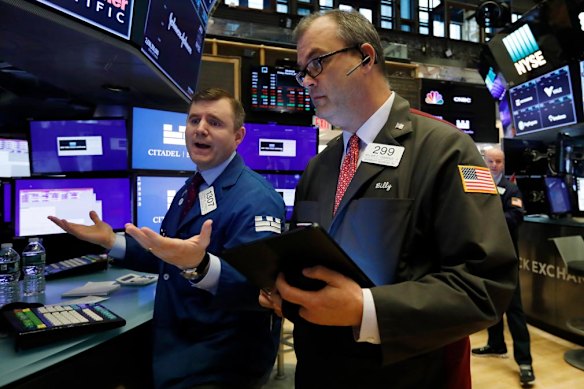
Overnight the S&P 500 rose 0.4 per cent for its 10th gain in the past 11 days, a day after dropping from its all-time high. The Dow Jones soared 874 points, or 1.7 per cent, to a record, and the Nasdaq composite slipped 0.1 per cent.
The expectation on Wall Street seems to be that the United States and Iran will ultimately agree to reopen the Strait of Hormuz to oil tankers. That would hopefully improve the flow of crude, lower oil’s price and remove some of the upward pressure on inflation that’s hurting the world. Such hopes, along with strong profit reports from US companies, helped launch the S&P 500 on a nine-day winning streak that ended Wednesday, a day short of its longest run in three decades.
Stocks of smaller companies helped lead the way, and the Russell 2000 index of the smallest US stocks jumped 1.4 per cent. They can reap the biggest benefits of falling interest rates, and the yield on the 10-year Treasury dipped to 4.47 per cent, from 4.49 per cent late on Wednesday, as oil prices sank.
Lower yields can make it less expensive for companies to borrow cash, which many smaller companies need to do to grow.
AI stocks took a sudden back seat after dominating the market.
Broadcom sank 12.6 per cent, even though both profit and revenue for the chip company surpassed analysts’ expectations. Chief executive Hock Tan said its AI semiconductor revenue more than doubled to $10.8 billion during the quarter and that demand is only getting bigger. He is forecasting AI semiconductor growth to top 200 per cent in the current quarter.
Analysts have been saying AI stocks may have run too high, becoming too expensive, and that the broad US share market may be set for a slowdown following an unrelenting streak of nine straight winning weeks for the S&P 500, its longest since 2023.
Outside of tech, PVH Corp, the company behind the Calvin Klein and Tommy Hilfiger brands, tumbled 20.2 per cent, even though it also beat Wall Street’s first-quarter sales and profit targets. Chief executive Stefan Larsson warned that it’s feeling “the prolonged effects of the Middle East conflict, which is putting pressure on” customers in the region.
Reports on the US economy, meanwhile, came in mixed. One said that slightly more US workers applied for unemployment benefits last week, which could indicate a slowdown in the relatively solid US job market.
In share markets abroad, indexes rose in Europe.
With AP, Bloomberg
The Market Recap newsletter is a wrap of the day’s trading. Get it each weekday afternoon.
From our partners
Disclaimer : This story is auto aggregated by a computer programme and has not been created or edited by DOWNTHENEWS. Publisher: www.smh.com.au