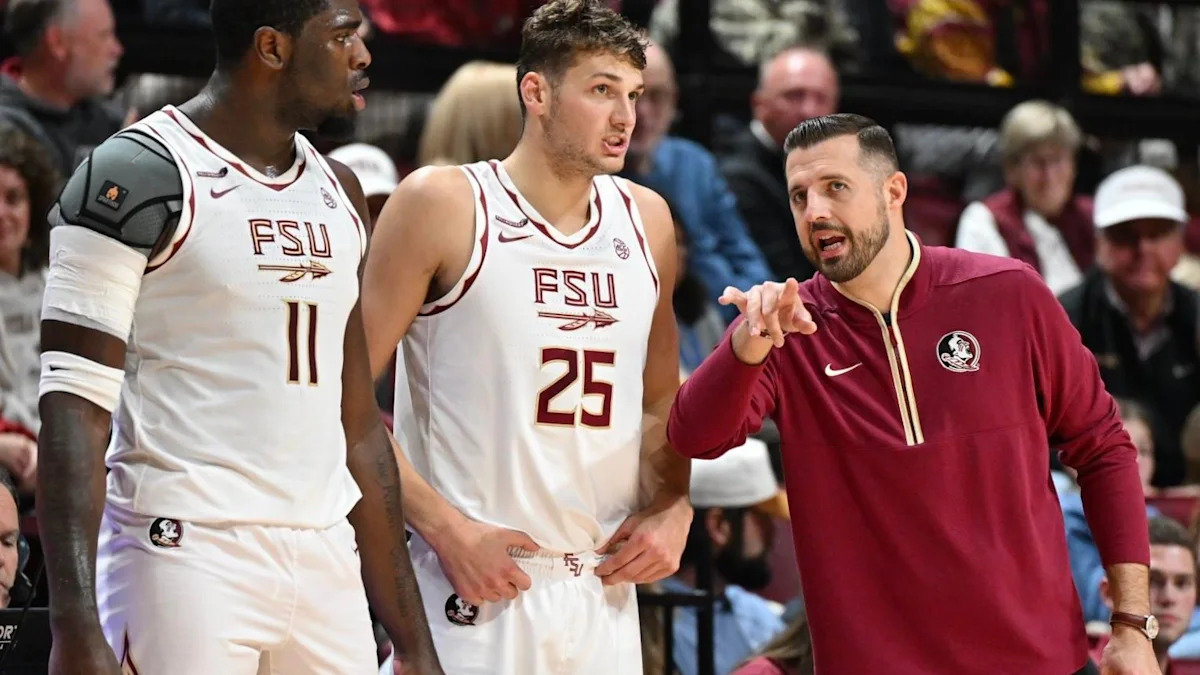
With the Florida State men’s basketball team just shy of 20% of the way through its regular season, it’s a good time to pause and reflect on what we’ve seen on the court so far.
Is FSU better than last year?
Yes … I think? Just going off the eye test, the Seminoles seem improved. The positional size is in another stratosphere compared with last season’s team, looking much more like a Leonard Hamilton team than coach Luke Loucks’ inaugural season. (In fact, FSU is the fourth-biggest team in the country by average height, which is very Hamiltonesque indeed.) There are also at least four players with NBA athleticism, which is about three more than last season.
Advertisement
The predictive metrics also point to an improved team. FSU is ranked 55th in KenPom, which is two spots better than its highest ranking last season. The ‘Noles are also 55th on Bart Torvik’s site, which was topped last season only by the ranking following FSU’s near-miss against Duke in the ACC Tournament.
And yet, what has FSU really proved capable of this year that it couldn’t accomplish last season? Florida State is 5-1 through six games — the exact same record as Loucks’ team sported last season through six games. And just like last year, it’s made up of a hard-fought loss to Florida and five double-digit wins against low-majors, with the smallest margin of victory the exact same (14 points) in both seasons.
Two statistical areas do show massive improvement compared with last season: rebounding and free-throw shooting. Last year FSU was a so-so offensive rebounding team and a downright dreadful defensive rebounding team, ranking 319th in the country in the latter category. Even in the early blowouts, teams like UT Martin grabbed 37% of their own misses against the undersized ‘Noles. (For context, a 37% offensive rebounding rate for the whole season would have ranked 15th.) So far this season, FSU might just be the best rebounding team in the country, ranking 13th on the offensive glass and a shocking third on the defensive glass, making the Seminoles one of just three teams to rank inside the top 15 in both categories (along with Vanderbilt and Louisville).
Free-throw shooting has shown similar improvements. A season ago, FSU ranked 231st in the nation in free-throw percentage at 71.3% and 191st in how frequently it got to the free-throw line. So far this year, FSU is 12th in free-throw percentage, making 81.6% of its attempts, and it’s even better at getting to the free-throw line, ranking sixth in the country. Any team that gets to the line a ton and makes over 80% of its attempts is going to be a tough out. Unfortunately, as strong as the ‘Noles have been from the charity stripe, they’ve been equally as bad from the perimeter — more on that below.
Advertisement
So how good is FSU? Unlike last season, the Seminoles get two more layups before facing the meat of their nonconference schedule, which means we really won’t know for another week. Last season saw a rude awakening, with Florida State getting destroyed by 40 and 34 in back-to-back games against Texas A&M and Georgia. My hunch is that will not happen this season, if for no other reason than the rebounding. But is FSU good enough to pull off wins?
So, about that 3-point shooting. Is FSU really this bad?
Shooting a putrid 25.8% from beyond the arc, Florida State is currently 335th in the nation and the worst 3-point shooting team in the ACC. It’s been so bad that last game’s 8-of-25 performance was seen as a solid step in the right direction. Do I think FSU will finish the year making just 25% of its 3-point attempts? No. Last season that would have been dead last in the country by over 2 percentage points. However, I also don’t believe FSU is going to suddenly morph into a team of snipers either.
Even during the offseason, Michael Rogner and I (and plenty of people in the comment sections) wondered where consistent shooting was going to come from. That concern was amplified for me after seeing a few fall practices, and now, six games in, it’s clear that there’s really not anyone who poses a true game-in, game-out threat from deep.
Advertisement
Part of the problem is that the team’s best pure shooter — Brandon Bass Jr. — is a freshman who simply doesn’t appear ready to handle the speed and physicality of high-major basketball. And even when he has earned minutes, he needs to be more aggressive hunting his shot. I remember watching P.J. Savoy, another guy brought here to do nothing but bomb away, come into the game and get six or seven 3-point attempts in 10 minutes of action. Bass, who is shooting 63.6% on the year, played 15 minutes against Green Bay and attempted only one 3-pointer. That rate needs to at least triple. Some of it is on his teammates for not finding the shooter in his spots, but some of it is on Bass hesitating when he gets it in the corner. Hopefully, both of those problems start to abate.
Beyond Bass, not a single player is even shooting 30% from deep. Sebastian Rancik shot 33% last year in the Big 12, and combined with his 86% mark from the free-throw line, you get the feeling (hope?) that he just needs to see a few go down. Shon Abaev and Kam Taylor also have great strokes from the charity stripe, but neither has made more than 29% from deep in his college career. In Abaev’s case, shot selection is an issue. In Taylor’s, he just doesn’t look comfortable with his mechanics, as evidenced by his taking only 15 total attempts despite playing 25-plus minutes a game. However, the junior did hit 35% during conference play last season at UNC Asheville, which just happens to be FSU’s next opponent, so maybe this reunion will get him going?
Is FSU an NCAA Tournament team?
I get asked this question a lot, and my honest answer is that the Seminoles certainly can be. But the next part of the answer is that it’s really the wrong question. Unless you’re a legit top-20 type of team, the question isn’t, “Is team X good enough to make the NCAA Tournament?” but rather, “Will team X have an NCAA Tournament-quality resume?”
Advertisement
FSU found out the hard way last season that despite playing NCAA Tournament-quality basketball for the final six weeks of the season, the Seminoles’ nonconference performance was so damaging to their metrics that they weren’t even in the bubble discussion. So, what does FSU need to do to have an NCAA Tournament-quality resume? Simply put, the ‘Noles must beat at least one of Tennessee, Texas A&M or Houston, and they must not lose to either of the other two by 25 or more points.
Following the Ball State game, senior Alex Steen said something to the effect that winning by 1 or 40 doesn’t matter because it’s still a win. Unfortunately, that is just not accurate in college basketball. Predictive metrics like KenPom, Torvik and BPI appear on the actual team sheets evaluated by the NCAA selection committee, and those metrics absolutely treat a 40-point win and a 1-point win vastly differently.
For example, FSU is favored by 23 over UNC Asheville on KenPom. If the ‘Noles were to win this game by only 1 point, their ranking would drop precipitously. Now, it is true that losing the game would be even worse. The committee also views things like Quad wins and losses, and losing to UNC Asheville at home would surely be a Quad 4 loss (i.e., the worst kind of loss you can have). But winning by 1 point, while not a loss, would be about as damaging as a win can be. And when you’re a bubble team playing with a razor-thin margin of error, you can’t afford damaging wins.
What happens if the Seminoles don’t beat one of the three aforementioned nonconference teams? You’d probably be looking at a situation where FSU would need 11 conference wins at minimum, plus another one or two in the ACC Tournament. The ACC, while perhaps looking improved in the middle of the league, still offers nowhere near as many Quad 1 and 2 win opportunities as a league like the Big 12 or SEC does. Complicating things further, FSU plays Virginia and Duke just one time each, both on the road, meaning the only real chance at a marquee home win is against Miami in the final game of the season (unless you think Pittsburgh is for real, and hey, maybe it is?). Where would the Quad 1 wins come from if you don’t grab one against Tennessee, Texas A&M or Houston? Maybe at NC State or at Stanford?
Advertisement
OK, so which of those three nonconference teams can FSU beat?
I’m going to keep it real with you: Houston looks like a freight train. The Cougars physically imposed their will against Florida and Kansas on back-to-back nights and looked as if they could go again the next day. They don’t turn the ball over, they shoot free throws as well as FSU does (literally the exact same percentage) and their defense is ranked first in the country. Even with the game in Jacksonville, that feels like a tall order.
Tennessee and Texas A&M are both talented teams with some impressive early-season performances. However, both do have flaws FSU could exploit. Tennessee has an elite defense, but the Vols struggle to close out possessions at times, ranking 234th in defensive rebounding. FSU could shoot poorly from the field but still find a way to win by generating eight to 10 extra possessions and making a bevy of free throws.
Texas A&M has an elite offense that ranks 16th in the country in 3-point percentage, making over 41% of its attempts from deep. While that could certainly pose an issue for FSU, 3-point shooting can be a fickle friend — especially in neutral-site gyms. Meanwhile, the Aggies’ free-throw shooting ranks 252nd in the country, and they also give up a bunch of offensive rebounds. If that game is a whistle fest, advantage Seminoles.
Either seems winnable with the right set of circumstances, but I’ll go with the Vols as FSU’s best chance, even though it’s a true road game.
Disclaimer : This story is auto aggregated by a computer programme and has not been created or edited by DOWNTHENEWS. Publisher: Sports.yahoo.com