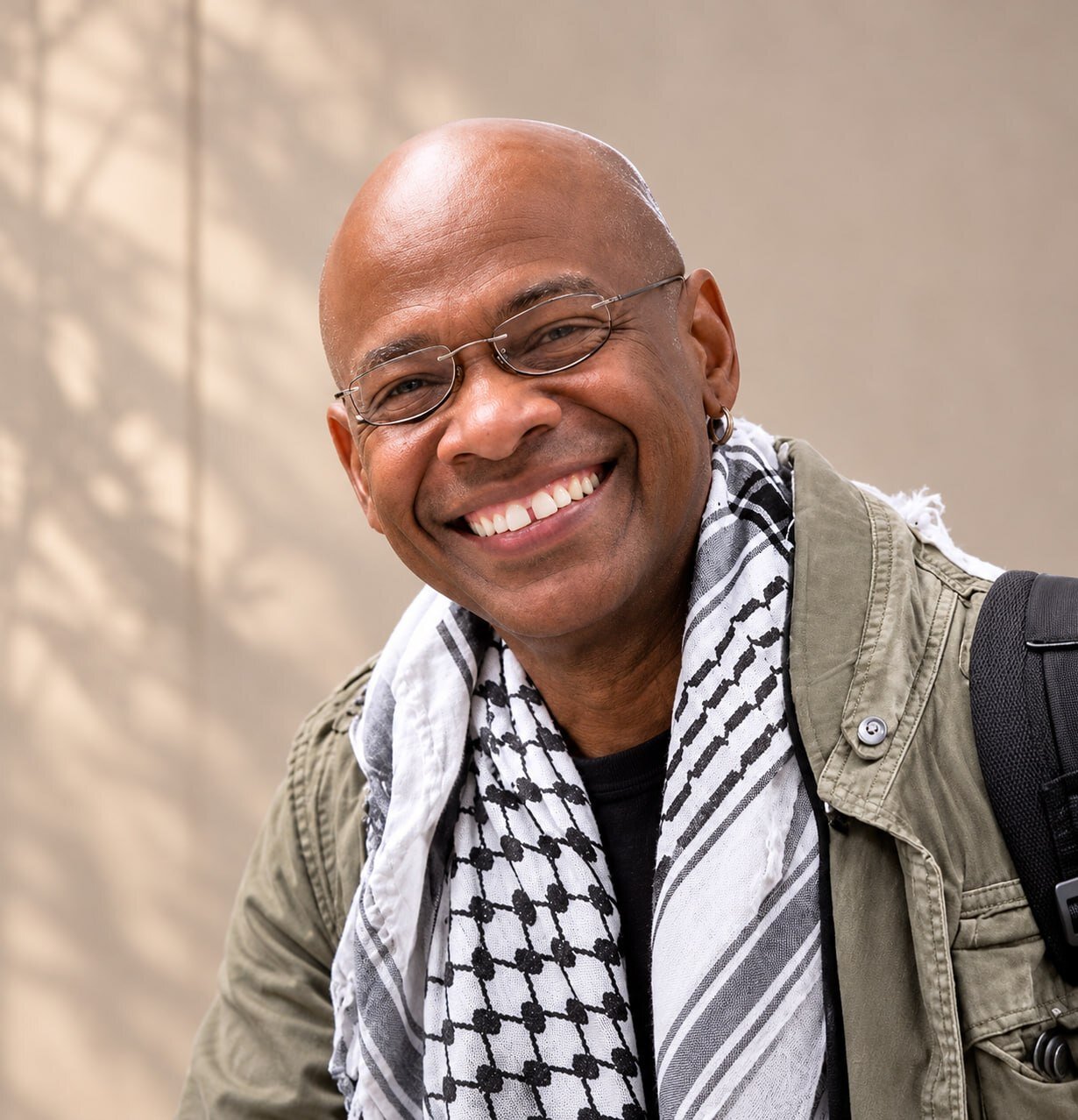
TEHRAN – Michel DeGraff, a Haitian-born linguist and professor at the Massachusetts Institute of Technology (MIT), has spent three decades examining the relationship between language, power and social justice. His academic work focuses on how language can reinforce social hierarchies and systems of domination, as well as how mother tongues can become instruments of resistance and liberation. His latest book, Our Own Language: Harnessing the Power of Kreyòl and Other Mother Tongues for Education and Liberation, explores these themes through the experience of Haitian Creole and other minoritized languages.
DeGraff’s work came under controversy after he proposed an MIT course examining the role of language and linguistics in decolonization and liberation struggles in Haiti, Palestine and Israel. The university rejected the proposal in July 2024. DeGraff argues that the decision reflected political pressure and restrictions on academic freedom rather than concerns about his academic qualifications or the course’s content. He has also challenged what he describes as the marginalization of Palestinian perspectives in academic institutions and public debate.
In an interview with the Tehran Times, DeGraff discusses his experience at MIT, the political uses of language, the responsibilities of universities and the connections between linguistic hierarchies and struggles for liberation. He also reflects on how language shapes perceptions of the war on Iran and why the voices of Palestinians and other marginalized communities must be heard.
Below is the full text of the interview:
I’ve read quite a bit about your experience at MIT, especially the controversy surrounding the course you proposed. I’d like to hear your own perspective on it directly. You spent so many years at MIT as a linguist and educator. Could you tell us how your proposed course on language, decolonization, and Palestine came about, and why it became so controversial?
I was born in Haiti, so I grew up in a country where language plays a really crucial role in creating hierarchies of power. It’s not only the choice of language in Haiti. There’s Haitian Creole, which we call “Kreyòl”, and French. Everybody speaks Kreyòl, while only a small percentage of the population speaks French. But French is the language used in all formal venues where power is created and transmitted.
Very early on, even before I knew about linguistics, I became very aware of the power of language to create hierarchies of humanity. That’s really how I became a linguist. Even when I was studying computer science and working with linguists and researchers in AI back in the early 1980s, I discovered that, in Haiti, I had been lied to for the first 18 years of my life. I had been convinced that my native language, Kreyòl, was not a language but “broken French.”
When I realized that this was a lie, I felt that I needed to understand what makes a language a language, and also how language can be used in such powerful ways to create hierarchies of power. That’s really how I became a linguist. I became a linguist because of this deep question about the relationship between language and power.
My work at MIT over the past 30 years has always been about that question. I’ve taught classes called Creole Languages and Caribbean Identities [1]. I have a co-taught course called Black Matters [2], and I’ve taught courses on linguistics and social justice [3]. These were never controversial. My colleagues knew about them and never complained.
In fact, I’ve been invited to be a keynote speaker at major conferences, for example at the Linguistic Society of America (LSA). At one [4] of these conferences, I was introduced by one of my colleagues, whose name is Norvin Richards.
That talk was titled “7/4/1776… 7/14/1789… 11/18/1803… 7/4/2017… Revolutions across space and time.” You see, it had the word “revolutions” right in the title. “Revolutions” was part of the title of a major lecture at a summer institute organized by the Linguistic Society of America—the world’s largest association of linguists.
I’m telling you all this to explain that my work has always been about language and power. My colleagues knew that. They supported it. One of them even introduced one of my talks on that topic.
So, when October 7, 2023, happened, it quickly became obvious to me, once again as a linguist, how language was being weaponized. “Weaponization of language” has become a very popular term, but we linguists have discussed this concept for decades. There’s Dwight Bolinger’s book called Language: The Loaded Weapon. The Use and Abuse of Language Today [5]. This is one of my favorite books. There is also a book by a well-known linguist and philosopher, a former president of the Linguistic Society of America, about the politics of language. Her name is Sally McConnell-Ginet [6], and she has a book called Words Matter: Meaning and Power [7]. Professor McConnell-Ginet was one of the guest speakers at my Fall 2024 People’s Seminar which taught the same contents of the course that MIT Linguistics had rejected in July 2024— “Language and linguistics for decolonization and liberation in Haiti, Palestine and Israel [8].”
Again, these books, on language as weapon, the importance of words, and the politics of language, are all about language and power.
After October 7, we quickly saw how journalists, politicians, presidents, including Trump in Washington D.C. and Netanyahu in Tel Aviv, were using language as a loaded weapon.
Then there was the famous congressional hearing of December 5, 2023, when the House Committee on Education and the Workforce brought in three presidents of prominent universities: Sally Kornbluth from MIT, Claudine Gay from Harvard, and Liz Magill from the University of Pennsylvania. In fact, I have connections with all three universities, directly or indirectly. The then-president of Harvard is, like me, Haitian American, and my son is a senior at Harvard. I went to the University of Pennsylvania to earn my PhD. I am currently a professor at MIT. So, these three universities are very familiar to me.
I was shocked to see how three intelligent presidents were being trapped by language as a loaded weapon, to use the metaphor from Dwight Bolinger’s book.
Let me give you a quick example that is easy to understand. There was a question concerning “intifada.” Elise Stefanik defined “intifada” as a call for the genocide of Jews. She said, verbatim according to the minutes [9] of the hearing, that there’s been “students chanting, ‘There is only one solution, intifada revolution.’ ‘Globalize the intifada’…”; then she suggested that “intifada” means:
“… a call for violent armed resistance against the State of Israel, including violence against civilians and the genocide of Jews… this call for intifada is to commit genocide against the Jewish people in Israel and globally…”
She then quickly moved on to ask whether the presidents accepted such “type of hateful speech” whereby students on their campuses were calling for the genocide of the Jews.
This was such a clever trick because the presidents should have rejected Stefanik’s presupposition about the meaning of “intifada.” They should have said, “No, that’s not what Intifada means.”
Clearly, for example, in the Warsaw Ghetto, when Jews were being subjected to genocide by the Germans, there was a well-known uprising called the Warsaw Ghetto Uprising. As documented by internet archives and related articles (such as here [10] and there [11]), that uprising has been described, in Arabic translation of the U.S. Holocaust Museum, as “intifada.” If an uprising by Jews against their own genocide can be described by a Holocaust Museum as “intifada,” it is clear that intifada cannot mean calling for the genocide of Jews. That is such a lie.
And yet, during that hearing, no one challenged that assumption, that presupposition. That is a classic linguistic move used to trick people into accepting a false assumption.
I thought, “Oh, gosh, this is December 5. I have to…”—December 5 is also the date when Christopher Columbus started the colonization process in my native Haiti, including the genocide of the native population (the Taínos) there. One of his first acts was a linguistic one—renaming the island of Haiti as “Hispaniola” (little Spain). Early December 2023 was also the time for me to propose a course to my colleagues for the upcoming calendar year (2023–2024). For the fall of 2024, I had the option of proposing a “Special Topics” seminar. I thought, “Well, this has to be the topic. We linguists have to examine such an egregious and depraved use of language, which can even entrap some of our most powerful and influential thought leaders…”
I was expecting my colleagues to say, “Yes, go for it,” especially in the world’s #1 linguistics department founded by none other than Noam Chomsky, who has been at the forefront of the study of both language and power and as well at the forefront of the defense of academic freedom, free speech and also for the defense of universal human rights, including of course Palestinian rights. And he also happens to be Jewish and fiercely anti-Zionist.
I was shocked that my proposal was met with such violent and irrational rejection.
I had a Zoom meeting with my department head on December 8, 2023, three days after proposing the course—I had submitted my proposal on December 5, 2023, the very same day that I noticed the use of linguistic trumpery in Congress. During that meeting, which started with a linguistic argument, the first thing he did was to challenge my use of the word “resistance” in the context of Palestinian liberation struggles.
I had to disagree right there because I’m from Haiti. Haiti is a country born out of resistance in 1804. That resistance had to be violent because of the very structure of white supremacy weighing down my ancestors. In 1685 already, the French published the Code Noir, which means “Black Code.” This was a legal text that treated my ancestors as non-human. The Code Noir treated my ancestors as furniture.
Interestingly, the first article of the Code Noir concerned Jewish people, which again shows the power of language. Here is a document called the “Black Code,” and its first article sought to remove the property rights of Jewish people in French colonies in the Americas.
Given that background, how could I not see the struggle of Palestinians as resistance? To me, that is resistance. But, at the very beginning of our meeting on that day, he objected to my use of the word “resistance” in that context.
From there, things went downhill. He also disagreed with my use of the term “genocide.” For him, when Netanyahu called Palestinians “Amalek,” that was merely a rhetorical flourish. It does not mean that Netanyahu had any genocidal intent.
It was clear that we had a deep political disagreement, including a disagreement about language.
I wrote to him afterward. He had accused me of antisemitism because I had said that Liz Magill was afraid of losing funding from Jewish donors. That was a fact. Jewish donors at the University of Pennsylvania had threatened to withdraw donations if Magill did not put more pressure on the university to repress Palestinian advocacy.
I wrote to Magill to say that she was afraid of losing donations from Jewish donors. He felt that my use of the phrase “Jewish donors” was antisemitic.
I emailed him to remind him that The New York Times [12], The Washington Post [13], The Chronicle of Higher Education [14], The Jerusalem Post [15], The Times of Israel [16], Haaretz [17], etc., had reported on this issue, referring to the fact that Jewish donors were using or withdrawing donations to put political pressure toward political causes, including pressure on universities to repress over advocacy for Palestinian rights.
All this is to say that the disagreement was political from the outset.
A couple of weeks later, I heard that the title of my course was raising concerns in the department. The title, back then, was “The Use of Language and Linguistics in Decolonization and Liberation Struggles.”
What about that title could cause concern when, in the past, I had taught courses on social justice and had used titles and taught classes that routinely included words like “colonization,” “revolution” and “liberation”? Clearly, the issue was political, not about the course content, but about Palestine. To me, it was a clear case of the Palestine Exception to academic freedom and free speech.
Then we had a back-and-forth over email for months—from January to July 2024. I proposed the course on December 23, 2023, and eventually, in July, I received the final email telling me that the course had been rejected, in spite of my providing, via a long email exchange [18], many more details about that course than, as far as I know, I or any other MIT Linguistics colleagues had ever provided about any previous course.
Basically, the ad hoc review committee which was put in place, for the first time ever in my 28-year history at MIT, to review my course and which included the very same department head who had yelled profanities to me in disagreement with my language and politics about Palestine and Israel, argued that I could teach about Haiti but that I lacked the expertise needed to teach about Palestine and Israel. This is certainly among the most anti-intellectual and racist arguments [19] on the part of any linguist, because the exploration of language and its uses in novel contexts is what we work on every day, and we routinely take our knowledge about one language that we’re familiar with and extend it to another language that we do not know.
This is how we define our field: we always try to apply what we know about one language to other languages. In my case, I wanted to explain what I know about language and power in Haiti and in the Caribbean to language and power in other areas, such as Palestine. This is exactly what MIT is supposed to stand for: the drive to advance knowledge and expand expertise.
For my MIT linguistics colleagues to tell me that I do not have this right is, to me, the most blatantly insulting example of discrimination and, really, racism. They are, in effect, saying that, as a Haitian, my academic lane is just to study Haiti. I cannot extend my knowledge of language and power to Palestine and Israel, even though I had previously extended my inquiries to Europe, Africa, Australia, New Zealand, etc.
When I discovered the links between Congress and MIT, including letters from Congress to MIT that cited my name as an example of antisemitism and that called on MIT to stamp out antisemitism on campus, it became clear to me that my departmental colleagues were, in a way, being pushed by Congress to repress my teaching and my speech.
I even have an email dated March 13, 2024, from one of my colleagues answering my question why this extraordinary level of scrutiny of my course proposal about language and liberation in Haiti, Palestine and Israel:
“Well, what has changed is, the whole world it seems and the atmosphere on campus. There are suspicions from all directions to all directions, some warranted some not, people worry how their ethnic backgrounds (even putting aside religious beliefs) will make others perceive them or react to them. This is a very real worry for faculty as well as students. So, don’t you think that under these circumstances a communal faculty is warranted to see what is the best thing we can do to represent the department, and the people in it? How can this possibly hurt???”
This email clearly shows a direct link between the political climate in Washington and the level of repression against my course proposal. Indeed, the email came to me just six days after Representative Virginia Foxx wrote her March 8, 2024, letter [20] to MIT falsely accusing me of antisemitism based on my social-media posts and essays advocating for Palestinian rights and against the genocide. So, the rejection of my course was never about “expertise,” “questions of fit, given the linguistics curriculum,” “outsourcing” of teaching to guest speakers, etc. It was all about political risk assessment and “the atmosphere on campus [and] suspicions from all directions to all directions.”
The notion that MIT’s repression of academic freedom and free speech is politically driven was explicitly confirmed in a one-to-one meeting with MIT’s Vice Provost for so-called “Open” Learning (MIT OL) in February 2026. This meeting took place in his office, following up on his invitation for a one-on-one conversation, after a protracted exchange with MIT Open Courseware (MIT OCW) staff, including both MIT OCW’s Executive Director and MIT’s Dean for Open Learning. I had complained to both about MIT OCW’s embargo on the videos they had filmed of my Fall 2024 People’s Seminar sessions on “Language and linguistics for decolonization and liberation in Haiti, Palestine and Israel.” I had also complained about this embargo at a public “Festival of Learning” event hosted by MIT Open Learning in January 2026. At our meeting on February 13, 2026, the Vice Provost for Open Learning did admit that the embargo on the videos was imposed, not for any academic or intellectual concerns, but out of MIT OCW’s need to protect MIT from potential political backlash and loss of federal funding. The Vice Provost even argued that it would be a bad idea to directly confront with bare hands an enemy armed with a machine gun—as if MIT, with its intellectual and scientific capital and its formidable endowment, were fighting with “bare hands.” Don’t we all wish our own hands were that “bare”? The Vice Provost committed to reviewing the videos himself to conduct due diligence and evaluate potential risks, promising a response by February 27, 2026. As of now, 8 months later, he has not followed through. This sequence of events is yet another flagrant manifestation of the Palestine Exception at MIT where academic freedom and OCW’s mission of “unlocking knowledge,” like MIT’s overall mission to “advance knowledge” for a “better world,” are subordinated to self-censorship, risk management and politically-motivated repression.
You have since taken legal action involving MIT and a congressional committee. What do you hope to achieve, and what, in particular, would you like the public to understand about your case?
The objective is very simple. Universities exist to advance knowledge. Our job is to examine very difficult questions and work with our students to help them understand how to tackle these questions, even when these questions are made “controversial” for political reasons.
If, as a professor, I am not allowed to engage in that kind of research or advance knowledge because a particular area is deemed controversial or has been made controversial by contingent political circumstances, then we lose the fundamental ingredients of what it means to offer a liberal education.
It means that our teaching and research become dependent on the political whims of whoever is in power in Washington or, in this case, Tel Aviv. That fundamentally defeats the purpose of a university.
Moreover, the US Constitution guarantees rights that include the right to free speech. In my particular case, my dean, the dean of the School of Humanities, Arts, and Social Sciences, told me in writing that I was being punished for, among other things, publishing essays and writing email messages protesting what I perceived, and still perceive, as discrimination.
This is a clear violation of my right to free speech and my right to protest. I have the right to protest discrimination. In fact, Massachusetts has laws that clearly state that people who experience discrimination have the right to protest. I am still exercising my right to protest against discrimination.
My case is far from unique. Similar pressure is being exerted on professors, students, and staff throughout the United States and beyond. I am part of networks of professors, staff, and students who have been subjected to similar or worse pressure and punishments. Some have been physically brutalized, while others have been fired, demoted, suspended or expelled.
A student was expelled for writing an essay that made some pro-Israel students feel “unsafe.” The day after those students wrote on Twitter that the essay had made them feel unsafe, the dean of student life at MIT, who is also pro-Israel, called the student into the disciplinary process. The student was eventually expelled. The expulsion letter made explicit reference to the essay the student had written— “On pacifism.”
Imagine that: a student expelled from a university for writing an essay. It was a scholarly essay. In fact, I now cite that essay in my own writing. It is very much in the spirit of Frantz Fanon and Martin Luther King. It is a beautifully insightful essay.
If we allow this to continue, our education system will become like the one I grew up with in Haiti. When I was a child, people could not criticize the Duvalier dictatorship in Haiti, which lasted from 1957 to 1986.
They could not criticize the government without getting into trouble.
Now, to be in the United States of America, the land of democracy, the land of the free and the brave, and have my MIT colleagues tell me that I do not have the right to teach about a particular topic because of political risk stemming from an authoritarian government is like going back to the Duvalier dictatorship era in Haiti when we had no academic freedom and free speech.
I must resist that, not only for my own sake as a scholar, activist and person of conscience, but also for the sake of our democracy.
I’ve read your article, “Liberatory Linguistics in a Time of Fascism [21],” in which you connected the marginalization of Haitian Creole with the way Palestine is discussed in public debate today. Now that you’ve discussed your childhood and your experience in Haiti, I can understand that connection. But I’d like to hear you explain it further.
To me, the connection is very straightforward. That is why I am still dumbfounded, embarrassed, and quite upset by the fact that my colleagues at MIT Linguistics, which is supposed to be the number one linguistics program in the world, do not understand it. These are colleagues who have all the intellectual wherewithal to make sense of the connection.
For them to not understand the connection between my work in Haiti and what is happening in Palestine and Israel, and to claim that I lack the expertise needed to extend my research to that area is, to me, such blatant and ugly trumpery and hypocrisy. Whenever I think about it, I find it deeply upsetting.
What I grew up with in Haiti, as I mentioned earlier, was the use of language not only in terms of which language is used in particular areas of power, but also in terms of how intellectuals and scholars themselves define certain categories. Consider, for example, what a Creole language is and what makes Creole languages an exceptional type of language.
Much of my work concerns what I find quite interesting about the use of the words themselves for the sake of building and consolidating power structures and hierarchies of humanity. In fact, I coined the term “Creole exceptionalism” to describe the long-standing myth that Creole languages are exceptional: that their histories, development, and structures place them in a separate category from other languages.
I have grouped these hypotheses under the label “Creole exceptionalism.” What we see here is the use of linguistics and linguistic theories to create, in the terminology of August Schleicher (one of the founders of modern historical linguistics) “grades of man [22].” If language is an index of our humanity, then suggesting that an entire group of people speaks languages that are somehow structurally different from other languages implies that those who speak Creole languages belong to a special category of humanity.
For a couple of decades now, my work in linguistics has sought to demystify these racist beliefs, which are rooted in scientific racism for the sake of geo-political conquest and domination. This is one of the main themes in my recently published MIT Press book Our Own Language: Harnessing the Power of Kreyòl and Other Mother Tongues for Education and Liberation [23] which MIT Linguistics is not allowing me to teach.
We see similar patterns in many parts of the world. In fact, my Our Own Language book examines how mother tongues can be used for liberation from such patterns of domination. That liberation theme too is the central theme of the book.
In it, I look at many parts of the world where language is used both for domination and for liberation. Interestingly, my MIT Linguistics colleagues do not want that book taught in the department even though it was published by none other than … MIT Press!
Given my interest in language and power, what is happening today around Palestine and Israel, particularly the use of language to shape perceptions of reality and create a fog around genocide, is a central area of interest for me.
If anything, there is an urgent need to focus on this area because a genocide is taking place there. If language is being used to create a fog around that genocide, we linguists have the tools to dissipate that fog. Addressing this should be a priority for us.
In January 2024, while I was serving on the executive committee of our major professional association, the Linguistic Society of America (LSA), I proposed that the LSA issue a statement inviting linguists to use their expertise to examine patterns of language use surrounding the genocide.
The goal was to ensure that we could share knowledge about these issues. In the past, the LSA had issued statements on the Black Lives Matter movement and on the use of gender pronouns. The LSA had also issued a statement about Ukraine. One might think that Ukraine is quite remote from linguistic issues, but it is not, because language plays a key role in the conflict between Ukraine and Russia.
Given this history of statements by the LSA, I felt that we should also issue a statement about the use of language about Gaza and the genocide there.
Some of my fellow linguists on the LSA executive committee accused me of antisemitism for making that proposal. I was accused of being antisemitic for suggesting that linguists use their expertise to demystify the use of language surrounding the genocide. In making these accusations they enlisted Representative Virginia Foxx’s letter to MIT making similar accusations.
Eventually, I resigned because I could not tolerate being insulted by linguists when I was asking them to use their skills to do what those skills warranted: speak the truth about the weaponization of language for a genocide. I wrote an account of this and related incidents in an essay [24] for Inside Higher Ed. The title of the essay is: “When Language Is a Weapon.”
When I was reading your article, I thought I could apply your perspective to what is happening in my country, Iran. If you applied your approach to the war on Iran, how would you analyze the language used by the US and other governments to describe military operations, civilian casualties, and claims of self-defense?
That is an interesting question, and it could certainly be a topic for future research: to examine the language used around this particular conflict. For now, I find it fascinating that Trump’s genocidal [25] language about Iran—for example, his threat [26], in April 2026, that “a whole civilization will die tonight, never to be brought back again”—echoes that of Netanyahu about Palestinians in Gaza.
Pouya Alimagham, my Iranian colleague and professor of history, has helped me develop a broader and deeper understanding of the history of Palestine and the region, including Iran. He has examined how propaganda about Iran, including propaganda spread by Iranian expatriates in the United States, distorts perceptions of the country through language.
I often use the term “linguistic trumperies” to describe the use of language to create misperceptions of reality. I like the word “trumperies,” especially its root— “trump.”
Language can make something as abnormal and cruel as genocide appear normal and natural. When genocide, as in the case of Gaza, is masked by Israel as “self-defense,” people become more willing to accept such a vile crime against humanity as if it were a necessary “war” by a “moral” army.
Language is thus a lethal tool. It really is a weapon of mass distraction. It is powerful.
This is why I am concerned about, and so disappointed in, linguists, like my MIT Linguistics colleagues [19] and those on the Executive Committee of the Linguistic Society of America [24], who object to examining these uses of language around an ongoing genocide. We linguists do have the means to demystify these mechanisms and show how language can be used to manipulate perceptions of reality. It is our duty to shed light on these linguistic trumperies.
Beyond your own experience, I was wondering what you think your students lost when the proposed course did not go ahead. Did you find other ways to engage them with the issues you wanted to explore?
What was lost was an opportunity—an urgent opportunity in time of genocide—to see MIT rise to the occasion and fulfill its mission of educating students in #MindHandHeart mode for a #Betterworld—these hashtags are MIT’s own slogans! We do need to live up to our mission even when there is political and financial pressure to lie or conceal the truth.
My son, who is now finishing his studies at Harvard, was deeply disappointed, even bitterly disappointed, to see the Harvard president fail to rise to the occasion and promote the true mission of the university, which is to seek veritas. That is our mission: to seek the truth.
MIT has experienced similar failures. For example, when MIT expels a student for writing an essay “On pacifism [27]” and on ways to achieve justice, this punishment represents a profound failure of the university. It is a failure to allow students to pursue veritas, to seek the truth.
At Harvard, the president told my son and his fellow students that Harvard could not discuss divestment [28] from Israel because education was supposed to remain neutral [29]. Can you imagine that? The president of Harvard told my son and his fellow students that divestment was off the table because the university was supposed to remain neutral.
When has education ever “impartial source of knowledge,” as Garber claims [30]? When is investment ever neutral? If investment itself is not neutral, why should divestment be avoided as a challenge to neutrality?
That “neutrality” pretext has caused my son and his comrades’ profound disappointment. Similar trumperies at MIT and other universities have caused so many students to become so deeply disappointed in their universities.
At the same time, however, they’ve gained something most valuable. They’ve had the opportunity to witness firsthand something I have researched and taught for decades: the relationship between power and knowledge.
They can now see in real time something that Michel Foucault discussed extensively. Foucault wrote about what he called “regimes of truth,” referring to the deep connections between the production of knowledge and the production of power.
His point was that knowledge and power are never separated. They are part of the same cycle: particular regimes of power promote certain forms of knowledge that, in turn, reinforce structures of power.
What my son and many other students have gained is the opportunity to see all of this happening in real time. They have lost a certain sense of innocence, but they have gained a much deeper understanding of the politics of academia as embedded in the geo-politics of Empire.
To me, that seems like a net gain.
Another net gain is that they’ve also learned how much power they have to make real change in the world, even in a context of rising fascism where some of their own professors and university administrators are complicit in genocide. At MIT, even the local chapter of the American Association of University Professors (AAUP), whose mandate is to defend academic freedom and free speech, has become complicit with the MIT administration violating my own academic freedom and freedom of speech. I wrote about this “new McCarthyism [31]” in AAUP’s Academe Blog.
My son is now on leave from Harvard and is doing practical work in journalism, writing about these issues because he has experienced them firsthand. That is an education he could never have received entirely in a classroom. He gained it through the encampment.
One of the slogans at the encampment was “Liberated Zone.” During my 30 years at MIT, the encampment in the spring of 2024 was one unforgettable moment when I truly and deeply felt that education is liberation.
I’ve never had any such feeling of collective and mutual liberation among my faculty colleagues or in faculty meetings, where so many falsehoods and cowardice and lies and bullying keep being promoted and where even faculty chairs have participated in silencing other faculty members. But at the encampment, I saw students firsthand developing tools for their own liberation and for collective and mutual liberation.
To me, that was a unique moment in my history at MIT. And that too seems like a net gain for us all.
The essay written by Prahlad Iyengar, the brilliant PhD student who was expelled for his writing, also stands out as a gain. It contains all the essential principles that are now being taken up around the world.
Recently, students at Columbia University who were protesting against genocide wrote a beautiful letter [32] to high school students in France to share concrete practical advice about liberation movements and their sustainability. I found the letter deeply moving. What I saw in it were the same principles that my comrade Prahlad Iyengar had set out in his essay “On pacifism [27],” for which he was expelled.
When I see these connections between the students’ revolutionary writings from MIT to Columbia to France, I feel that this is indeed a net gain, because the students are the future. They’ve come to understand, first of all, the role of Palestine in the global struggle for liberation. But they’ve also come to understand their own power in ushering in social justice. They could never have learned that in the classroom or with ChatGPT. They learned it as part of their protests on campus.
To sum up our discussion, I want to ask you: Among so many conflicts happening around the world right now, whose voices do you think the world most needs to listen to today?
I think, first and foremost, the voices of those whom Fanon called “The Wretched of the Earth” from Haiti to Palestine, especially the Palestinians going through a live-streamed genocide for the past three years and being able to resist the way they keep resisting. Actually, let’s please not say “three years.” Let’s reckon with the too often forgotten or hidden fact that they’ve been going through a genocide for nearly a century. It’s so wrong to think of the genocide as starting in 2023. If we read Rashid Khalidi, if we read Ilan Pappé, and if we care to read about the history of Palestine, it’s been a slow genocide over one century.
But then, it’s like the story of my Haitian ancestors. These days when I feel despair facing fascism near and far, what I often do is read history and read what the founding father of Haiti, Jean-Jacques Dessalines, wrote when he was struggling against the French. He wrote about the power of language, the soft power of language, and he wrote about using Kreyòl as our “lang a nou”, you see. And Lang a nou, “our own language,” is the title of my book.
So, I feel that listening to those historical voices, like Dessalines and the Palestinians, is important. We have the author Ghassan Kanafani, who wrote so powerfully about the importance of culture in resistance. And if you think of the student movement, think of Mahmoud Khalil in New York and his story at Columbia and in detention which he has now recounted in his book No land to stand on [33]. I find such inspiration in this story. Think of what ICE did to him in spite of his permanent-resident visa and his American wife and American newborn. I think we need to listen to these voices. They are powerful voices to listen to.
There’s also all the poetry coming from Palestinian poets. I think of the work [34] of Huda Fakhreddine who translates into English such beautiful poetry.
What voices should we hear? These are the voices I think should inspire us through their writing, their sumud and their heroic resistance. I don’t speak Arabic, so I feel eternally grateful to authors and poets like Huda who translate Arabic into English.
Just yesterday, I was at a poetry reading, and one of my comrades read a translation of this beautiful Urdu poem, “Lullaby for a Palestinian Child,” by Pakistani poet Faiz Ahmad Faiz:
Don’t cry child, your mommy has only just cried herself to sleep.
Don’t cry child, just a while ago your daddy took leave of all his sorrows.
Don’t cry child, your brother has gone to another land chasing after his butterfly dreams.
Don’t cry child, your sister has married and left for another country.
Don’t cry child, in your courtyard they bathed the dead sun, and buried the moon, before leaving.
Don’t cry child, if you cry, mommy, daddy, sister, brother, the moon and the sun, all will have you made even weepier.
But maybe if you smile, they will one day all return to play with you.
Those are the voices we need to listen to, to give us energy and hope for a better tomorrow.
References
[1] Creole Languages and Caribbean Identities (MIT OpenCourseWare, Spring 2017), course page. https://ocw.mit.edu/courses/24-908-creole-languages-and-caribbean-identities-spring-2017/
[2] Black Matters: Introduction to Black Studies (MIT OpenCourseWare, Spring 2017), course page. https://ocw.mit.edu/courses/24-912-black-matters-introduction-to-black-studies-spring-2017/
[3] Linguistics and Social Justice: Language, Education and Human Rights (MIT OpenCourseWare, Fall 2021), course page. https://ocw.mit.edu/courses/24-s96-linguistics-and-social-justice-language-education-and-human-rights-fall-2021/
[4] Michel DeGraff, “Revolutions” (14 July 2017), PDF hosted on Dropbox; linked in connection with the LSA keynote. https://www.dropbox.com/scl/fi/9sasv69xeduxh2ml10p8t/degraff_20170714_revolutions.pdf
[5] Dwight Bolinger, Language: The Loaded Weapon. The Use and Abuse of Language Today (Routledge), publisher page. https://www.routledge.com/Language—The-Loaded-Weapon-The-Use-and-Abuse-of-Language-Today/Bolinger/p/book/9780582291089
[6] Sally McConnell-Ginet, author page (Amazon). https://www.amazon.com/Sally-McConnell-Ginet/e/B003F4SE88/ref=dp_byline_cont_book_1
[7] Sally McConnell-Ginet, Words Matter: Meaning and Power (Cambridge University Press), front matter PDF. https://assets.cambridge.org/97811084/27210/frontmatter/9781108427210_frontmatter.pdf
[8] “Language and linguistics for decolonization and liberation in Haiti, Palestine and Israel,” DeGraff’s course proposal (Google Doc). https://docs.google.com/document/d/1qKDfAtQ9utIs-Z5jKdqYXScY6dYdXQ1GhvK4iQ5Nu6k/edit?usp=drive_link
[9] U.S. House of Representatives hearing, 118th Congress, hearing minutes/transcript (congress.gov). https://www.congress.gov/event/118th-congress/house-event/LC72923/text
[10] John Breasted, “Violence in Israel-Palestine is fueled by linguistic and historical lies,” The Berkshire Edge. https://theberkshireedge.com/john-breasted-violence-in-israel-palestine-is-fueled-by-linguistic-and-historical-lies/
[11] Reddit, r/Palestine, post on the Warsaw Ghetto Uprising being described in Arabic translation of the U.S. Holocaust Memorial Museum’s materials. https://www.reddit.com/r/Palestine/comments/1leq3ia/the_warsaw_ghetto_uprising_being_described_as_an/
[12] The New York Times, 20 May 2003, “Mideast Turmoil: Campaign — Jewish Donors, Democrats Urge Support for Road Map” (title reconstructed from the URL). https://www.nytimes.com/2003/05/20/world/mideast-turmoil-campaign-jewish-donors-democrats-urgesupport-%20road-map.htm
[13] The Washington Post, 21 March 2016, “With an Orthodox focus, Ted Cruz reaches out to Jewish donors and voters.” https://www.washingtonpost.com/politics/with-an-orthodox-focus-ted-cruz-reaches-out-to-jewish-donors-and-voters/2016/03/21/0f19e5ac-eee7-11e5-89c3-a647fcce95e0_story.html
[14] The Chronicle of Higher Education, “The Dangers of Donor Revolt.” https://www.chronicle.com/article/the-dangers-of-donor-revolt
[15] The Jerusalem Post, opinion article no. 769817. https://www.jpost.com/opinion/article-769817
[16] The Times of Israel, “Meet the leading Jewish political donors in this US election cycle.” https://www.timesofisrael.com/meet-the-leading-jewish-political-donors-in-this-us-election-cycle/
[17] Haaretz, 16 August 2023, “Revealed: Who the big Jewish donors are backing in the GOP presidential primary race.” https://www.haaretz.com/us-news/2023-08-16/ty-article-magazine/.highlight/revealed-who-the-big-jewish-donors-are-backing-in-the-gop-presidentialprimary-race/00000189-f43f-d387-afaf-f4ff0d2f0000
[18] Email exchange between DeGraff and MIT regarding the rejected course proposal (file on Google Drive). https://drive.google.com/file/d/1yzlERAUO4X9crzfGNvWHYGjNidEc4bJ5/view?usp=sharing
[19] The Tech (MIT), 22 August 2024, DeGraff and “linguistics for domination.” https://thetech.com/2024/08/22/degraff-linguistics-for-domination
[20] U.S. House Committee on Education and the Workforce, Rep. Virginia Foxx’s letter to MIT, 8 March 2024. https://edworkforce.house.gov/news/documentsingle.aspx?DocumentID=410253
[21] “Liberatory Linguistics in a Time of Fascism,” Taylor & Francis Online, doi:10.1080/0377919X.2026.2695569. https://www.tandfonline.com/doi/full/10.1080/0377919X.2026.2695569
[22] Remarks on Noam (MIT Press), on August Schleicher’s “grades of man.” https://remarksonnoam.mitpress.mit.edu/pub/g58bdora/release/2
[23] Michel DeGraff, Our Own Language: Harnessing the Power of Kreyòl and Other Mother Tongues for Education and Liberation (MIT Press), publisher page. https://mitpress.mit.edu/9780262053228/our-own-language-lang-a-nou/
[24] Michel DeGraff, “When Language Is a Weapon,” Inside Higher Ed, 13 June 2024. https://www.insidehighered.com/opinion/views/2024/06/13/duty-understand-weaponization-language-opinion
[25] Amnesty International, April 2026, statement on President Trump’s threats of large-scale civilian devastation in Iran. https://www.amnesty.org/en/latest/news/2026/04/iran-president-trumps-apocalyptic-threats-of-large-scale-civilian-devastation-demand-urgent-global-action-to-prevent-atrocity-crimes/
[26] Video of President Trump’s April 2026 threat that “a whole civilization will die tonight” (YouTube). https://youtu.be/RDH9GcYu2Fs
[27] “On Pacifism,” Independent University of Scientists. https://www.iuscientists.org/on-pacifism/
[28] The Harvard Crimson, 29 October 2024, on President Garber, divestment and the HOOP Israel-Palestine encampment. https://www.thecrimson.com/article/2024/10/29/garber-divest-hoop-israel-palestine-encampment/
[29] The Harvard Crimson, 30 May 2024, on Harvard’s institutional voice report. https://www.thecrimson.com/article/2024/5/30/harvard-institutional-voice-report-compared/
[30] Harvard University, correspondence from President Alan M. Garber, 3 October 2024 (published 28 October 2024). https://www.harvard.edu/media-relations/2024/10/28/oct-3-2024-correspondence-from-president-alan-m-garber/
[31] Academe Blog, 30 January 2026, “The New McCarthyism at the MIT Chapter of AAUP.” https://academeblog.org/2026/01/30/the-new-mccarthyism-at-the-mit-chapter-of-aaup/
[32] Drop Site News on X: Columbia students’ letter to high school students in France. https://x.com/DropSiteNews/status/2113177108633551325
[33] Huda Fakhreddine, No Land to Stand On (Macmillan), publisher page. https://us.macmillan.com/books/9781250462008/nolandtostandon/
[34] Huda Fakhreddine, author page (Goodreads). https://www.goodreads.com/author/list/14290502.Huda_Fakhreddine
Disclaimer : This story is auto aggregated by a computer programme and has not been created or edited by DOWNTHENEWS. Publisher: tehrantimes.com