
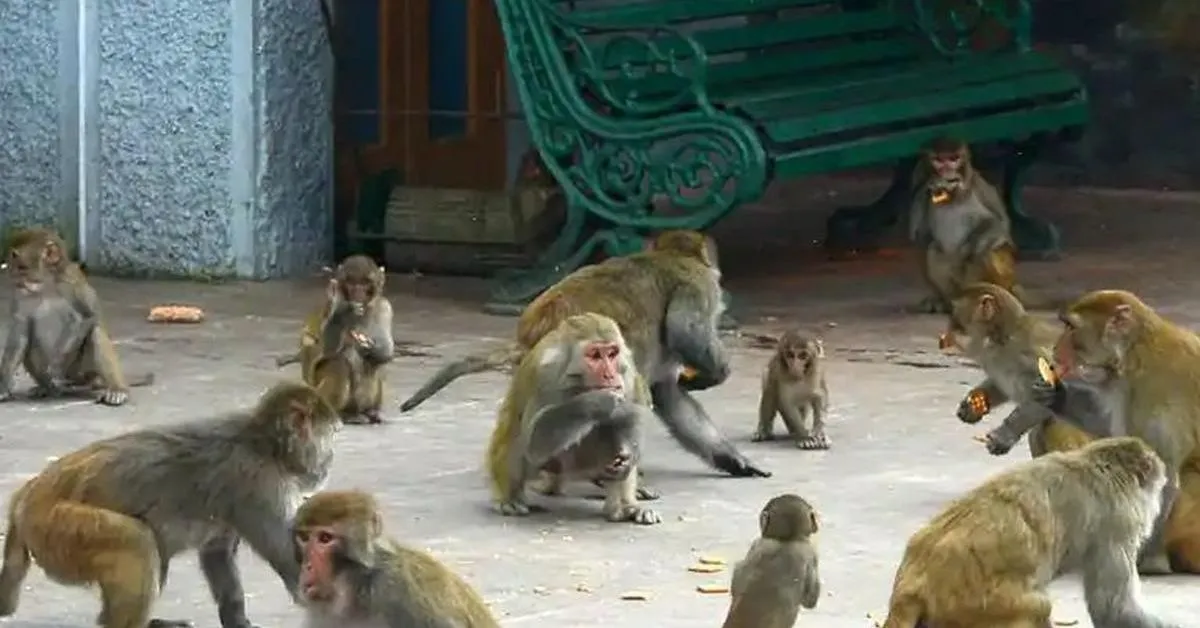
On 22 September 2026, a 91-year-old woman, Najamunisa Begum, died in Karnataka’s Koppal district after a monkey allegedly knocked her down outside her home.
CCTV footage showed the animal approaching and attacking her. She suffered injuries in the fall and later died in hospital. The circumstances of the incident are being examined.
In 2026, the headlines have supplied plenty of reasons to be wary of monkeys.
Such incidents are often reduced to a simple question: Why are monkeys becoming aggressive?
VIDEO | A 91-year-old woman died on Monday after allegedly being attacked and pushed by a monkey (Colobine) in BT Patil Nagar, Koppal district.
The incident occurred as the elderly woman, identified as Najamunisa Begum, stood outside her house. The monkey reportedly attacked and… pic.twitter.com/sOIq7kIuWQ
— Press Trust of India (@PTI_News) September 22, 2026
On 16 September, a British tourist was reportedly bitten by a monkey while walking towards the Taj Mahal in Agra. A South Korean tourist was also bitten near the Taj Mahal’s eastern gate on 26 July.
And in June, 24-year-old Anitha died at the Kalugasalamoorthy Temple in Thoothukudi district, Tamil Nadu, after she and her husband were feeding fruits to monkeys. According to police, several monkeys gathered around the couple. Anitha panicked, lost her footing and fell from the hilltop.
So, has the monkey menace gone too far?
Caution is warranted around any wild animal that can bite, attack, or cause someone to panic and fall.
But a temple monkey that has grown accustomed to being fed is not the same as a macaque that has learned to follow tourists for food. Nor is either the same as an animal defending itself after being chased or threatened, or one living around markets, garbage and crops where human food is easier to find than natural forage.
A monkey may happily grab your Kurkure, Oreo or biscuit. That does not make these monkey food.
The banana, too, has become part of our cultural shorthand for what monkeys eat.
In reality, macaques are adaptable, varied feeders. Research on rhesus macaques has recorded fruits, flowers, leaves, buds, seeds and insects among their natural foods. A study in Chitrakoot, based on observations from 2009 to 2011, found 25 troops across temple, urban, roadside, riverside, forest and settlement habitats. The animals consumed plant material and insects alongside food provided by people.
Human food can be easier to obtain than natural food
Why climb, search and forage through a forest when a person may be carrying lunch?
We teach them to ask for food
#AAI#Chennai use this opportunity to get a nice interview with the monkey on how nice the facilities are at our world renowned airport.
Can talk about how smooth it is to jump around empty terminals, dusty handrails and rooftops.
Also don’t forget to ask about the new pickup…
— Srinivas (@Srinivas_091294) September 15, 2026
A study published in Animal Cognition in March 2025 examined free-ranging Hanuman langurs living around the Dakshineswar temple in Bengal, a religious site that also attracts tourists.
Researchers observed the same troop over several years and identified seven distinct food-solicitation gestures. Some langurs stood upright, extended their hands, held people’s hands, embraced their legs or pulled at their clothes.
The researchers recorded 1,293 begging events, with about 81% ending in the langur receiving food, according to a science communication account by IISER Kolkata.
A gesture is repeated because it has been rewarded. Over time, humans become part of the animal’s foraging strategy.
The study notes that the religious status of Hanuman langurs contributes to frequent feeding at Dakshineswar and that prolonged human contact can reduce their fear of people. The researchers also caution that processed food can have physiological effects on primates.
Even a temple lamp becomes a lesson
A study published in the American Journal of Primatology in April 2025 recorded 2,704 attempts by wild bonnet macaques to extinguish oil lamps containing food rewards such as sesame seeds, rice flour and coconut.
Adult monkeys were much more successful than younger ones: success rates were 81.1% for adult males and 75.3% for adult females, compared with 30.1% and 18.8% among subadult males and females.
The finding was about problem-solving, but it also shows the environment these animals inhabit: one in which human religious practices can create new and repeatable feeding opportunities.
At Jaipur’s Galtaji Temple, in July 2026, wildlife experts and forest officials raised concerns about hyperkeratosis among monkeys around the temple.
Wildlife veterinarian Ashok Tanwar attributed the animals’ altered diet partly to repeated feeding of items such as chana, makhana and laddoos. Forest officials said warning boards were being installed and affected monkeys were being captured for treatment.
Tourism can make this relationship worse
A 2011 study of rhesus macaques along an 11-km stretch of National Highway 7 through the Kanha-Pench corridor in Madhya Pradesh examined how roadside feeding affected their distribution, group size and mortality.
Five macaque groups occupied stretches of the road, together covering about 7.3 km. Group size varied with the availability of food along the road. During the study, 54 macaques were killed in road accidents, with the highest road mortality recorded in summer, when tourist inflow was greater.
The roadside snack may last seconds. The behavioural consequence can be long-lasting.
What has Delhi done, and does it help?
Delhi has responded largely by moving monkeys out of residential and commercial areas. Government data released in January 2026 showed that 6,591 monkeys were relocated to Asola-Bhatti Wildlife Sanctuary between 2021 and 2025.
Yet relocation does not remove the conditions that made a settlement useful to a macaque in the first place. Food remains in markets. Waste remains accessible.
And when a monkey enters a home, the encounter can become hostile.
India’s environment ministry itself lists habitat fragmentation, degradation, reduced food and water availability, development and the adaptability of species such as monkeys to human settlements among factors contributing to human-wildlife conflict.
So, instead of asking only why monkeys are coming into our homes, temples, markets and tourist sites, it is worth asking what they are finding there.
Laddoos, biscuits, makhana, chips.
For a highly adaptable primate, these are dangerous rewards. If the reward keeps coming, it is harmful for both the monkey and the human that offers it.
Sources:
‘Over 6,500 monkeys relocated to Asola-Bhatti Wildlife Sanctuary in last 5 years: Delhi govt’: By PTI, Published on 14 January, 2026
‘Jaipur’s Galtaji monkeys suffer bleeding skin disease as devotees feed sweets’: By India Today News Desk, Published on 12 July 2026
‘Into the Fire: Problem-Solving and Pyrocognitive Behavior of Temple Dwelling Bonnet Macaques, Macaca radiata, in India’: By Mildred Berlena Blessy Herald Victor, Vinothini Govindharaj, Paul A. Garber, Parthasarathy Thiruchenthil Nathan, Published on 16 April 2025
‘Monkey bites UK tourist at Taj Mahal:Clings to her hand after attack, had also bitten 6-year-old boy’: By Bhaskar English, Published on 16 September 2026
‘Tamil Nadu Woman Dies After Fall From Hilltop Temple As Monkeys Surround Her’: By J Sam Daniel Stalin, Published on 27 June 2026
Disclaimer : This story is auto aggregated by a computer programme and has not been created or edited by DOWNTHENEWS. Publisher: thebetterindia.com




