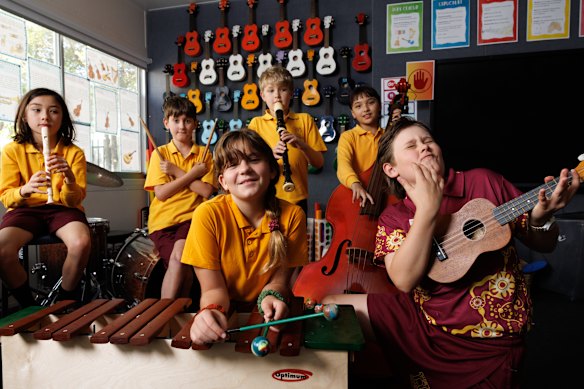
The NSW government has just announced its ambitious 10-year Time for Music plan, promising every primary school student access to music learning and the opportunity to learn an instrument. That’s extremely welcome news.
For parents, teachers and children, this is one of the most exciting education announcements in years. It recognises something many of us have known for a long time: music brings schools to life, and that’s something worth nurturing.
We know that music helps children listen, collaborate, concentrate and connect with others. At a time when screens, devices and artificial intelligence are becoming part of everyday life, music offers something profoundly human. It gets children singing together instead of scrolling alone.
Perhaps the most encouraging part of this announcement is that it finally shines a spotlight on music learning in primary schools. While most secondary schools employ specialist music teachers, music in primary schools has too often depended on luck. Some students have experienced rich and engaging music programs, while others have missed out entirely.
Importantly, that’s not because classroom teachers don’t care about music. They do. Many primary teachers would love to do more music with their students. However, a 2025 study found that 69 per cent of NSW primary teachers lack confidence and feel ill-equipped in delivering music in the classroom. Teaching music well requires specialist training, just as teaching mathematics, science or literacy does. Being able to make music and being able to teach music are not the same thing. A talented musician may inspire an audience but a skilled music teacher inspires learning. If every child is going to have access to meaningful music education, we need more of both.
Great music programs depend on great teachers. We need teachers with the confidence, knowledge and practical skills to deliver meaningful music education. A cupboard full of shiny new ukuleles is not a music education strategy. In the hands of a skilled teacher, however, those instruments become tools of creativity and joy.
Great music education is about much more than putting instruments into children’s hands. Before children learn scales, finger positions or chord shapes, they learn through singing, chanting, moving, listening and play.
A child’s first instrument is their voice and it is the most accessible instrument they will ever own. Singing can begin from the earliest years and its benefits reach far beyond the music room. Music is widely recognised for its benefits to children’s cognitive, social, emotional and creative development, and active engagement in music has been found to support reading and strengthen comprehension, vocabulary and listening.
From kindergarten onwards, children build musical skills gradually through participation, developing confidence and understanding before progressing naturally to instrumental learning. That’s where the best music programs begin.
The government’s 10-year rollout gives NSW a unique opportunity to get this right because building a strong music education workforce takes time. Fortunately our state already has thousands of talented musicians, performers, composers and conductors. Many have been waiting for an opportunity exactly like this. With the right support they could become specialist primary music teachers and help deliver this vision.
At the same time, we need to support the classroom teachers already working in our schools. They need access to high-quality professional learning and, crucially, the time to participate in it.
While some pathways already exist to get musicians into primary schools, they are mostly ad hoc and not equitably accessed across the state. Opportunities to train as specialised primary music educators are also limited. There is currently no formal, accredited degree in Australia that offers this type of training.
A 2023 study found mandated music education training in primary teaching degrees at university had declined by 53 per cent over the previous 14 years. Generalist teachers interested in specialist music training must develop their skills separately as part of their professional development.
To support the Time for Music initiative, the Sydney Conservatorium of Music will deliver professional learning opportunities for both experienced musicians and generalist primary teachers from 2027. These sessions will focus on practical, hands-on upskilling of teachers to engage primary children in high-quality music education. This approach is already proving to be successful overseas in developing confident and competent teachers.
So, yes, bring on the recorders! Bring on the ukuleles! Bring on the string orchestras, jazz bands and slightly off-key school assembly sing-alongs. Let’s celebrate the joyful noise, the musical discoveries and the confidence that come from children making music together.
But before the instruments arrive, let’s make sure the teachers are ready. Now that really would be music to our ears.
Carla Trott is a senior lecturer in music education at the Sydney Conservatorium of Music and a primary and secondary music teacher.
Get a weekly wrap of views that will challenge, champion and inform your own. Sign up for our Opinion newsletter.
 Carla Trott is a senior lecturer in music education at the Sydney Conservatorium of Music and a primary and secondary music teacher.
From our partners
Disclaimer : This story is auto aggregated by a computer programme and has not been created or edited by DOWNTHENEWS. Publisher: www.smh.com.au