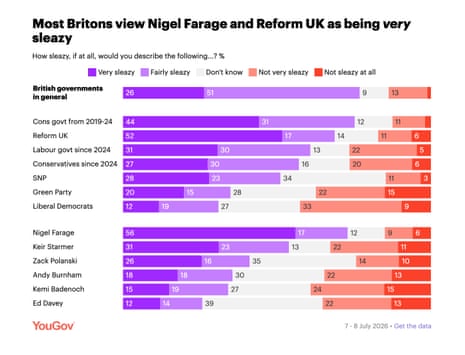
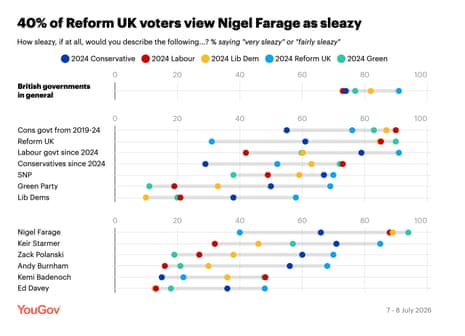
YouGov has published polling today suggesting that more than half of voters regard Nigel Farage as “very sleazy”. On this measure, he scores far worse than any of the other party leaders. Even 40% of Reform UK voters regard him as “sleazy”.
Here are the figures. This chart shows the figures for parties, party leaders, and “British governments in general”.
And this chart shows how views vary depending on which parties people support.
In his write-up for YouGov, Dylan Difford points out that Reform UK’s rating on this measure has got worse.
Reform being viewed as sleazy is not necessarily a new thing, but the perception has grown. In October 2024, at the height of the freebie-gate scandal, half of Britons saw the party as sleazy, a clear 18 points lower than today.
However, a seedy shift is not limited to Reform, with belief that the Green party is sleazy having roughly doubled from 18% to 35% over the last 21 months, while such a view of the Lib Dems is also up seven points.
By comparison, evaluations of the current Labour government, its Conservative predecessor, or British governments in general remain largely unchanged over this period.
One problem with polling like this is that, while the views of voters are always interesting, they are not always correct. When people tell pollsters they regard a politician or a party as “sleazy”, it can mean they view them as corrupt, or morally dubious; but it can just mean they do not like them.
For example, this polling suggests 73% of people view Farage as either very (56%) or fairly (17%) sleazy. But 77% of people see “British governments in general” as either very (26%) or fairly (51%) sleazy.
That is a judgment that would surprise many people who take a serious interest in how British politics operates. UK governments have multiple flaws, but by international standards they are not corrupt and ethical standards are reasonably high. These figures probably have more to say about popularity than morality.
Zack Polanski, the Green party leader, has welcomed research out today arguing that a well-designed rent control policy could save the government billions of pounds and lift hundreds of thousands of people out of poverty.
The report, produced by the Institute for Innovation and Public Purpose at UCL, says that if rents in England had been frozen in November 2022, the government would now be saving £2bn a year – and average renting households would be saving £2,400 a year.
The report also dismisses claims that rent controls would collapse the private rental market because they would lead to landlords refusing to carry on renting their property.
In his speech, Polanski said:
If Andy Burnham is serious about ending rip-off Britain, fixing our broken system and putting money back in the pockets of ordinary people – rent controls simply must be at the top of his agenda.
We hear plenty of scare stories about landlords being bankrupted by rent controls. But this research exposes that as nonsense. Over the last three and a half years, we could have saved households on average £2400 a year – while still allowing landlords to enjoy profit margins four and a half times larger than the average UK business.
We need a prime minister who is willing to control the rental market, lower prices – and doesn’t fear the bond markets. No half measures: it’s time for our next prime minister to show us what he’s made of.
The report, by Beth Stratford and Joe Beswick, says:
We conclude that the risks associated with rent controls, though significant, are manageable – and pale against the cost of inaction: spiralling housing benefit spending, rising homelessness, and entrenched poverty and inequality.
The authors say that rent controls have worked in the past.
England’s private renters face some of the worst affordability pressures in the developed world. The evidence makes clear that neither new house-building nor increased housing subsidies can realistically address the full scale of the problem. By contrast the historical record across Europe shows that the most decisive improvements in housing affordability in the 20th century came from the direct regulation of rents.
On potential savings, the authors say that if the government had frozen rents in November 2022, it would have been able “to restore housing support payments to cover the cheapest 30% of local rents and would still be saving an estimated £2bn a year in housing benefit spending by now”.
That would save the average renting household £2,400 a year, “boosting the disposable income of renters in the poorest quintile by 22%”, they say.
As for claims that rent controls would put landlords out of business, the authors say even with rent controls landlords would still be making healthy profits.
For mortgaged landlords, a 20% reduction in rent reduces mean pre-tax profit margins from 70% to 64% – which means they would still be 4.5 times bigger than the mean pre-tax profit margin for UK businesses. Profit margins for unmortgaged landlords (58% of all unincorporated landlords) would be higher still. These figures do not take account of capital gains from house price appreciation.
This chart illustrates these figures.
The authors say:
A 10% reduction in rents would cause 2.3% of landlords to become unprofitable – significantly fewer than the 4.8% of landlords tipped into lossmaking by changes to mortgage interest tax relief (MITR) and interest rate rises since 2021-22.
The report recommends combining rent controls with a policy giving tenants a minimum six months to find alternative accommodation if a landlord decides to sell, and giving tenants, and then councils and housing associations, first refusal to buy.
It also says rent controls could lead to many properties being sold off and acquired by councils for social rent.
Crucially, if accompanied by the right fiscal and legal framework, landlord exit presents a historic opportunity: a managed transfer of homes out of the insecure private rented sector and into permanently affordable ownership.
Richard Tice, the Reform UK deputy leader, has dismissed the police investigation into donations worth £500,000 made to Reform UK by Fiona Cottrell as being linked to a “politically-motivated smear campaign”.
Speaking on Times Radio this morning, he said he did not know about the police investigation until it was reported today. He went on:
I’ve known the Cottrell family, my family have known the Cottrell family, and the broader Hesketh family for 50 years, a very successful aristocratic family.
And, as far as I’m concerned, she’s a permissible donor. And that’s the end of it.
And this is a politically-motivated smear campaign by people who wish us ill.
Boris Johnson, the former Tory PM, has joined those paying tribute to the former minister Ann Widdecombe, who has died.
In a post on social media, he said:
I am sad to hear about the loss of Ann Widdecombe, a heroic Brexiteer and a great speaker who could move Tory audiences to such ecstasy that she was a very hard act to follow.
(When a politician praises a colleague who has died, sometimes what they say is revealing about how they would like to be remembered themselves. This may be a good example.)
This is from William Hague, who had Widdecombe as his shadow home secretary when he was Tory leader.
So very sorry this morning to hear of the death of Ann Widdecombe. She was a great friend and a unique personality. Her enthusiasm, clarity and warmth will be much missed.
And this is from Priti Patel, who was home secretary under Johnson.
Ann Widdecombe was a much-loved member of the Conservative family. She was principled, always stayed true to her values and her faith and had a great sense of humour. Her authentic and no-nonsense approach to politics has stood the test of time and she will be remembered as one of the most captivating, engaging and memorable politicians of her generation.
It was a privilege to work closely with her while she was in William Hague’s Shadow Cabinet and to call her a friend. May she rest in peace.
There are more tributes to Widdecombe, including from Nigel Farage and Kemi Badenoch, in our story.
Andy Burnham has jokingly endorsed Count Binface, the joke candidate who seems to be Nigel Farage’s main opponent in the Clacton byelection. “Count Binface, you are carrying the hopes of a nation,” Burnham said at an awards ceremony. The Sun has video footage.
On X, the rightwing social media platform, there are a lot of Nigel Farage supporters claiming that Binface is the establishment candidate in the byelection. Here is an example from Rael Braverman, whose wife Suella is Reform UK’s education spokesperson (and who has held the posts of home secretary and attorney general, which is about as establishment as anyone can get).
Binface is an establishment tool.
Don’t be fooled by the act.
Burnham’s comment will no doubt encourage these claims.
Immigration policy (see 9.24am) is just one area where Andy Burnham faces an acute challenge when he becomes PM. Here are some of the other stories around this morning about Burnham and what he might do when he takes power.
-
Jim Pickard, George Parker and Jennifer Williams in the Financial Times say Burnham is considering having a deputy PM based in Manchester running his No 10 North. The deputy Labour leader, Lucy Powell, is well placed to get this job, they report.
Burnham is expected to spend several days a month in Number 10 North. Caroline Simpson, chief executive of the Greater Manchester Combined Authority, has been lined up to run the new office.
But the transition team has also raised the idea that the new unit could be given political direction by the next deputy prime minister, who would be based in Manchester, according to people close to the situation.
Burnham has deliberately held back from naming any members of his cabinet, leaving Whitehall in a state of suspension even as access talks have begun between the incoming prime minister and civil service chief Dame Antonia Romeo.
Lucy Powell, the elected deputy leader of the Labour party, is in pole position to become the deputy prime minister. As a Manchester MP she would be ideally placed to work out of Downing Street’s northern offshoot.
-
John Bew, a former No 10 foreign policy adviser, has told the Times that Burnham could face an international crisis within weeks of taking office. Bew said:
I’d say there’s a high likelihood of a series of quite challenging contingencies happening.
One is a horizontal or vertical escalation from Putin over the course of this summer and beyond because the war [in Ukraine] is not going well for him.
It has been reported that Bew is talking to Burnham’s team, but not about taking a formal role in his administration.
-
Some ministers are lobbying Burnham to keep their jobs. In their London Playbook briefing for Politico, Sam Francis and Megan McElroy have a good summary.
Cabinet auditions continue across Westminster. Business Secretary Peter Kyle was at least direct about it, telling the Guardian’s Richard Partington that “I want to stay, I’ll just stay where I am.” He also declared Britain needs “Manchesterism.” In another not-very-subtle intervention, David Miliband used his foreign policy speech last night to restate his support for electoral reform (he previously backed the Alternative Vote at the 2011 referendum, while still an MP) and back a Burnham-style transfer of power out of Westminster (the Arguably substack has the full script). Just before Miliband spoke, Yvette Cooper revealed to Chatham House that she had spoken to Andy Burnham before heading to NATO — meaning she’s already giving him foreign affairs advice.
Tendring district council, which covers Clacton, has announced that the byelection there will be held on Thursday 13 August.
This marks the first setback for Reform UK, whose leader Nigel Farage is defending his seat after resigning to trigger a byelection in the hope of seeing off the threat that a standards inquiry will lead to a recall byelection being held later this year anyway. Reform wanted the byelection to be held a week earlier, on 6 August.
Announcing the decision, the acting returning officer, Ian Davidson, said: “The electoral timetable is set out by law and so we are bound by these dates.”
The council says:
Potential candidates will … have four days, from Tuesday 14 July to Friday 17 July at 4pm, to submit their nominations.
Residents not already on the electoral register have until 28 July to apply to vote in time for the byelection, and until 5pm the following day (29 July) to apply for a postal or postal proxy vote.
Davidson has also posted a picture of the writ he has received from the Clerk of the Crown in Chancery telling him to organise the byelection.
Jeffrey Donaldson, the former DUP leader, Jeffrey Donaldson has been removed from the privy council, it has been confirmed.
In a statement, the clerk of the privy council said:
Now, therefore, by and with the advice of His Majesty’s Privy Council, it is hereby ordered, that the name of the said Jeffrey Donaldson be removed from the list of Members of His Majesty’s Most Honourable Privy Council.
Last month Donaldson was found guilty of 18 child sex offences.
YouGov has published polling today suggesting that more than half of voters regard Nigel Farage as “very sleazy”. On this measure, he scores far worse than any of the other party leaders. Even 40% of Reform UK voters regard him as “sleazy”.
Here are the figures. This chart shows the figures for parties, party leaders, and “British governments in general”.
And this chart shows how views vary depending on which parties people support.
In his write-up for YouGov, Dylan Difford points out that Reform UK’s rating on this measure has got worse.
Reform being viewed as sleazy is not necessarily a new thing, but the perception has grown. In October 2024, at the height of the freebie-gate scandal, half of Britons saw the party as sleazy, a clear 18 points lower than today.
However, a seedy shift is not limited to Reform, with belief that the Green party is sleazy having roughly doubled from 18% to 35% over the last 21 months, while such a view of the Lib Dems is also up seven points.
By comparison, evaluations of the current Labour government, its Conservative predecessor, or British governments in general remain largely unchanged over this period.
One problem with polling like this is that, while the views of voters are always interesting, they are not always correct. When people tell pollsters they regard a politician or a party as “sleazy”, it can mean they view them as corrupt, or morally dubious; but it can just mean they do not like them.
For example, this polling suggests 73% of people view Farage as either very (56%) or fairly (17%) sleazy. But 77% of people see “British governments in general” as either very (26%) or fairly (51%) sleazy.
That is a judgment that would surprise many people who take a serious interest in how British politics operates. UK governments have multiple flaws, but by international standards they are not corrupt and ethical standards are reasonably high. These figures probably have more to say about popularity than morality.
Libby Brooks has written her First Edition briefing about the Reform UK funding scandal. It features an interview with Anna Isaac, who broke the story about Farage’s undisclosed £5m donation and who has led the Guardian’s coverage of this controversy.
The Labour party has welcomed the news that the Metropolitan police are investigating donations worth £500,000 made to Reform UK by Fiona Cottrell, whose son George is a convicted fraudster and a friend and aide to Nigel Farage. Anna Turley, the Labour party chair, said:
Nigel Farage can run against a bin in his distraction byelection, but he can’t hide from legitimate questions. Why did the mother of the convicted criminal who secretly bankrolled him donate half a million pounds to Reform UK? Where did the money come from? Why did George Cottrell have such a prominent role in his operation without having an actual job? It’s right that the Metropolitan Police are looking into this.
The British public know when they’re being taken for fools – if Nigel Farage could clear his name, he would have done it by now.
Lisa Nandy, the culture secretary, was on the Today programme this morning. She is close to Andy Burnham (they represent neighbouring constituencies) and she said two things would be different when he became PM.
I think there will be two things that will be different under Andy Burnham.
The first is that it will be faster and bolder and he’s willing to think very differently about how we deliver that change.
No 10 for the North has attracted a lot of interest, but that really is about shifting the centre of gravity in the country, so that all parts of the country are seen and heard and are able to contribute.
But the second thing that I think will be different is that I think we will wear our hearts on our sleeve more. I think people will see us taking the fight to any system that stands in the way of them living better lives.
And I really think, at the moment, at a time when trust in the power of government to change people’s lives is very weak, that that is an enormously important thing.
Here are more extracts from the letter to Andy Burnham signed by nearly 80 Labour MPs urging him to adopt a more liberal stance on immigration. (See 9.24am.)
Immigration and asylum is a test case for how we do so. Polling in this area shows that most voters are “balancers” who understand the benefits and the costs of migration. In this group, some prioritise order and control; while others prioritise compassion, justice and rights. We must speak to both groups simultaneously and persuasively. Currently, we are seen to talk much more about control than compassion. And when we talk about compassion, progressives do not believe us because our hostile rhetoric has already alienated them. That rhetoric also raises the salience of asylum as a problem in the minds of those already anxious about lack of control. Our approach needs a refresh.
Talking tough is not the same as effective action. The reductions in the asylum backlogs, in small boat crossings and in hotel use that we have seen are the fruits of what our Labour Government started in its first 12 months or so. We also started an asylum accommodation pilot with local authorities – to regionalise the system and move away from rip-off private contracts. We pursued greater international co-operation – like the UK-France pilot, and persuading Germany to amend its criminal law on small boat parts. We were starting to do what we promised: controlling our borders while making the asylum system work fairly.
This should set out expected migration flows, labour market needs, public service impacts and policy choices, all supported by an annual statement to Parliament. It should form a core part of our mission to raise living standards over the next decade through delivering good growth in every postcode.
On asylum and refugees, we must start by stripping out the hostile rhetoric which triggers existing anxieties. We must also deliver an efficient asylum system, which should include: closing asylum hotels and investing savings into national housing stock; improving the asylum accommodation system – starting with progressing local authority pilots that have been paused; ending rip-off contracts and the privatisation premium; tackling the appeals backlog by resourcing the existing appeals body properly; and building a coalition of willing countries around a future vision for refugee protection that is not reliant on irregular migration. We need an expansion of managed asylum routes, a review of the pause on family reunion for unaccompanied minors, and the introduction of the right to work for asylum seekers after six months.
The former Conservative minister Ann Widdecombe has died aged 78, her management has said. Kevin Rawlinson has the story.
Good morning. Even the BBC has (almost) given up describing Andy Burnham as the person who is likely, or almost certain, to become the next PM. As of last night, it is now, barring something so unexpected it would be in the act of God category, a done deal. Labour published the names of the MPs who have already nominated Burnham, and he has got 322 nominations. There are only 81 Labour MPs left who have not nominated anyone. By coincidence (or not?), 81 is exactly the number of names a rival candidate would need to stand. But in Labour politics the outgoing leader does not nominate a successor, and so in practice Burnham has already cleared the threshold. It’s wrapped up; he is the next leader and PM.
Currently, Burnham has strong support from all wings of the party. Leftwingers and Blairites seem equally enthusiastic. Unfortunately for Burnham, that is unlikely to last.
Last night, as Pippa Crerar reports, Burnham made an appeal to the left by saying Labour “didn’t get it right” with its initial response to Israel’s assault on Gaza after the Hamas attack on 7 October 2023. Labour had to “do better”, he said.
Leftwingers who are not in the Labour party have criticised Burnham overnight for not going further and describing Israel’s conduct as genocide.
Today Burnham is facing a further challenge from the left. AsRichard Vaughan, Kitty Donaldson and Caroline Wheeler report in a story for the i, almost 80 Labour MPs have signed a letter to Burnham complaining that the immigration policies being implemented by Shabana Mahmood, the home secretary, risk Labour being seen “as a pale imitation of Reform [UK]”. Patrick Maguire from the Times has posted the full text of the letter on social media.
The MPs are particularly critical of Mahmood’s plan to make migrants already in the country wait much longer before they can qualify for indefinite leave to remain (ILR). Currently people normally have to wait five years, but Mahmood wants to make 10 years the norm, with some groups having to wait even longer.
In their letter, the MPs say:
After Reform’s “Boris wave” rhetoric, we decided to fight on Reform’s territory. Targeting a group of migrants that followed the rules, and applying this retrospectively, does not pass the fairness test for a compassionate but firm system. We do not recall being asked on the doorstep to make it harder for migrant workers to settle in the UK. Yet we are expending political capital, huge Home Office resource, and losing progressive voters on an indefinite leave to remain reform which few really understand or want. People in Makerfield talked about irregular migration, not making it harder for nurses and care workers to settle here. With a 10-20 year settlement period, the UK would be an international outlier – weakening our soft power and our appeal as a place to study, invest, build a life and form relationships.
It would weaken our communities and undermine our own strategies on child poverty, violence against women and girls, and homelessness. And the proposals would cost the state billions. This kind of reactive policy making is anathema to who we are, what we stand for, and how we should do politics.
The letter implies that Burnham should move Mahmood from the Home Office. But during the Makerfield byelection campaign Burnham broadly supported what Mahmood is doing – even though last year, when the ILR plans were first announced, he said he had “a concern about leaving people without the ability to settle, one of the concerns being if there is a need to constantly check up on the status of countries where people have come from, that might limit the ability of the Home Office to deal with the backlog”.
There are plenty of other stories around today about the challenges facing Burnham. I will post about them soon.
And Reform UK remains under pressure over its finances. Here is our latest story by Anna Isaac.
Here is the agenda for the day.
10am: Karl Turner, the suspended Labour MP, hosts an LBC phone-in, standing in for James O’Brien.
11am: Zack Polanski, the Green party leader, gives a speech on rent controls.
11.30am: Downing Street holds a lobby briefing.
If you want to contact me, please post a message below the line when comments are open (between 10am and 3pm), or message me on social media. I can’t read all the messages BTL, but if you put “Andrew” in a message aimed at me, I am more likely to see it because I search for posts containing that word.
If you want to flag something up urgently, it is best to use social media. You can reach me on Bluesky at @andrewsparrowgdn.bsky.social. The Guardian has given up posting from its official accounts on X, but individual Guardian journalists are there, I still have my account, and if you message me there at @AndrewSparrow, I will see it and respond if necessary.
I find it very helpful when readers point out mistakes, even minor typos. No error is too small to correct. And I find your questions very interesting too. I can’t promise to reply to them all, but I will try to reply to as many as I can, either BTL or sometimes in the blog.
Disclaimer : This story is auto aggregated by a computer programme and has not been created or edited by DOWNTHENEWS. Publisher: theguardian.com