
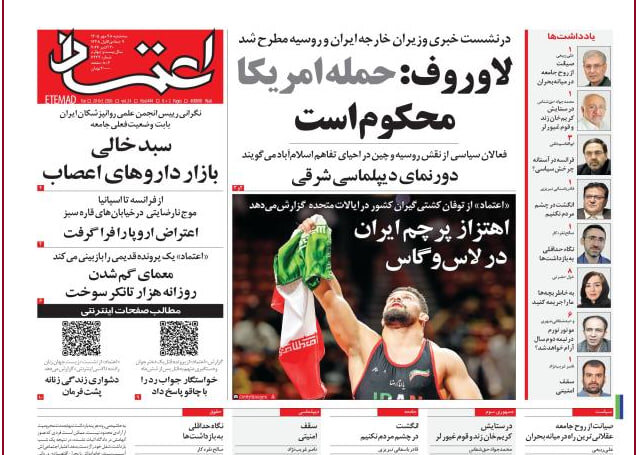
In a note, Etemad examined US rhetoric about using the “Mother of All Bombs” and Iran’s response that it could employ the “Father of All Missiles.” The paper argued that Iran’s statements do not necessarily mean such bombs would be ineffective, nor that Tehran has publicly revealed the nature or scope of any potential response. Political declarations, deterrent warnings, and military operational plans are three distinct matters.
The verbal clash between the “Mother of All Bombs and the Father of All Missiles” reflects a battle of narratives more than a definitive answer to a military question. Washington seeks to intimidate through displays of destructive power, while Tehran emphasizes its retaliatory capabilities and the costs of any attack. Ultimately, the impact of either narrative will depend not on the names of bombs and missiles but on real military capabilities, political decisions, and the consequences of any confrontation.
Khorasan: Iran has achieved many of its war objectives
Khorasan argued that Iran has already achieved many of its goals in the conflict. According to the paper, many of the developments currently unfolding in Europe are a result of Iran’s actions. While Western governments had intended to dedicate significant financial resources to supporting their populations, they have instead been forced to return to older policies to manage the economic consequences of the war. This has led to growing public dissatisfaction and notable social reactions. The newspaper claimed that Iran has already attained a large portion of its objectives: it succeeded in limiting the conflict from a national to a regional level, forcing its foes to operate under those constraints. It also asserted that Iran overcame infrastructure-focused warfare, severely suppressed enemy agents within the country, and maintained overall domestic stability by preventing major shortages and deep economic stagnation.
Ettelaat: Which side will compromise, Iran or the US?
Ettelaat discussed the lack of progress in ongoing negotiations between Iran and the United States, citing former Minister of Culture and Islamic Guidance Ali Jannati. He argued that diplomacy has not failed, because opportunities for negotiation remain available even under the most difficult circumstances. Over the past month, Qatari mediators have reportedly conveyed Iranian proposals to the United States and delivered Washington’s responses back to Tehran. According to Jannati, the talks have stalled because Iran proposed seven principles as the basis for negotiations and the United States broadly accepted the framework but strongly disagreed over the sequence in which the provisions should be implemented. Washington wants the nuclear issue to be addressed first, whereas Tehran views it as the final matter for discussion. He suggested that both sides continue to insist on their positions and that little progress is likely unless one party shows flexibility and makes concessions. Otherwise, he warned, the possibility of renewed war remains.
Vatan-e-Emrooz: France bowed to Hormuz
Vatan-e-Emrooz analyzed protests in France and comments made by President Macron. According to the paper, Macron acknowledged in a televised address that French citizens had reason to be upset about rising fuel prices linked to developments in the Persian Gulf. The newspaper noted that Macron had previously stated that France was living with the consequences of the closure of the Strait of Hormuz. It linked current economic pressures to events eight months earlier, when US and Israeli attacks on Iran led to the closure of the strategic waterway. The paper argued that the disruption of oil shipments through Hormuz triggered increases in fuel costs, inflation, and living expenses worldwide. It contended that these economic effects have fueled ongoing protests in France, which began in mid-September over shortages of teachers and inadequate school facilities but have continued for more than a month due to broader concerns about the cost of living.
Shargh: Repeated US threats aim to weaken social resilience
In an interview with Shargh, Seyed Jalil Mirmohammadi Meybodi, a member of the Iranian Parliament’s Industries and Mines Committee, discussed the main source of “psychological warfare” against Iran by the Trump administration. He argued that it originates from US policy and Washington’s extensive media capabilities. Psychological warfare is one of America’s principal tools in its confrontation with Iran, and Tehran faces an enemy that controls powerful global media networks. He claimed that the United States has failed to achieve its objectives and has therefore resorted to new threats and attempts to project victory. He said that Donald Trump continually seeks to portray himself as victorious and might use a major military action, such as a large-scale bombing campaign, to claim success. Meybodi also argued that any new military action against Iran would be met with a reciprocal response. In his view, frequent public discussion of war often makes actual conflict less likely, and recurring threats may be intended more to influence Iran’s political and psychological calculations than to signal an imminent military operation.
Disclaimer : This story is auto aggregated by a computer programme and has not been created or edited by DOWNTHENEWS. Publisher: tehrantimes.com





