
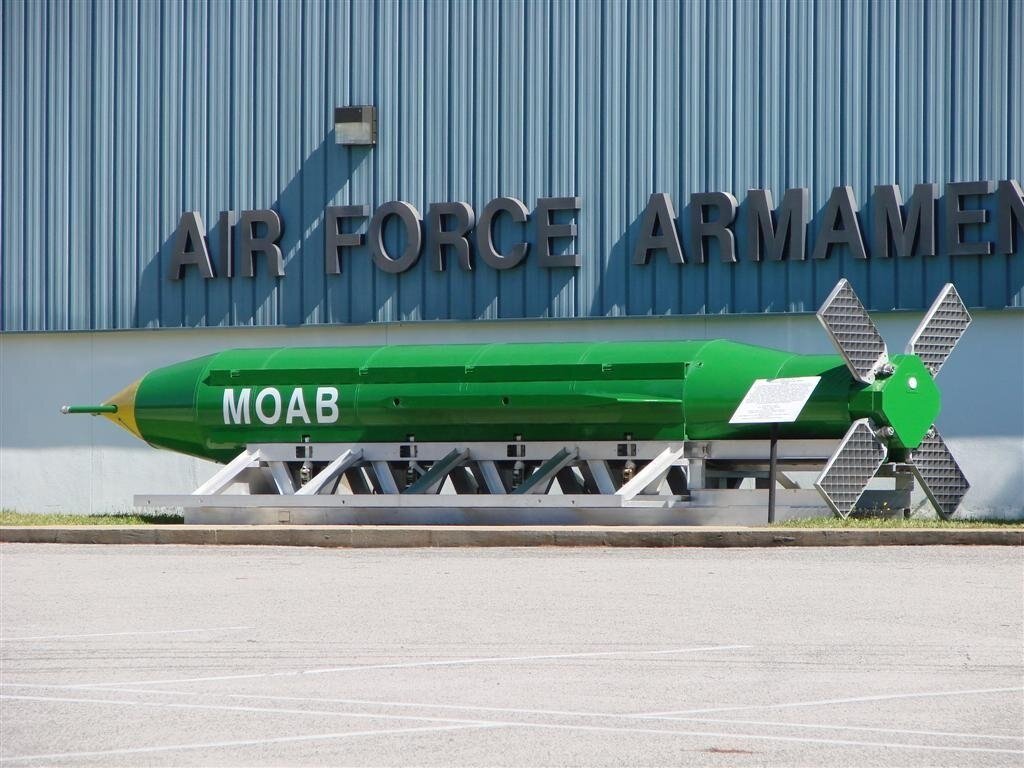
TEHRAN — The possible use of America’s largest non-nuclear bomb against Iran may offer President Donald Trump a dramatic display of military power, but it is unlikely to resolve the strategic predicament facing Washington, analysts have warned, arguing that a spectacular explosion cannot substitute for a viable path out of a protracted war.
CNN reported on October 14 that the US military had developed strike plans that could include the GBU-43/B Massive Ordnance Air Blast bomb, commonly known as the “mother of all bombs,” against Iranian energy infrastructure and nuclear sites if Trump orders a resumption of combat operations. The report cited multiple US officials familiar with the planning.
The prospect of deploying the weapon has raised questions about whether Washington is seeking a decisive military outcome or a dramatic action that could allow the president to declare victory without achieving his stated strategic objectives.
Even within US military planning circles, doubts have emerged over the weapon’s effectiveness in changing the course of the war, CNN reported. Reuters subsequently reported the story, noting that it had not independently verified CNN’s account.
A dramatic explosion, but what strategic result?
Dani Citrinowicz, a former Israeli military intelligence official, told the BBC that even using the “mother of all bombs” would not force Iran to surrender.
“Even the use of the [mother of all bombs] will not force Iran to surrender; although such an attack could have psychological effects and give Trump an opportunity to claim an imaginary victory,” he said, according to the quotation provided in the BBC-attributed report.
The assessment points to a fundamental distinction between the destructive power of a weapon and its ability to achieve political objectives. A strike can cause extensive damage without compelling an adversary to accept the attacker’s demands or bringing a conflict to a favourable conclusion.
Sina Azodi, director of the Middle East Studies Program at George Washington University, similarly questioned the strategic logic behind the reported option.
“Trump has a strange fascination with the symbolic use of American military power and wants to advertise it on his personal social media account through a grand spectacle and a massive explosion,” Azodi said, according to the quotation provided.
He also highlighted the weapon’s limitations against deeply buried targets, noting that it detonates in the air and has limited capacity to penetrate far underground.
The distinction matters because the MOAB was designed primarily to produce devastating blast effects over a broad surface area. It is not the same as a specialised penetrator designed to attack deeply buried, hardened facilities.
In an October 15 Al Jazeera explainer, military analyst Elijah Magnier said that using the MOAB would not guarantee the destruction of Iran’s deeply buried nuclear installations and could amount to little more than “political theatre.”
A weapon cannot resolve a strategic deadlock
The reported plans have emerged as the Trump administration faces pressure to demonstrate progress in a war that has failed to produce a clear political resolution.
In a CNN broadcast on October 15, senior national security reporter Zachary Cohen said Trump and his advisers had spent months discussing options that could be presented to the American public as a “definitive end” to the war.
Cohen said the military had been tasked with developing fresh strike options amid the absence of a diplomatic resolution and growing unpopularity of the conflict.
He also reported that the administration’s stated strategic goals remained unfulfilled.
That assessment raises a central question: what would a MOAB strike actually accomplish that previous attacks and existing military pressure have not?
The bomb’s destructive capacity is not in dispute. The uncertainty concerns whether its use would change Iran’s calculations, compel Tehran to capitulate or create conditions for a durable settlement.
A dramatic strike might generate powerful images and headlines. But if it does not achieve its declared objectives, it could instead expose the gap between the administration’s military capabilities and its ability to translate them into a political outcome.
The limits of spectacle
The MOAB is the largest non-nuclear bomb in the US arsenal. Its deployment would represent a major escalation, but its size alone does not make it an appropriate weapon for every target.
CNN military analyst and retired Air Force Colonel Cedric Leighton explained in a broadcast on October 15 that the MOAB is designed to inflict damage over a large surface area, whereas Iran’s hardened and deeply buried nuclear facilities present a different targeting challenge.
He contrasted the MOAB with the Massive Ordnance Penetrator, a different weapon specifically designed to attack hardened underground targets.
Leighton also questioned the suitability of the aircraft required to deliver the MOAB for the Iranian operational environment.
The technical limitations reinforce the broader strategic problem. A weapon capable of producing an enormous explosion is not necessarily capable of destroying every intended target, still less of compelling a country to surrender.
A face-saving exit is not the same as victory
The most consequential possibility raised by the reporting is that the proposed strike could be intended partly to shape the political narrative of the war.
CNN’s reporting suggested that the administration was examining military options that could enable Trump to present the conflict as decisively concluded. Such a scenario would make the distinction between a battlefield achievement and a politically useful declaration of victory particularly important.
Citrinowicz’s assessment, as quoted by the BBC, captures that concern: the attack might provide an opportunity to claim victory without necessarily producing the underlying result.
This is the danger of treating military spectacle as a substitute for strategy. An attack can be visually overwhelming and still leave the fundamental dispute unresolved.
For Washington, the question is not simply whether the United States can deploy a powerful bomb. It is whether doing so would bring the war closer to an outcome that can be sustained politically and strategically.
The quagmire remains
The possibility of using the MOAB does not, by itself, demonstrate that Trump has authorised such an attack. The reports describe contingency planning, not a confirmed decision to deploy the weapon.
Reuters said it could not independently verify CNN’s initial report. CBS News separately reported on October 15 that the White House and Pentagon had prepared plans for possible use of the weapon if ordered by the president.
If the bomb fails to achieve its intended military objectives, the administration could find itself confronting the same fundamental problem after an even more dramatic attack. If it is used primarily to create the appearance of a decisive outcome, the gap between the declaration of victory and the realities on the ground could become harder to conceal.
The “mother of all bombs” may offer Trump a spectacle of overwhelming force. But an explosion, however large, cannot by itself deliver a political settlement, compel an adversary’s surrender or guarantee a way out of war.
The real test is not the size of the blast. It is whether the strategy behind it can produce an outcome that military power alone has so far failed to secure.
Disclaimer : This story is auto aggregated by a computer programme and has not been created or edited by DOWNTHENEWS. Publisher: tehrantimes.com




