
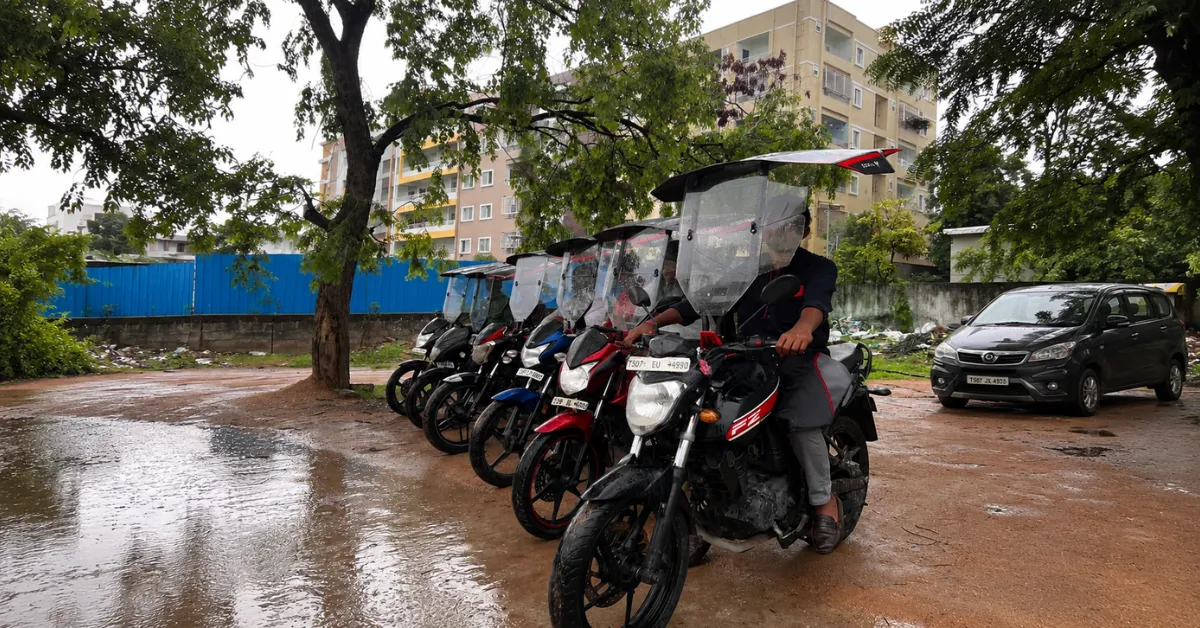
The arrival of the monsoon transforms India’s landscape, but for millions who rely on two-wheelers for their daily commute, it also marks the beginning of a season filled with challenges. Navigating waterlogged roads, battling poor visibility, and reaching destinations drenched are common realities for riders across the country.
The consequences extend beyond personal discomfort. Delivery executives struggle to protect orders from getting damaged, students often arrive at school or college soaked, and workers lose valuable time and productivity while commuting through heavy rain.
For many families that depend on two-wheelers for their livelihood, the monsoon can directly impact both earnings and everyday convenience.
Could a two-wheeler offer riders the protection of a car?
It was this recurring struggle that caught the attention of brothers Kashyap and Vidhey. Kashyap, an architect, and Vidhey, an engineer from IIT Bombay, observed how riders continued to brave harsh weather conditions year after year.
They began wondering whether two-wheelers could offer the same level of protection as cars, without sacrificing affordability or accessibility.
What followed was a long journey of experimentation. The brothers spent nearly three years refining their idea, repeatedly testing and redesigning prototypes to make them suitable for real-world conditions.
Challenges ranging from wind resistance to water leakage forced them back to the drawing board multiple times. Yet, despite setbacks and uncertainty, they remained committed to finding a workable solution.
Three years of prototypes, wind tests and water leaks
Their efforts eventually resulted in the SEPAL Shield, a detachable canopy and windshield system designed for scooters and motorcycles. The innovation can be installed within minutes and does not require any drilling or professional assistance, making it accessible to a wide range of riders.
Designed specifically for Indian roads and weather conditions, the shield helps protect riders from rain, wind, and dust while maintaining stability during travel. What began as an idea to make commuting more comfortable has now become a practical tool for thousands of people who spend hours on the road every day.
/filters:format(webp)/english-betterindia/media/media_files/2026/08/11/sepal-shield-2026-08-11-15-24-52.png)
Today, more than 20,000 riders across India are using the SEPAL Shield, turning a once-difficult monsoon commute into a more manageable experience.
From one idea to 20000 riders across India
The story of the SEPAL Shield is not just about a product; it is about recognising a problem that millions face and refusing to accept it as inevitable. By addressing a challenge that is often overlooked, two brothers have demonstrated how thoughtful innovation can improve everyday life in meaningful ways.
As another monsoon season sweeps across the country, thousands of riders are discovering that while the rain may be unavoidable, getting soaked on the journey no longer has to be. For them, a simple idea is helping ensure that bad weather does not stand in the way of work, education, or opportunity.
Disclaimer : This story is auto aggregated by a computer programme and has not been created or edited by DOWNTHENEWS. Publisher: thebetterindia.com





