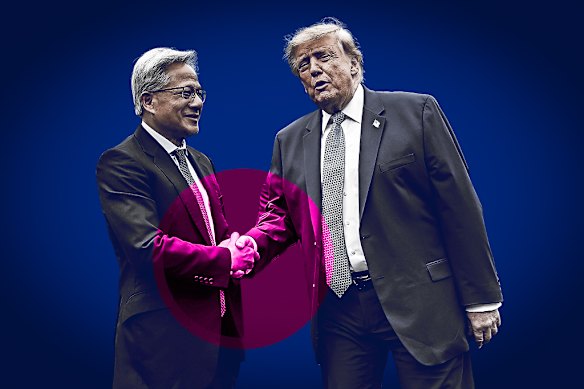
Donald Trump was ebullient and the US sharemarket roared its appreciation of Jensen Huang’s Lazarus-like return as Nvidia’s chief executive.
There are, however, threats lurking in the background that could spoil the story of Trump’s triumph and Huang’s redemption.
Trump has made no secret of the role he played in Huang’s reinstatement, 11 days after he was ejected from the company he cofounded following revelations of affairs with an alleged Chinese spy and one of his direct reports.
“I’ve been speaking to the [Nvidia] board directly and indirectly,” Trump said on Monday.
“I believe my intervention was very important,” he said.
The US president’s intervention certainly helped a sharemarket and Nvidia’s share price that were both in freefall last week.
The S&P 500 gained 4.7 per cent, the tech-heavy Nasdaq index rallied 6.5 per cent and Nvidia shares soared by more than 31 per cent, adding back nearly $US1 trillion ($1.5 trillion) to its market value, which had seen $US2.5 trillion evaporate after Huang’s forced resignation on November 12.
‘I’ve been speaking to the [Nvidia] board directly and indirectly. I believe my intervention was very important.’
Donald Trump
Trump, who owns shares in Nvidia, cited the impact of the scandal and Huang’s ejection on the sharemarket as a key factor in his decision to intervene. He has always seen the sharemarket as both a barometer of his personal performance and of the US economy.
Artificial intelligence spending and the wealth effects flowing from the market’s embrace of AI are estimated to account for more than a third of the growth in the US economy this year, with AI stocks accounting for up to half of Wall Street’s gains before last week’s sell-off threatened to implode the market, with severe repercussions for the US economy.
That’s the backdrop, and obvious motivation, for Trump’s unprecedented intervention in the governance of a major listed company.
Trump also had a personal rapport with Huang, a major donor to Trump’s beloved White House ballroom project, as well as a highly influential adviser – perhaps the most influential of all the tech heavyweights – on all things AI.
The Nvidia board, which last week ruled out Huang’s return and commissioned a search for his replacement, said it had voted unanimously to reinstate him after a series of discussions with Huang, and after it had “received input from senior levels of the United States government.”
Based on that input (from Trump), directors were confident that Huang’s reinstatement posed no national security risk, they said.
Trump, in a post on Truth Social, said the US Attorney-General Todd Blanche (his former personal lawyer) had confirmed that the US government does not possess evidence that Huang engaged in any unlawful conduct.
US intelligence services have been investigating Alice Huang (no relation) since June last year for her potential links to Chinese intelligence agencies. Jensen Huang has admitted – after denying it to his board – to an affair with her.
That affair, and another with a direct report from within the company, would normally be reason enough to remove a chief executive, particularly after they’d denied the relationship was sexual.
Huang, it seems, is that mythical CEO – the CEO who is irreplaceable. Trump described him as “a national treasure,” an assessment that the market, and many of Huang’s peers and former employees, appear to agree with. The events that led up to his ousting from the company, however, still have the potential to rebound on the company, Trump and the market.
Alice Huang was chief executive of a Singapore-based company, Megaspeed, that acquired huge volumes of Nvidia’s most advanced chips and deployed them in data centres in South-East Asia, where Chinese companies may have used them to train their artificial intelligence models. Megaspeed has been accused of smuggling some chips directly to China in breach of US export controls.
The US Secretary of State, Marco Rubio, is reported to have passed memos on the affair and US intelligence’s suspicions of Alice Huang’s relationship with China’s spy agencies to Trump, although Trump has said he hadn’t read them.
The Nvidia scandal disclosed a rift between Rubio, US Treasury Secretary Scott Bessent and US Commerce Department Secretary Howard Lutnick, who had, for whatever reason, refused to place Megaspeed on the US “entity list,” which would have blocked it from receiving Nvidia’s most advanced chips. The company was added to that list on Monday.
The Nvidia board, when they dumped Huang, created an independent board subcommittee and retained the law firm Wachtell, Lipton, Rosen & Katz to conduct an independent investigation into whether Huang was targeted by a foreign intelligence agency and whether corporate secrets or national security information were compromised by his affair with Alice Huang.
That investigation continues. The board has also announced the formation of a committee of independent directors to oversee trade compliance and national security risks, which will retain external advisers with national security expertise and hire a chief compliance officer to oversee compliance across the company.
The Nvidia directors said they would continue to co-operate with ongoing government investigations and inquiries.
That’s the threat the company – and Trump and his administration – now face after Trump’s intervention and his assurances that Huang’s reinstatement posed no national security threat.
The board (and/or Huang) might be able to have some influence over the internal investigations, but US intelligence investigations continue and Congress has flagged its interest in pursuing its own investigations.
Jensen Huang is scheduled to appear before the Senate Banking committee on December 3, and it is inevitable, with senior Democrats and Republicans expressing their concerns about his resumption of the CEO role, that there will be multiple congressional hearings at which he and other Nvidia employees and, perhaps, board members will be asked to attend.
The Democrats, very aware that perceptions of corruption were a winning issue for them at the midterms, will also want to explore Trump’s rule, the conflicting positions of members of his administration and the personal financial conflicts that Trump and Lutnick, whose family is also reported to have an interest in Nvidia shares and in data centres in South-East Asia, may have had.
They might also want to look into reports on social media that on Friday, someone – or several someones – bought a swag of call options over Nvidia shares and made more than $US300 million when the share price rocketed back up on Monday.
Those hearings and the continuing investigations by US agencies and the company could backfire on Trump, Huang and the Nvidia board.
What if they do find that Alice Huang was a spy? What if they conclude that Jensen Huang – a vocal advocate for unrestricted sales of Nvidia chips – knew that billions of dollars worth of its advanced chips were being sold, directly or indirectly, to China in breach of export controls? Or, what if evidence of another Huang affair with an Nvidia subordinate were to emerge?
Nvidia may have just stopped selling even its second-most powerful chips to China – but if it were found that Jensen Huang and/or anyone else within the company breached the Export Control Reform Act, which requires quite specific export licences for sales to China, they would be exposed to jail terms of up to 20 years and fines of $US1 million per violation. The company could also lose its licence to export, which would be crippling, even company-destroying.
Any new adverse finding from any of the investigations – or evidence of another dalliance with a direct report – would place Huang, and the Nvidia board, in an invidious position and create a major embarrassment for Trump and his administration.
If that happened, would the board fire him again?
The Business Briefing newsletter delivers major stories, exclusive coverage and expert opinion. Sign up to get it every weekday morning.
From our partners
Disclaimer : This story is auto aggregated by a computer programme and has not been created or edited by DOWNTHENEWS. Publisher: www.smh.com.au