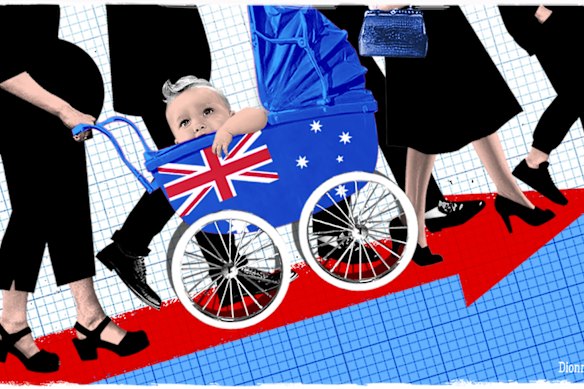
You may have heard that Australia’s birth rate has hit a new low of 1.48. That’s almost one and a half babies per woman, when we need just over two to stop our population from going backwards.
I’ve tried valiantly to do my bit by having two children, a daughter and a son, in 2023 and 2025. Naturally, my primary motivation in doing so was to make a future treasurer’s job easier by bolstering the tax-paying workforce. Of course, this still isn’t enough. To quote Peter Costello’s famous slogan, I’ve had “one for your husband and one for your wife” but not “one for the country.” Yet.
It’ll probably never happen because I’m broke, exhausted and my ovaries are almost at extinction point. Not to mention the fact that my partner has informed me that he’ll be ducking out for the proverbial pack of cigarettes if I even so much as start talking about baby number three.
All this aside, is there a universe in which the government might be able to bribe me, and others like me, into further expanding our families? Everyone has a price. What’s mine? And, with deficits forecast until 2066, can Australia even afford it?
As a country we’ve long been overly generous to those investing in housing stock. What about those of us investing in the foundational bricks and mortar of a stock of Aussie babies?
A couple of weeks ago, following the publication of the latest Intergenerational Report, there was a short-lived flurry of discussion around why the birthrate is so low, who was responsible, and whether fewer babies even matters when we can top up the population via migration.
Cue outcry about inadequate paid parental leave; a price-gouging, profit-driven childcare system not fit for purpose; and men’s failure to step up and do more chores around the house. Oh, and we’ve all become so self-involved and pessimistic about the future that remaining child-free has become an increasingly attractive lifestyle choice. All valid points. All ignore the powerful allure of cold, hard, tax-free cash during a cost of living crisis.
When the latest birthrate stats were released, politicians expressed the usual concern but declined to do anything much about it. As Treasurer Jim Chalmers told the Today show, “I don’t like to tell families what decisions to make about when to start a family; whether to start a family; how many kids to have.” This rhetorical shrugging of the shoulders in the face of what is a monumental catastrophe for the budget, the economy and long-term intergenerational equity is not only defeatist, but a cop-out.
In doing so, Chalmers was quick to rule out any return to the Costello-era baby bonus. By current standards, what was $3000 for every baby in 2002 (worth around $5567 today) seems almost like small change, especially when the cost of raising a child is now estimated to be $17,800 per year. Nevertheless, bribing parents with juicy bundles of cash did induce some to have more kids. Detailed analysis from the e61 Institute shows Australia’s baby bonus “increased monthly births by around 6.5 per cent”.
That’s 1300 additional future taxpayers arriving per month, with an overall cost to the budget of around $86,000 each in today’s dollars. When you consider that the average Australian contributes $2.5 million in taxes across their lifetime, renewing the baby bonus begins to seem like a no-brainer. What’s almost certain, however, is that a lump sum payment of $5k is no longer enough.
The government’s lack of interest probably stems from the fact the longstanding quick fix for plunging birthrates in Australia and across the Western world has been to boost the population via migration. However, the rise of populist anti-immigrant parties such as One Nation, Reform UK, Germany’s AfD and France’s National Rally has meant that the social licence for higher levels of migration is rapidly falling away.
The Labor government is presently trying to pull off the contradictory feat of simultaneously curtailing migration and propping up a faltering economy. GDP has for years been artificially buoyed by an influx of migrants, many of them temporary. The birth rate will become an even more salient challenge as the major parties and One Nation engage in a race to the bottom over who can cut out the greatest number of migrants.
A deeper look at the demographic data during the baby bonus years reveals that the payment’s impact was greatest in increasing the number of families with three or more children, which led to a rise in births of 9 per cent among that group. This was most effective for “older” mothers aged 35-39. (in obstetric terms only – otherwise we’re spring chickens.)
There is a related crisis affecting a very similar cohort: the travails of the first home buyer. The average first home-buying Aussie is now in their mid-30s, the age e61 analysis showed was most susceptible to Howard-Costello baby bonus-related bribery.
This alignment is the result of a housing market stacked against young people colliding with the injustices of women’s biological clock, as mid-to-late 30s is when our fertility generally declines. Many in this cohort will already be parents who are deterred from having another child because they lack that spare bedroom or additional space to put them.
Could we explore linking family size to housing benefits? Rightly or wrongly, Australia became a nation of landlords due to decades of favourable tax policies designed to boost housing investment. What about a nation of larger families? In terms of shaping culture and changing behaviour, negative gearing and the capital gains tax discount was one of the most successful tax policies ever (even if it only benefited Boomers and Gen X at the expense of the rest of us).
Why not allow parents to negatively gear the cost of raising their kids? Now that’s a bribe I could take.
Kylie Moore-Gilbert is a research fellow in Security Studies at Macquarie University and a regular columnist.
The Opinion newsletter is a weekly wrap of views that will challenge, champion and inform your own. Sign up here.
 Kylie Moore-Gilbert is a research fellow in Security Studies at Macquarie University and a regular columnist for The Age and The Sydney Morning Herald. She is the author of The Uncaged Sky: My 804 Days in an Iranian Prison.
From our partners
Disclaimer : This story is auto aggregated by a computer programme and has not been created or edited by DOWNTHENEWS. Publisher: www.smh.com.au