

When sport and sex collide in team environments, masculinity often becomes misogyny, prompting many to ask what lessons football club culture teaches men about how they treat women.
Iwas 18 years old but basically a boy when I played my first senior football match. A stripling with a barely broken voice, I’d just finished year 12, never had a girlfriend, and didn’t know what to expect playing alongside grown men in the southeast suburbs of Melbourne. Yet this sporting season would become, I realise now, 30 years later, my introduction to manhood, or masculinity.
Or rather, to a certain kind of masculinity. It was football-club masculinity – a way of being a man that felt imperious, muscular and unquestioned. It was mine to be had, and that was exciting. Also confusing. Empowering, but at times, disturbing. I remember every formative moment.
I remember playing a wintry away game at a ground nicknamed “The House of Pain”, and elbowing an opponent in front of their hostile, boozy crowd. I took my cue from the lads to antagonise the booing and braying masses further, by grinning and raising two middle fingers. Bottles were thrown at me when we won. It was utterly thrilling.
I remember a pair of brothers on my team who were funny and wild. They were big and had trained as boxers and occasionally – when singing the club song in the rooms after such wins – they would strip naked and dance in the middle, beer and water thrown over them while we all laughed at their floppy, unselfconscious spectacle.
And I remember the time I was showering after a game, in a darkened concrete space, and a veteran midfielder walked in and saw me and my shoulder-length hair from behind. “F— me, mate!” he roared. “You look like a chick from the back. Lucky I didn’t bend you over!”
The biggest moments and revelations that year seemed to come at the fraught intersection of sport and sex, men and women, which was bewildering and awkward in so many ways. None more so than the end-of-season interstate footy trip – a two-day maul of young men rumbling through a state capital, spilling out of taxis and spewing up in gutters.
I remember how we commandeered the streetscape, catcalling girls in cars and girls in bars – girls alone and girls with partners – all of us insulated and emboldened in the anonymity and impunity of our group.
I remember a pub with two topless barmaids, each with a glass jug held up between their breasts, soliciting tips for a performance on a short riser in the front bar with blackened windows.
And I remember getting back to the hotel after 48 hours of binge-drinking, ready to shut my eyes, but they were wide open now, drunk on a cocktail of alcohol and youth and the communal seedy strut of the fellas in full flight. We were flying out the next day, actually, and I had a question about the itinerary, so I jogged down the hall to the room of a genial defender, who opened the door with a benign smile.

doors of an AFL club as a 17-year-old,
I felt a fundamental need to belong,” remembers former West Coast Eagle Mitch Brown.Getty Images
“Yes, mate?” he asked, but I didn’t know what to say – I couldn’t even speak – because beyond him, on a freshly made pair of queen beds, were those same barmaids, rhythmically writhing, contorting their naked bodies and supplicating themselves for half a dozen men. Men I knew to be husbands and fathers. Men who now stood nude, stroking themselves with one hand, in readiness for whatever came next.
Thirty years later, I can see that background scene in cinematic slow motion. But mostly I see the foreground, and the way the player who opened the door looked at me. Unhurried, unembarrassed and untroubled, he waited for me to gather my thoughts as if nothing strange was happening at all – as if happy to chat about the weather, or direct me to the ice machine.
“Never mind,” I said, nodding slowly. “It’s OK.”
It’s not really OK, of course. It’s not new, either. Nor is it confined to any one level of sport. Or to sport itself. And it’s probably not going away soon. The Sydney Swans saga is merely the latest murky instalment in a long history of problematic conduct and questionable decision-making at the troublesome junction of athletes and sex, but it also prompts a question: Does football club culture foster disrespect towards women?
Ask a few dozen people within the world of sport, as Good Weekend did, and you emerge with answers but mostly more questions. Is this societal problem different or worse in sport? How does it manifest? What are the preconditions? Who’s responsible and how does sport respond? Is anything changing? If not, why not – and how can we make that happen?
This story isn’t about the five players at the centre of the aforementioned news, but let’s use that as our starting point. When the story first broke – that a handful of Swans players were being suspended by Sydney for the rest of the season, on the eve of finals, for breaching club behavioural standards – Anna Krien’s heart sank.
“Here we go,” thought the author of the seminal Australian book Night Games: Sex, Power and Sport. “And my heart sunk a little further because one of my sons follows the Swans, doggedly and joyously.”
‘There’s almost this sense of amnesia, like, “Everything’s getting worse.” ’Anna Krien, author of Night Games
Krien was called for comment by people expecting her to rage against new evidence of an old intractable system. The only problem was that Krien saw notable change, mainly in the “genuine, human and empathetic” response of the club (aside from some clumsy language, later corrected). “The Swans immediately said, ‘No, those players aren’t playing any more this season.’ And that is huge. That is absolutely huge. That wouldn’t have happened years ago,” she says. “There’s almost this sense of amnesia, like, ‘Everything’s getting worse.’ ”
Fourteen years ago, when Krien was writing her book – based on the 2012 rape trial of a footballer (who was acquitted) – the first statements made following any “sex scandal” would have smeared the invisible party, but that didn’t happen this time. Nor did retired stars jump online admonishing women for their role in sexual misconduct, as some did during the episode Krien explored.
Yet another alleged girl making alleged allegations after she awoke with an alleged hangover and I take it an alleged guilty conscience, went one tweet from a former footballer at the time. Girls when will you learn, at 3am when you are blind drunk and you decide to go home with a guy it’s not for a Milo. Allegedly.
Such rubbish certainly still exists on social media, but not from public figures this time around – an important temporal distinction when citing degraded digital forums as evidence of cultural rot. “It’s like going to a sewerage farm and saying, ‘I can’t believe it smells like shit,’ ” Krien says. “We’ve got to give it the disdain it deserves.”
Commentators waded in, nervously reflecting on what it meant for Sydney’s flag chances, and were pilloried for dodging the issue. Krien instead saw positive peer pressure. “People were pointing out how these dudes are not legends, how they f—ed up all their mates’ seasons. And that’s such a different stance and position.”
Krien notes that some journalists even showed a kind of “media illiteracy” in asking why organisations hadn’t been more strident in centring the “victims” (who are actually “complainants”) while also demanding an apology (which would prejudice any case). “You’re not really meant to say anything,” says Krien. “That’s the deepest respect you can give to the situation.”
The AFL took its reluctance to speak too far, according to one former AFL associate, who points out that the league released a statement on day one of the saga but it took a week for anyone from headquarters to front the press, reflecting a familiar front-office attitude that can be summarised in one word: entitlement. “While the crowds keep coming and the ratings are good, they think, ‘We’ve got this right,’ ” says the associate. “I understand the importance of club autonomy in these moments, but the AFL is the governing body and their silence is massive. That pause says, ‘If we can keep away from this, we will.’ ”
A former AFL staffer sees it differently. Sean Gorman used to have strident views about the AFL prior to working there as a social policy manager, when leaders routinely reached out in crisis, asking head office for help. “People think the AFL has this magic fairy dust they can sprinkle to solve problems, but they have to step back from these things when they become police matters,” Gorman says. “It might sound like a cop-out, but it’s not. It’s a conundrum within a paradox within an irony.”
The best way Mitch Brown can describe the experience of being part of an AFL team – as he was with the West Coast Eagles for 10 years – is to liken it to the clubhouse from the kids’ movie The Little Rascals. “No girls allowed!” says Brown, who came out as bisexual in 2025, a decade after retiring. “It’s like, ‘This is our last space we can keep as our own and not have women or gender-diverse people pulling us up all the time,’ because that’s exhausting for a lot of these men, who want to remain at the top of the tree.”
They’ve felt that way since they were feted as teenagers, after all, many from single-sex private schools and coached by former players who’ve never left the system. “There’s this very closed-off mindset and world view,” says Brown, and then you become a professional sportsman, an alpha, “a marketing tool for the patriarchy”, there to reinforce the standard to other men.
“Here’s how it works,” explains Brown. “When I first walked in through the doors of an AFL club as a 17-year-old, I felt a fundamental need to belong, and that want to be ‘one of the boys’ and accepted by the gang outweighs any moral compass or sense of respect for yourself or others.” Suddenly, he was inside a homogenous group seven days a week. Training and meetings, games and recovery, lunches and dinners, camps and trips.
At the start of the year there was his initiation, which involved being handcuffed to an older player and drinking whatever they drank. At the end of the year, there was a party where players were outnumbered by sex workers and strippers and Brown was told to lay down on the ground for lap dances with everyone watching. “And you don’t question it,” says Brown. “You just think, ‘We’re rock stars, this is how we live.’ That cultural wallpaper is so much stronger than anyone sitting you down, going, ‘Hey Mitch, this is how we disrespect women.’ ”
It’s also a space that brooks no dissent. Break ranks and you’re violating a code and potentially committing career suicide. Brown saw guys try to push back – usually fringe players. “Then the types of conversations you’d have about those people tells you, ‘Don’t be that f—ing person,’ ” says Brown. “That’s how these cultures maintain themselves.”
Perhaps the more useful question, in this moment, is whether or not we’re OK with what sporting culture is right now. That’s what Rana Hussain – a specialist communicator on matters of inclusion who has worked with AFL clubs as well as Basketball Australia and Cricket Australia – says we need to ask. Which elements are helpful, and which are problematic? Right down to the language we use to describe vaunted stars, who are “brutal” and “tough”, “uncompromising” and “dangerous”. Risk-takers. Boundary-pushers. “What does that project about masculinity?” she says. “There’s a lot in there that says, ‘Maybe this culture’s not that great for men’ ”
I find myself thinking of an old skit from the comedy show Inside Amy Schumer – a parody of Friday Night Lights, the TV show based on my favourite book. In the sketch, a team of baffled high school gridiron players can’t understand the dictum of their new coach: “Clear eyes, full hearts, don’t rape”. (Can we rape at away games? they ask, genuinely confused. What if it’s Halloween and she’s dressed like a sexy cat?)
I remember feeling annoyed over that depiction of boys playing sport. Maybe I was just uncomfortable with the telling punchline – a pre-game speech from the coach explaining how football isn’t about rape. “It’s about violently dominating anyone that stands between you and what you want!” he bellows, in a thick Texan drawl. “You’ve got to get yourself into the mindset that you are gods, and you are entitled to this! That other team, they ain’t just gonna lay down and give it to you. You gotta go out there and take it!”
The above is only the barest exaggeration of the motivational language used in every team I played with since I was 13 years old. What I’m curious about, however, is if that kind of language is used by women and girls in their huddles. Dr Adele Pavlidis researches sport and gender equity as director of the Griffith Centre for Social and Cultural Research at Griffith University, and also just played her first season of masters football for the Surfers Paradise Demons. (The 46-year-old academic even got a few votes in the best and fairest.)
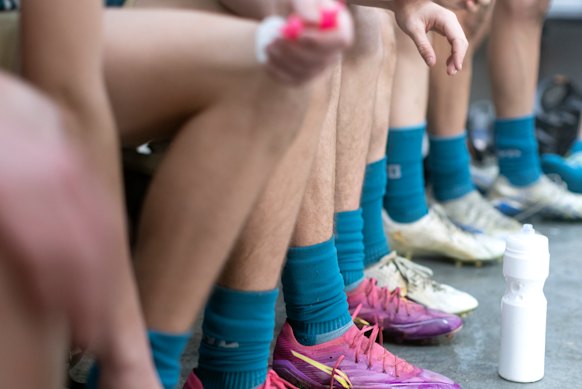
Pavlidis was most surprised by the end-of-season trip. There was too much drinking for her taste during their few nights at Mount Tamborine on the Gold Coast hinterland, but everything else – from an arvo on a high-ropes zipline course to team-building exercises run by facilitators – felt transformative.
“Lots of hugs and caring and sharing around the bonfire. Fights and disagreements, but no disrespect,” says Pavlidis. “There were thoughts spoken about the players who couldn’t be there, and an activity where we had a guessing competition based on photos we all shared of us as little girls. I would never claim that it’s some utopian sports space – it’s not going to be all love and candy – but there is this vulnerability that men are maybe not willing or able to express, whereas women have grown up knowing they need to lean on one another in that way.”
Men lean on and learn from one another in different ways. Luke Bateman experienced as much during his NRL career – which began with the Canberra Raiders in 2013 – from the abnormal wealth and privilege afforded to him as a teenager, to all those hours flanked by older, married mentors for whom adultery wasn’t surreptitious but celebrated. As his career progressed it felt as though any man who wanted to cheat was enabled by a culture of silence, from team leaders and coaches to the administration itself.
“If something gets out and becomes public, the wagons circle and everyone uses their connections and power to ensure image and brand and people are shielded from consequences,” says Bateman. “Because if those individuals suffer any consequences, there would have to be ownership around the culture itself, and then we would all be guilty.”
‘You’re not sitting there thinking, “This bloke is a terrible, disgusting person.” You think, “This bloke is a legend.” ’Luke Bateman, former NRL player
Stories about famous philandering players and coaches in sport have always swirled in public spaces, becoming a kind of minimised common knowledge, but it starts with tacit endorsement inside club walls. “You’re not sitting there thinking, ‘This bloke is a terrible, disgusting person.’ You think, ‘This bloke is a legend. How good’s that – what a f—ing champion,’ ” Bateman says. “And that goes to so many aspects of the culture. Drinking. Drug-taking.”
Blokes who went on a bender for three days without sleeping were treated with reverence, he says, while blokes who cheated with three women in one night were treated with “glorification, not condemnation”. Bateman himself had three partners between the ages of 16 and 24, and cheated on every one of them because that was his privilege – because that’s what elite footy players get to do. “You get given this whole new level of understanding: ‘The rules don’t apply to us,’ ” he says. “But those older guys were failed, too. Because they were the 18-year-olds once.”
Alcohol was always the accelerant. “What is underlying or unspoken gets completely let off the chain,” Bateman says. “You train and play and perform and you have these standards, and then when you let your hair down, it’s understood that it’s time to do the wrong thing. And it’s deeply embedded. It’s a rite. Game over, esky comes out full of beers, and you get the message: Fit in or f— off.”
Women, says Bateman, were seen as objects. Less than or second to men. Bateman is now a hugely popular fantasy bookfluencer, and puts it in literary terms: women were the dehumanised side characters to the triumphant male protagonists of every narrative. Inside the club, they were strappers – outside, they were strippers. “Always it was, ‘How is this woman going to be of service to me? What is she doing for me?’ ”
He saw parallels with homophobia, which showed up in hazing rites with homosexual undertones, like the end-of-season nudie run. If you didn’t score a try all year, you had to strip naked, then run in front of the boys, everyone slapping your arse and balls. Bateman scored only one try in his career, so he ran the gauntlet often. “It always struck me as such a paradox, that the way men created intimacy with one another was through homosexual shaming rituals,” he says. “We really desire connection and vulnerability, but the only way we can do it is if we’re also degrading someone? Really, the first person who’s disrespected in all of this are men themselves.”
Suspecting that such deeply weird business is true all throughout clubland, I asked a handful of friends for their most notable uncomfortable moments. Within minutes I had an array of replies, as if every guy has similar memories locked away in high-definition clarity.
Inside a suburban soccer club, a boy wearing tighty-whiteys was spotted one day with a slight erection – pitching an innocent half-tent – and was whipped with towels as a joke. All in good fun. Then he was held, arms pinned, so that the whipping could continue without any self-defence until it bloodied the middle of his Y-fronts.
At a cricket club, a scrap of carpet was displayed on a wall in the rooms, because it was decorated with an infamous semen stain. Sex workers had been invited there after a grand final victory, and a much-loved player had ejaculated on the carpet during the bacchanal. Apparently, that deserved commemoration.
Inside a basketball team, the young playing group agreed that every sexual conquest that season be proven with a pair of stolen underwear, pinned to the locker room wall. Recently worn panties were ideal, because a pair only counted after everyone had sniffed.
This is just a sample.
“Have you heard the phrase, ‘Uninitiated boys will burn down the village just to feel the heat’?” asks Hunter Johnson, founder of The Man Cave. There is an inherent desire in boys to be tempted and tested, Johnson explains, and at the end of these rites of passage, they develop into the next version of themselves. Problems arise when such rites are distorted, often by men who’ve gone through the same humiliation ritual. “It’s actually quite sad,” Johnson adds. “How did we get to this place of embarrassing others in order to feel hierarchy and worth?”
Is change possible? The answer depends on perspective. Have you heard of “pluralistic ignorance”? Basically, people over- or under-estimate the mood of any room, depending on what stereotypes tell them about an issue. This leads to the “perception gap”, where someone sits in a corner – maybe a young soccer player in a locker room – and he abhors the language used by a teammate about a woman they both know, but believes that 95 per cent of guys in the room are completely fine with describing her as a whore.
That’s the actual scene that confronted men’s mental health expert Dr Zac Seidler when he was 19. He spoke up anyway – “Man, you can’t talk about women like that” – and everyone laughed at him for being a killjoy. Years later, friends who were there told him they agreed, but couldn’t speak up. It felt too risky, yet this is exactly the risk men need to take. “The best thing to do – the hard thing to do,” says Seidler, “is grow a f—ing spine.”
Because sometimes, it works. Speaking up was the sanitiser for senator David Pocock, back in his national rugby union playing days, albeit on the issue of homophobia, famously calling it out on the field but also during influential conversations with Brumbies teammates. They banded together and became an island. “The playing group made a really conscious decision to talk about the language used in and around the team, the impact it was having, and what we wanted to do,” Pocock says. “As men, we’re often not very good at talking about deeper things and feelings, but it made us a better team, too.”
Johnson, who has privately mentored several high-profile athletes, says there are clear steps. First, speak confidentially with the women of the organisation, then the younger boys and junior staff. Find out what actually happens – and doesn’t – when lines are crossed. Catered interventions should pose practical questions. “What do you do if you see a mate ignoring someone’s personal boundaries? What do you do if you see something derogatory in a group chat?” asks Johnson. “Behaviour change has a long tail, but it has to begin with an honest picture of the culture.”
There needs to be room for messy conversations, too, because men are wary of cancellation for politically incorrect sentiments. They constantly consult Patty Kinnersly, CEO of Our Watch, with that exact concern. “You have so many men saying, ‘I get nervous about speaking in public because I might get a word wrong,’ ” says Kinnersly, who is also a board member at the Carlton Football Club. “We don’t need to give sport a free run, but if we’re asking men to come on this journey, we need to work with their intent.”
‘Behaviour change has a long tail, but it has to begin with an honest picture of the culture.’Hunter Johnson, The Man Cave
Others see change as something that can only begin higher up. Leading ethicist Dr Peter Collins has worked on integrity issues with multiple AFL clubs, along with rugby and swimming at the national level, and corporate boards from ANZ to BHP. He likes to tackle the head of any “collusive beast”, which is why, when he consulted with Cricket Australia, he put the onus for ‘Sandpapergate’ on everyone from the CEO to the chair. “Because they set the targets, and the tone,” he explains. “You can’t put it all on the players. A failure of culture is a failure of leadership.”
Practically, his suggested changes sound dry. Beef up codes of conduct. Distribute anonymous surveys. Institute mandatory reporting. None sounds more sober than accountability and governance, but that’s his big one. “When a complaint happens, it needs to be registered, recorded and noted in the board papers,” he says. “Deal with any breaches through fully independent investigations – with published findings – because only then will women feel free to assert themselves.”
Kate Jenkins, chair of the Australian Sports Commission and former federal sex discrimination commissioner, says systemic inequality is the first thing to address, whether you’re in mining or defence, parliament or police. And the best strategies target where we “live, work, play and learn”, making sport one of the most important vehicles anywhere for improving equity everywhere. “If sport can improve gender equality, then it has an oversized impact,” she says, “because it reaches into every home.”
We watch and deify athletes, which is part of the problem – and its solution. Fans often make incredible allowances for player misdemeanours, compromising beliefs for the payoff of belonging, but clubs should also note that women are less likely to perform moral gymnastics when scandals break. Deakin University fan culture expert Dr Kasey Symons points out countless testimonies from female fans who abandoned their clubs for transgressions – both historic and recent – that they cannot forgive, from the North Melbourne women put off by a former star player accused of violence against women, to the Hawthorn supporters who stopped cheering the brown and yellow after the club’s stance on the same-sex marriage plebiscite.
“They were actually lost to footy,” says Symons. “And it wasn’t until the AFLW came around that they felt like they belonged again. Some of them even changed teams.” Switching allegiance is breaking the golden rule of fandom, but women will do it if necessary. “What I usually say is that female sporting cultures are ‘come as you are’ environments, whereas male sporting cultures are ‘come as you should be’ environments,” says Symons. “Women’s sports were mostly born out of exclusion, so they went away and created these spaces where everyone was welcome.”
That rings true for Chantella Perera, a sports marketing executive and president of advocacy body Women Sport Australia. She’s also a former WNBL player who then played with women’s football teams at Hawthorn and West Coast, helping shape their inaugural seasons. Perera says those playing groups were acutely aware of the need to set the right tone. That blank canvas was a gift – for talking about what they wanted to do beyond the field, in the community. “We all felt a duty to do that on behalf of the code, for young girls and young boys, always putting our best foot forward,” says Perera. “We felt like we had an opportunity to reshape a traditional culture in football.”
That same clean-slate opportunity isn’t often open to men, but both the NRL and AFL have new clubs coming online soon, including the Tasmania Devils, led by CEO Brendon Gale. Gale previously led the Richmond Football Club (founded in 1897), where it was pointed out to him that for more than 100 years in Australia, Aussie rules had been played by men, coached by men, managed by men, umpired by men, and its stories told by men. “That’s the environment we’ve been brought up in, and women tend to be objectified in those environments more than other environments,” says Gale. “I’ve been in that environment, so I’m not holier-than-thou.”
With the Devils, there’s an opening to create a new space – one club, two teams – starting with a 9000-square-metre facility built with an equity mindset from the foundation stone up. By contrast, back at Tigerland, Gale remembers trying to retrofit women into an existing men’s club, whether installing power sockets for hair dryers or replacing urinals with stalls. “And I reckon that could have an impact on how women see themselves in those places,” he says. “They might be looking around wondering, ‘Am I really welcome, or am I tiptoeing around the joint?’ ”
Looking back, that formative footy season when I was 18 wasn’t all bad. Much of it was brilliant. And this, too, is worth remembering.
I remember a pre-season summer grind like no other, running 100-metre hill sprints over crunching yellow grass, pushing myself to meet the speed of more seasoned men. I vomited, then gulped cool water from a shared plastic bottle, then ran some more. Sounds awful? You feel alive in such moments.
We did a pub run another night, jogging from one local to the next, a cold beer skolled after each dogtrot, filled with sidebumps and elbows and banter. Juvenile? When you fall behind and someone yells, “As a group, lads!“, and two guys help you rejoin the pack, you feel an instant, grateful kinship.
They paid me $40 a game in tiny yellow envelopes, a pittance but a source of self-worth. I blew the money on jugs in the clubrooms, before we all hit the city together. From midnight every Saturday until daybreak, I got my first glimpse into the lives of adult males, like the captain, who knew I was studying psychology at university and called me “professor”. And the cop, who seemed like an actuary during the week, a warrior on the weekend – and a madman after too many bourbon-and-Cokes. He took me under his wing and praised my footy – “Sorry if I’m pissing in your pocket!” – and I’d never heard that phrase but I loved it, along with the sense that he saw me as a peer.
After training on Tuesday nights in the deep Victorian winter, the club would put on a pot of chunky soup and buttered bread, and we would sit together, still dewy and flecked with grass and mud, slurping and munching before traipsing home. Free hot soup on a cold night – my mum thought that was the best thing ever.
Outside of the football clubs in my life, male tears have had no audience.
I remember a feeling of community brotherhood, too – from the elderly bloke who noticed my headphones before every match and told me I needed to get some Smoke on the Water in there, to the developmentally disabled man with keys jangling off his acid-wash jeans, who watched every training session. He used to get kitted out in playing gear and run laps alone, and the boys would give him a cheer between drills, just as he cheered for us every Saturday. Where else would he go for such tangible belonging?
There are countless po-faced commentators who would tell you that footy clubs are nothing more than hotbeds of toxic masculinity. But they’re also a place for different men – chippies and lawyers and teenage students – to mix and learn. I’ve heard them share painful stories about mates who died, mums with cancer and kids facing bullies, and repeatedly seen them weep. Further to that point, and this is a point worth noting, I have never – ever – seen a man weep in person with other men outside that setting. Outside the football clubs in my life, male tears have had no audience.
The wrong lessons from sport have a way of persisting, though, often well into the future. I’d be lying if I didn’t admit that in the years since I stopped playing, that I joined the raucous celebration of female bodies in strip clubs, that I enjoyed lap-dances at bucks’ parties, and have been guilty on summer days of a drifting male gaze. It was probably most apparent to me 10 years ago, when a mate from overseas was visiting.
He was a guy I had known when we were younger. When we were loose. I took him to a game at the MCG, and beforehand, to the Royal Hotel on Punt Road – one of the few remaining pubs with topless barmaids. We drank our beers, served up with an attractive smile. Then those barmaids began soliciting tips – as they’d done all those years earlier on that footy trip when I was 18 – carrying a plastic jug between their breasts, hoping for notes and coins to be dropped inside. Men leered and smirked, and there was something volatile in the air, something feral, something off. I was in the wrong place. I try not to be any more.
Mitch Brown has his own fond memories from football, too, including those times at 5pm on a Saturday in the rooms after a win. You’re exhausted, and you’ve done it together, and the water from a hot shower stings the grass burns all over you, and the bruise on your elbow is wrapped in ice. That winner’s ache was glorious.
The problem, he says, is that any fond memories from the intersection of gender and footy at that time were, in hindsight, just normal, everyday acts of
kindness and respect. The bare minimum. Baseline expectations. “You do the littlest thing and it’s celebrated as a class act,” he says, “either because it’s rare and unique, or the bar is so low.”
The moment he prefers to remember is a reminder – from a conference in Canberra this winter, when he heard Adam Goodes speak. A decade after the champion was shamefully booed out of football, Goodes told the crowd that, sadly, the situation remains the same.
“Will I be sitting here in 10 years’ time, and nothing’s changed with respect to women?” Brown asks. He hopes not, because there’s too much at stake, not just for him or the women in his life but his two little boys. It’s just too important – for everyone – not to act. “We can’t be another generation that lets this pass.”
1800 RESPECT: 1800 737 732; MensLine: 1300 789 978
Read more from Konrad Marshall in Good Weekend magazine:
Get the best of Good Weekend delivered to your inbox every Saturday morning. Sign up for our newsletter.
Disclaimer : This story is auto aggregated by a computer programme and has not been created or edited by DOWNTHENEWS. Publisher: www.smh.com.au



