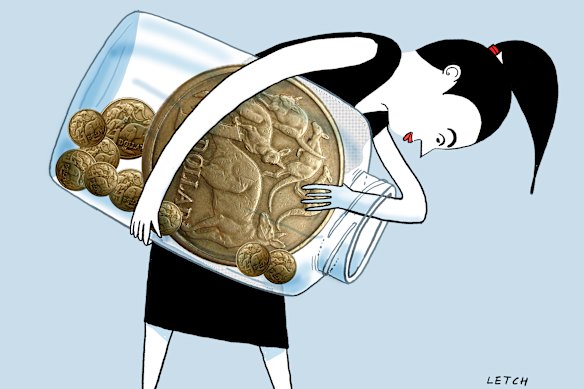
My children, aged 10 and 13, would like to start investing a modest amount in shares. They will have about $4000 to start and may then top up their investment once or twice a year with birthday, Christmas and pocket money. Could you please outline the best options in terms of simplicity and tax treatment, both now and into the future? I’m not sure whether the shares should be held in my name or theirs. My gross income is about $104,000 and my husband’s is $182,700.
We don’t want to spend too much time establishing or maintaining the investment – we’re looking for a “set and forget” approach – but we do want to be able to easily see fees, tax, performance (gains or losses) and overall returns. I’ve heard that platforms such as CommSec and Vanguard are fairly simple.
It’s terrific that your children want to start investing while they’re still so young. Time is the greatest asset an investor has, and starting early can make an enormous difference to the wealth they build over their lifetime.
One option is to buy shares or exchange-traded funds (ETFs) through a platform such as CommSec or Vanguard. But before you do that, think carefully about who should own the investment.
If the shares are held in a child’s name, special tax rules apply and investment income above modest limits is generally taxed at penalty rates. If they’re held in a parent’s name, those rules don’t apply, but all income and capital gains are taxed at the parent’s marginal tax rate.
There is another option that deserves serious consideration: an investment bond. It’s one of the simplest long-term investments available and ideal for a “set and forget” strategy.
The recent changes rushed through Parliament have changed the rules dramatically.
An investment bond lets you invest in a range of professionally managed funds while the provider pays the tax internally. That means there’s generally no annual tax return paperwork for you. If you keep the bond for at least 10 years and meet the contribution rules, the proceeds are generally tax-paid when you withdraw them. You can add to the investment each year, making it perfect for birthday and Christmas gifts.
Another major advantage is control. You keep ownership of the bond while nominating your child as the beneficiary. That means you decide when they’re mature enough to receive the payment, rather than handing control to them automatically when they reach adulthood.
For families looking for a simple, tax-effective way to build wealth for children or grandchildren, investment bonds are well worth considering. They won’t suit every situation, so it’s worth getting personal financial advice before deciding on the best structure for your family.
My father has a share portfolio that originally cost $300,000 and is now worth $500,000. He dies and leaves it to me. If I later leave the portfolio to my daughter in my will, will there be any capital gains tax payable at that time? If not, does she inherit my father’s original cost base?
Sadly, no. The recent changes rushed through Parliament have changed the rules dramatically – a death after July 1, 2027, will now trigger a realisation event on any pre-July 1 capital gains.
Tax will have to be paid on the capital gain accrued up to June 30, 2027 in the deceased’s date-of-death tax return. The beneficiary then takes the market value at June 30 as their cost base.
So, provided your father dies before July 1, 2027, no capital gains tax will be payable on his death, and you will inherit his original cost base of $300,000. But if you then die after July 1, 2027, your estate will have to pay tax on the difference between that $300,000 cost base and the market value at June 30, 2027.
Your daughter will inherit a cost base equal to the market value at June 30, 2027, but unless there are other assets in the estate, some of those shares are likely to have to be sold to pay the tax. That sale will also trigger a separate capital gains tax event on any gain that accrued after July 1, 2027.
I bought a property for $500,000 ten years ago, and its value on June 30, 2027, is $900,000. I sell it two years later for $800,000. Is the $300,000 gain simply treated under the 50 per cent capital gains tax discount, or is there some kind of apportionment?
Yes. The post-2027 loss of $100,000 reduces the pre-2027 gain of $400,000. Provided there is nothing else to consider, there is a $300,000 capital gain entitled to the 50 per cent discount. The post-2027 loss reduces the pre-2027 gain before the discount is applied.
I am the enduring power of attorney for my 91-year-old aunt, who still has good mental capacity and is actively involved in decisions about her finances. She lives in an Ozcare aged care facility and receives income from two indexed superannuation annuities – her own and one from her late husband. Because of this income, she has paid about $23,000 a year in income tax over the past two financial years. She is expected to reach the lifetime means-tested care fee cap next April, after which more of her income will remain in her account.
She would like to gift $30,000 in cash to family. I know that age pension recipients are generally limited by the gifting rules to $10,000 a year and $30,000 over five years before the deprivation rules apply. However, she is not receiving the age pension. Is she free to gift the full $30,000 without those restrictions? Also, would making the gift reduce the amount of income tax she pays each year?
There is no gift tax in Australia, so anybody is free to give away as much money as they wish. The only people who may be affected are those receiving some form of income support.
Whether giving away $30,000 would reduce her income tax depends on the assets she is disposing of and the income they are producing. This is something you should discuss with your accountant.
Noel Whittaker is author of Retirement Made Simple and other books on personal finance. Questions to: noel@noelwhittaker.com.au
- Advice given in this article is general in nature and is not intended to influence readers’ decisions about investing or financial products. They should always seek their own professional advice that takes into account their own personal circumstances before making any financial decisions.
Expert tips on how to save, invest and make the most of your money delivered to your inbox every Sunday. Sign up for our Real Money newsletter.
 Noel Whittaker, AM, is the author of Making Money Made Simple and numerous other books on personal finance.Connect via X or email.
From our partners
Disclaimer : This story is auto aggregated by a computer programme and has not been created or edited by DOWNTHENEWS. Publisher: www.smh.com.au