
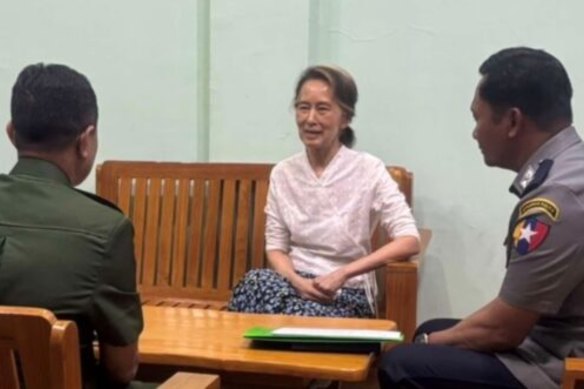

Singapore: Myanmar’s military has moved Aung San Suu Kyi, the nation’s most popular politician, from jail to home detention, marking the most significant shift in the regime’s strategy towards opponents since it rolled the tanks over her democratically elected government in the 2021 coup.
It may also be the beginning of a process leading to her full release.
What to make of this? The starting point is to note that in more than five years of brutal repression, civil war and economic vandalism, coup leader Min Aung Hlaing – a military dictator who now calls himself president after faux elections this year – has shown no liberalising tendencies.
It would seem unlikely the leopard is changing his spots. What he does crave, though, is credibility and, in turn, the easing of sanctions, access to finance and the normalisation of international relations.
Myanmar’s economy, growing at more than 6 per cent in the year before the coup, is now utterly cooked. Regime blundering and conflicts with pro-democracy forces and ethnic rebel groups has triggered a prolonged recession, exacerbated by the effective closure of the Strait of Hormuz in the Middle East.
As Min Aung Hlaing knows, a simple way to tap international goodwill without giving too much ground to opponents is through its management of Suu Kyi, a Nobel laureate.
The military has done it before.
In 2010, Min Aung Hlaing was a joint chief of staff when then-leader Thein Sein released her from a previous period of house arrest, a far more significant move than the one announced this week. It won the regime backslapping and a visit even from Hillary Clinton, the first by a US secretary of state in more than 50 years.
“President Thein Sein has taken the first steps toward a long-awaited opening,” Clinton told a press conference, referencing Suu Kyi’s release and the partial easing of restrictions on civil society. There seemed hope again for resource-rich Myanmar. Foreign investment surged.
The freed Suu Kyi went on to win the 2015 elections, the only fair vote the military actually recognised since the first post-independence coup in 1962.
When her National League for Democracy again trounced the military proxy in 2020, it was too much for the generals to bear, sanctions be damned.
They had their teeth on the throat of democracy all along.
Suu Kyi, the daughter of assassinated independence hero Aung San, was thrown into jail. So were colleagues and supporters. There she remained, her health and whereabouts unknown. The last time she was seen in semi-public was in May 2021 at the start of trials against her, widely regarded as shams. She is now 80 years old.
To prove she has gone into home detention, state media released a photo allegedly showing her “conversing with relevant officials during the amnesty process”. Her lawyers told Reuters she remains in the capital Naypyidaw and that they are allowed to meet with her for the first time in years on Sunday.
Suu Kyi’s move out of jail has not come from out of the blue. Her former president Win Myint (Suu Kyi officially held the title of “state counsellor”) was pardoned and freed last month. Soon after, Thai Foreign Minister Sihasak Phuangketkeow met Min Aung Hlaing and said the president was signalling “good things” for her.
Sihasak added that Thailand wished to bring Myanmar back into the Association of Southeast Asian Nations (ASEAN), a regional bloc that has excluded the generals’ participation since the coup. His trip to Myanmar and comments show at least some democracies are prepared to promote the post-election regime.
Late last month, Chinese Foreign Minister Wang Yi also travelled to Myanmar as part of a regional tour. China wants a pliant and stable government in Myanmar. Not only do they share a border, Myanmar holds China’s only viable direct access to the Indian Ocean.
Thousands of political prisoners remain in Myanmar’s brutal jail network, and most opposition is banned. The military continues to wage wars against those who defy it, killing civilians along the way.
And while the apparent change in Suu Kyi’s status is welcome, the fact is that she remains detained.
The government’s English-language mouthpiece, The Global New Light of Myanmar, declared she had been moved out of “humanitarian concerns as well as the state’s benevolence and goodwill”.
The “state” has repeatedly shown it does not care much for benevolence. It does, however, care for good PR.
Get a note directly from our foreign correspondents on what’s making headlines around the world. Sign up for our weekly What in the World newsletter.

From our partners
Disclaimer : This story is auto aggregated by a computer programme and has not been created or edited by DOWNTHENEWS. Publisher: www.smh.com.au


