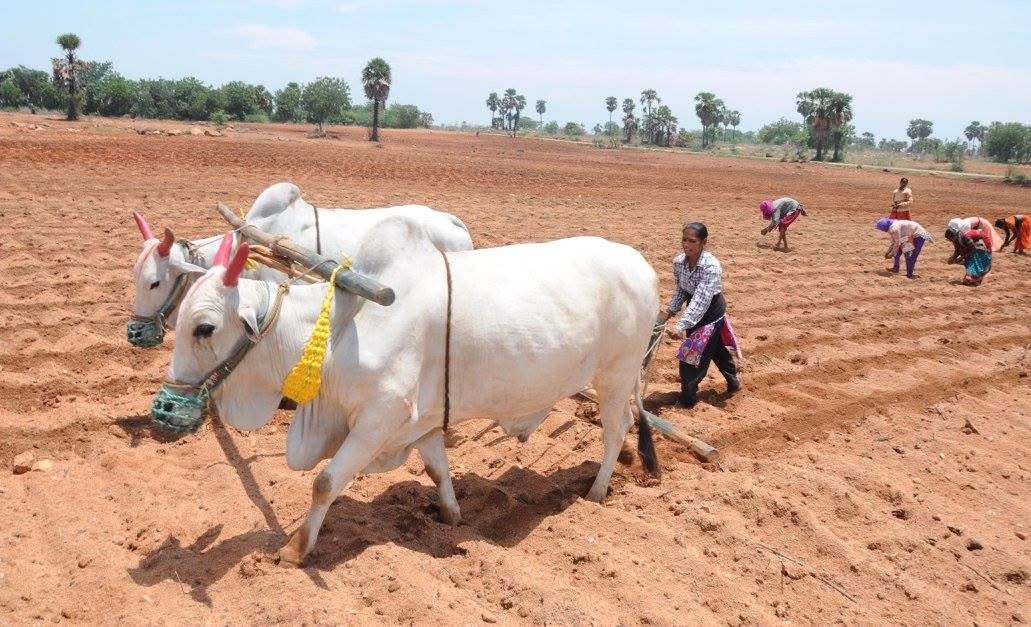
Nalgonda: Farmers in Nalgonda district have taken up cultivation in less than half of the normal area for the monsoon season, citing unfavourable weather, lack of irrigation and declining groundwater levels. Against a normal cultivated area of 11,23,750 acres, sowing has been reported in less than six lakh acres as of the first week of July. Farmers have taken up cultivation on only 25 to 30 per cent of their land holdings due to inadequate rainfall, limited irrigation and depletion of the water table.
As per the agriculture department’s action plan, paddy was expected to be cultivated in 5,35,000 acres and cotton in 6,30,000 acres. However, paddy transplantation has been taken up in only 10,000 acres. No paddy cultivation has been reported in the area under irrigation of the Nagarjunasagar left canal. Farmers have raised nurseries for paddy covering about three lakh acres and completed field preparation, but the actual extent of transplantation will depend on rainfall over the next 15 days.
Cotton has been sown in about 5,57,000 acres, but crop survival will depend on rainfall over the next one-and-a-half months. Apart from red gram, farmers have not shifted to alternative crops despite advisories from the agriculture department.
The declining water level in the Nagarjunasagar Project has affected irrigation prospects for about 2.5 lakh acres under its ayacut. The reservoir level has fallen to 513 feet, close to the dead storage level. Groundwater levels have also declined by an average of 7.33 metres, reducing the viability of borewell irrigation.
Farmer Kambala Somaiah said he cultivated only half an acre out of his three-acre holding due to insufficient borewell water. “Water from his borewell was flowing at barely the pressure of a household tap, making it inadequate for irrigation,” he said. He added that even the standing crop depends on groundwater availability.
Another farmer, N. Yadagiri, who sowed cotton in one-and-a-half acres, said germination had occurred but survival would depend on rainfall in the next 15 days.
District agriculture officer V. Vinod Kumar said rainfall patterns remained uneven. “Technically, a day is classified as a rainy day when at least 2.5 mm of rainfall is recorded,” he said. He added that light showers had supported cotton crop survival but had not improved groundwater levels. With no significant rainfall forecast for the next 45 days, prospects for crop survival remain uncertain.
He advised farmers to shift to alternative crops such as red gram, castor, sunflower and green gram, and said awareness programmes would be conducted at the village level.
Disclaimer : This story is auto aggregated by a computer programme and has not been created or edited by DOWNTHENEWS. Publisher: deccanchronicle.com