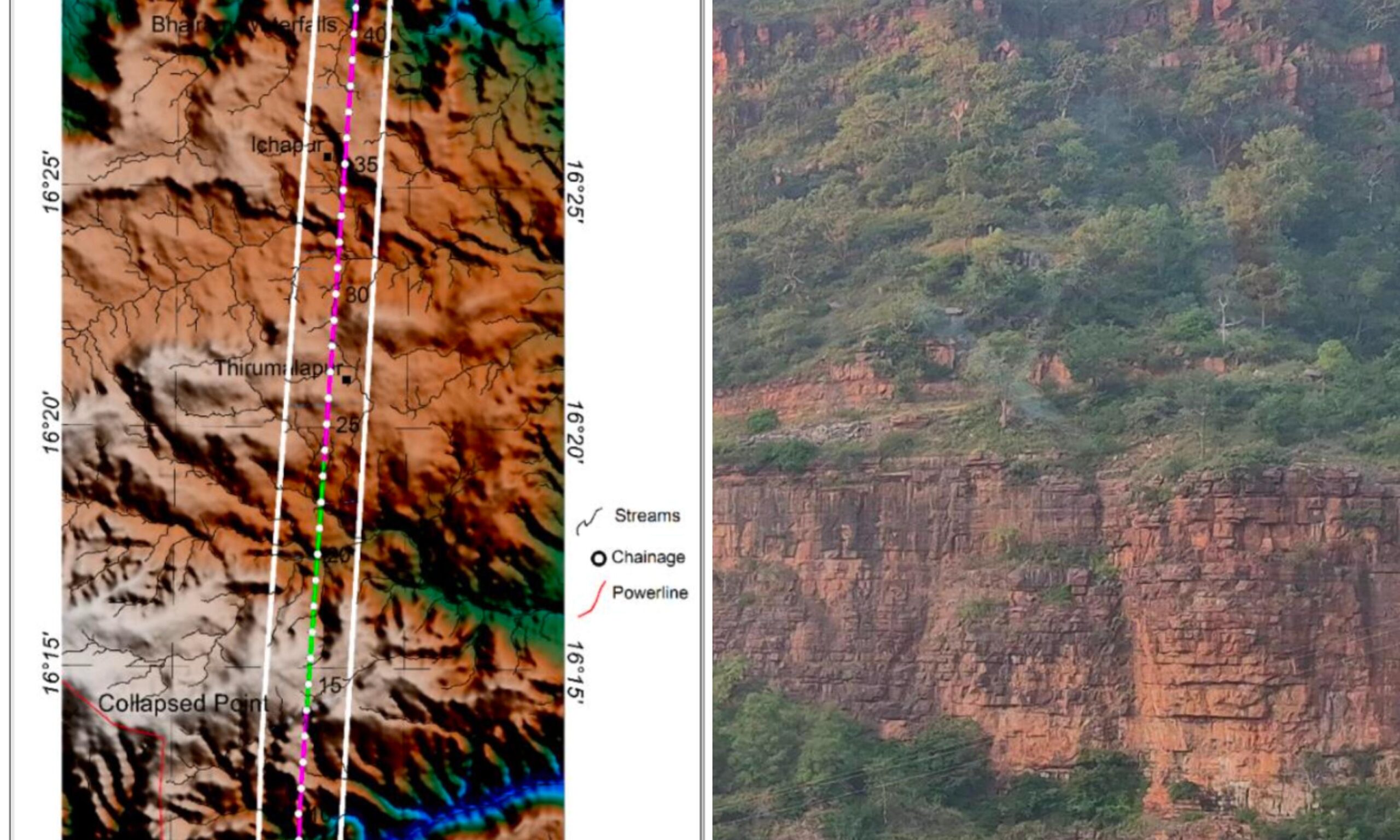
Hyderabad: Work at the SLBC tunnel, progressing slowly but steadily from both the inlet and outlet ends, still faces some serious challenges, especially in at least four locations along the alignment where detailed geological studies have found some structural features that begin on the surface of the Nallamala hills and go to the tunnel depth and deeper into the ground.
A detailed study by the CSIR-National Geophysical Research Institute (NGRI) using electromagnetic survey earlier this year, has identified weak, fractured zones in the rock structure in addition to areas where the rock types also change. The study confirmed that the point where the tunnel collapsed in February 2025 at the 13.95-km point in the inlet section under Eagalpenta of Nagarkurnool district, was a structurally weakened zone. The accident led to the death of eight workers.
In what could be a possible indication of why the tunnel workers went ahead with their work in a structurally weak zone where the collapse occurred, the NGRI study found a similar fractured zone at the 11-km point which was crossed by the tunnelling team without any problems.
The study was submitted to the state government a few days ago, and its findings will guide all the work from now on, in both the inlet and outlet sections of the tunnel. While the inlet section starts near the Krishna river not far from the Srisailam dam, the outlet section starts from near the Taldevarapally in Champapet mandal of Nalgonda district.
According to the NGRI report, further weak zones were identified at the 15 km and 17 km points from the inlet end, while an entire kilometre-long section along the alignment, from 19 to 20 km, was also found to be a weak zone. This was found to be on account of two factors, the perennial Nallavagu stream that flows on the surface with a lot of moisture seeping down to the tunnel level at 250 metres below mean sea level and further down, and weaker rock structures. The average depth of the tunnel from the surface is around 450 metres.
“Since we found the weak zones to be a bit wide in some of these sections, the advice was that the bypass crossing the collapsed zone be dug on the east side of the tunnel alignment, the side away from the river side. Another area of concern could be where the weaker quartzite section meets the stronger granite at the 21 km point,” a NGRI scientist, who is part of the study group, told Deccan Chronicle.
“But the good news is that instead of blind execution, excavation now will be scientifically guides,” the NGRI scientist said.
Disclaimer : This story is auto aggregated by a computer programme and has not been created or edited by DOWNTHENEWS. Publisher: deccanchronicle.com