Somewhere far into interstellar space, NASA’s Voyager 1 space probe is about to reach a lonely milestone.
After rewriting our understanding of the solar system nearly 50 years ago, it already became the most distant human-made object in 1998 as it flew away from Earth at 38,000 miles per hour.
Now, it will break another distance record, reaching one light-day away: At about 16 billion miles, it will take a full day for light to travel between the spacecraft and its home planet. Light, the fastest-moving particle in the universe, is what scientists use to communicate with the probe. NASA expects the record to be broken around 2:16 a.m. Wednesday.
Voyager 1 and its trailing twin Voyager 2 were designed and built by NASA’s Jet Propulsion Laboratory in La Cañada Flintridge. To this day, a small flight control team at the lab monitors the probes and sends occasional commands.
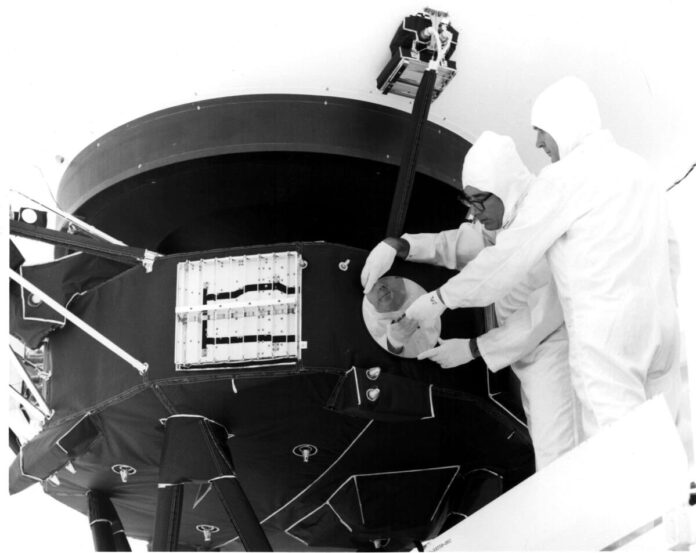
Engineers secure the cover over the Voyager 1 Golden Record in 1977.
(NASA/JPL-Caltech)
Wednesday morning’s record is a meaningful marker for Alan Cummings, a Caltech senior research scientist who worked on the mission as far back as the Nixon administration, years before its launch.
“It’s not a scientific milestone, but it is an engineering milestone,” he said, “a tribute to the engineers who designed something that can last that long.” Generations of engineers, he said, have kept it going.
The Voyagers explored Jupiter and Saturn in greater detail than ever before. Voyager 2 is the only spacecraft to have visited Uranus and Neptune, the most distant planets in our system. The images and data the two sent back depicted worlds much more vibrant and dynamic than scientists expected.
“I looked up at our own moon, and I was thinking in my mind that they would all look like that — all the moons of the other planets,” Cummings said. “The fact they weren’t and they were so diverse was just astounding.”
As the Voyagers sent back their images, “it was exciting to get up every day and see what was going to be next,” he said. At a Caltech auditorium, “there was a picture of Io, the moon of Jupiter. It had volcanoes and it was all orange and black, and my immediate reaction was, ‘No, the Caltech students had pulled a prank.’”
What Cummings really looked forward to, as a scientist, was the moment Voyager 1 reached the sea of cosmic particles zipping through the nothingness that lies beyond our sun’s bubble of charged particles — what physicists know as interstellar space.
Scientists didn’t know exactly where that boundary was. Some calculated Voyager would find it by 1980, Cummings remembered.
Voyager 1 didn’t reach it until 2012.


1. Jupiter from Voyager 2 (NASA/JPL) 2. Saturn storms observed by Voyager 2. (NASA/JPL)
The probe’s pristine measurements of interstellar space — untainted by the sun — gave scientists their first direct taste of the space between stars.
“It was all new information,” Cummings said. “You had to go there to measure it, because you couldn’t deduce any of this from near Earth.”
As Voyager 1 ventures deeper into the frontier, its solitude is defined not just by distance, but also by time. In an era of instantaneous communication, Voyager 1’s one-day time delay is a hard limit imposed by the laws of physics.
To celebrate it, NASA is asking people to flash the Morse code for VGR — the mission’s call sign — into the night sky Tuesday to create a “symbolic wave of golden light encircling the planet.”
Despite the distance, Cummings can’t help but still feel connected with the spacecraft.
He helped design and build an instrument to detect the interstellar cosmic particles. The device was so fragile, the team decided to send him up an elevator and many flights of stairs to check on it one last time as it sat atop the rocket.
Consequently, Cummings says he was the last person to ever touch Voyager 1.
As it travels away from Earth, there is virtually no chance any human will touch it again. Scientists expect to lose contact with the probe around 2036 as its radioactive power source fades out. Voyager 1 will then continue drifting through the Milky Way galaxy for millions to billions of years. It could very much outlive Earth, which the sun will consume in about 7 billion years.
On its body, adorned with scientific instruments, Voyager 1 carries a golden record filled with sounds and sights of our science, culture and home planet — should any space-faring beings stumble upon our humble probe.
Although, that likely won’t be anytime soon. The first star along Voyager’s path is more than 17 light years away, or about 6,200 light days.
More to Read
Disclaimer : This story is auto aggregated by a computer programme and has not been created or edited by DOWNTHENEWS. Publisher: latimes.com