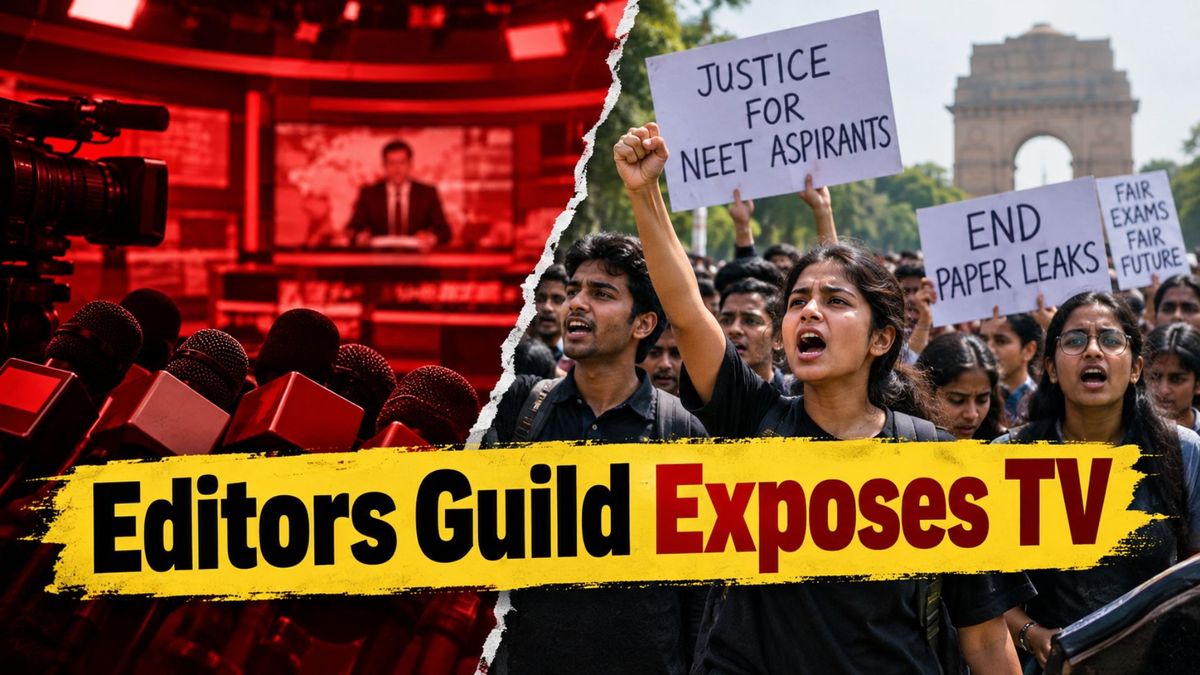
India’s most influential body of editors has trained its lens on how the country’s newsrooms handled the biggest youth uprising in years, and its verdict on mainstream television is damning. The Editors Guild of India‘s new State of the Media Report finds that TV channels first under-reported and then actively delegitimised the NEET protest, even as print newspapers and independent digital platforms became the spaces where student voices were heard and validated.
The report studies coverage of the June to July 2026 agitation that grew out of the NEET paper leak and wider anger over corruption in the education system. Its conclusion is blunt: while television struggled to hold public trust, independent digital voices and print journalism carried the story of the NEET protest.
Also Read: Jantar Mantar Protest: Questions Without Answers
What the Editors Guild Report Set Out to Examine
The report, researched by Megha Sharma and Rishab Gaur, monitors how the NEET protest was framed across mainstream television, Hindi channels such as Aaj Tak, ABP News, TV9 Bharatvarsh and India TV, independent digital outlets, international media, and the major print dailies. It anchors its timeline to activist Sonam Wangchuk’s hunger strike, which the Editors Guild describes as the turning point that drew national sympathy and cornered the government.
The study frames four questions: whether the protest was under-covered in its early growth phase, what dominant frames outlets used once they did cover it, how TV narratives differed from independent and social media narratives, and how attacks on journalists and framing choices affected public trust. The movement, led by the Cockroach Janta Party, escalated into the “Chalo Sansad” march on 20 July, which met heavy police resistance, and ended with the resignation of Union Education Minister Dharmendra Pradhan on 25 July.
How Television Covered the NEET Protest
The Editors Guild report is sharpest on television. Between 6 and 15 June, it says, mainstream TV gave the movement minimal airtime, filling its hours with unrelated controversies while the story built elsewhere. When channels did turn to the NEET protest, the report finds, much of the coverage was hostile.
According to the Guild’s framing analysis, Republic TV and Times Now reached for language like “anti-national,” “paid” and “goondas,” casting the agitation as conspiracy or a security threat rather than a student grievance. The Hindi channels reinforced official narratives in their own ways. The report says Aaj Tak focused on clashes and a law-and-order breakdown, ABP News framed the opposition as opportunistic and cast students as political pawns, TV9 Bharatvarsh highlighted overnight protests and the anger of youth, and India TV tied the demonstrations to Uttar Pradesh politics and electoral strategy.
A coding table in the report drives the point home. It records that in Republic TV and Times Now coverage, student voices were largely absent, with visuals dominated by clashes and lathi-charges. The finding is stark: mainstream TV leaned toward hostile and conspiratorial framing, while independent and international outlets emphasised education failure and the voices of the young.
Also Read: Jantar Mantar Protests: A Generation Demands to Be Heard
The NEET Paper Leak and Print’s Accountability Frame
If television is cast as the villain, print journalism is its counterweight. The Editors Guild finds that the major newspapers legitimised the NEET protest by documenting it as a serious accountability crisis rooted in the NEET paper leak, rather than dismissing it as fringe.
The report says The Indian Express described the Cockroach Janta Party as a “youth pressure group” even before its Jantar Mantar demonstrations, and built a narrative arc from satirical online origins to mobilisation, confrontation and finally Pradhan’s resignation. The Hindu, it finds, framed the issue around examination governance and accountability rather than personalities, keeping the focus on NEET irregularities. The Times of India tracked the NEET protest chronologically, marking it by day counts, while Dainik Bhaskar moved from treating the movement as a novelty to dramatic, event-driven headlines once Pradhan responded.
The report also notes how coverage shifted as the NEET paper leak story grew. Hindustan’s Delhi edition, it points out, carried no identifiable coverage on 13 June but gave the protest front-page prominence by 31 July, framing it as a sustained confrontation between students and the government. The core distinction the Editors Guild draws is this: the TV narrative was one of disorder and conspiracy, while the print narrative was one of accountability, chronology and the legitimacy of youth mobilisation over the NEET paper leak.
Independent and International Media Told a Different Story
Away from the studios, the report finds a very different register. It credits independent digital outlets such as The News Minute and Scroll.in with highlighting the exam leaks and the student suicides from early on, when much of television had looked away. Independent YouTubers, the Editors Guild notes, amplified student voices and helped sustain attention through the weeks of agitation.
International coverage followed a similar path. The report says the BBC, The New York Times and Al Jazeera framed the movement as a generational challenge. Its coding places the BBC’s emphasis on shrinking space for dissent, Al Jazeera’s on the exam leaks and emotional testimonies from the ground, and Reuters in a broadly neutral position focused on exam reforms. Across these outlets, the report records, student voices were consistently present, the opposite of the near-absence it maps in the most combative TV coverage of the NEET protest.
Also Read: How Gen Z Dismantled Godi Media’s Decade of Distortion
Attacks on Journalists and the Godi Media Chants
Beyond framing, the Editors Guild report documents the physical risks reporters faced and the erosion of trust between the public and mainstream TV. It records that a Times Now reporter was assaulted in Delhi, a Zee News team was heckled in Patna, and chants against “godi media” rang out at protest sites in Mumbai and Bengaluru.
The Guild connects these two threads into what it calls a dual crisis of safety and credibility. Its own statement of 23 July, cited in the report, condemned both the attacks on journalists and the collapse of trust facing the profession. The report argues that young protesters increasingly treated mainstream television as an adversary, a mistrust captured in the anti-media chants, while print and digital outlets became the channels through which the public followed the story.
A Credibility Gap the Editors Guild Cannot Ignore
The report places the NEET protest coverage in a longer arc of Indian media history, comparing it to the JNU agitation of 2016 but on a far larger scale, and describing it as one of the biggest youth challenges to the Modi government since 2014. What emerges, the Editors Guild says, is a clear credibility gap: television lost public trust at the very moment the story mattered most, and independent digital platforms and newspapers filled the vacuum.
For a report signed by the Guild’s office-bearers, President Sanjay Kapoor, General Secretary Raghavan Srinivasan and Treasurer Teresa Rehman, the weight lies in the source. This is not an outside critic but the country’s editors acknowledging that mainstream television failed a defining test during the NEET protest. In the note opening the report, MxMIndia founder Pradyuman Maheshwari, a member of the Guild’s State of the Media Committee, frames the episode as a reflection of how young Indians are reshaping democratic discourse, and how the media’s choices can either silence or amplify them.
The Editors Guild grounds its verdict in the coverage record, from the early under-reporting to the resignation of a Union minister over the NEET paper leak. Its central message is one the industry may find hard to hear: during the NEET protest, the outlets with the largest reach did the least to earn the public’s trust.
Disclaimer : This story is auto aggregated by a computer programme and has not been created or edited by DOWNTHENEWS. Publisher: theprobe.in