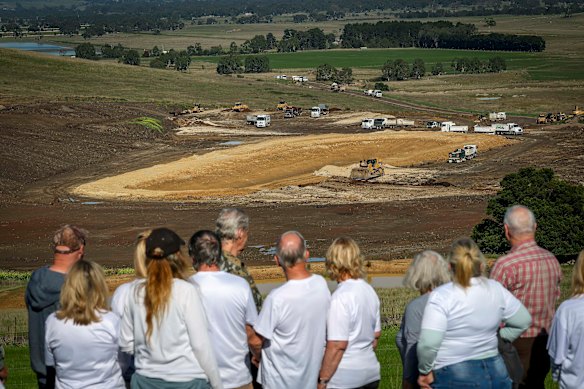

The rolling hills of Eden Park are usually a peaceful place. Just west of the Whittlesea township, its tree-lined avenues are dotted with the homesteads and hobby farms of people seeking a quiet life.
Billionaire pokies and pub baron Bruce Mathieson’s quest to build a 50-megalitre dam has shattered that country quietude on Melbourne’s northern fringe.
For several months, Eden Park residents have angrily watched as an armada of heavy haulage trucks rumbled through their community, carting more than 1 million cubic tonnes of soil onto the previously empty paddock where the dam is being built.
Residents have campaigned in vain to try to shut the project down, their outrage amplified on community social media pages filled with images of convoys of monster trucks dominating the roads and dashcam footage of alleged dangerous driving by truck drivers.
Whittlesea Council, which says it is powerless to intervene to control or stop the dam’s construction, accuses the project’s builders of doing unacceptable damage to local roads, and is weighing up suing for almost $2 million of ratepayers’ money spent repairing them.
Mathieson, now based in south-east Queensland, has dismissed opponents of his dam project as “idiots”, arguing that once built, it will be a community asset and a crucial water source for firefighters.
“You look at all the farmers around the whole country and what’s their problem? It’s water,” Mathieson said.
“So I had an opportunity that I could get a big dam built there. It’s in no one’s way, and it’ll be a great asset. The area should be happy. If there was a fire, where do you reckon they’d get all the water? They wouldn’t go down the road and turn a hose on.”
Still, unhappy residents say the sheer scale of the earth-moving project has transformed the landscape into something closer to a quarry than a farm dam.
“This is no mere dam, but a colossal landfill, set to swallow a million cubic metres of earth scraped from every corner of Melbourne,” said Eden Park resident Jason Simpson, who lives about three kilometres away on a bush block with a distant view of the site.
Simpson said the trucks and diggers stir up giant clouds of dust that resemble smoke from the deadly fires that torched the region on Black Saturday in 2009, and travel far enough on the breeze to settle on his outdoor furniture.
Critics say the project has exposed large regulatory holes. Melbourne Water granted a licence to build the dam and while it has told residents it was not aware of how much fill would be imported to the site, it is also not responsible for regulating its import, nor for truck movements.
Whittlesea Council insists it has no authority over the project, and was given minimal information by Melbourne Water about its scale, despite the volume of earthmoving.
The council is now weighing up pursuing the dam’s builders for the $1.7 million it claims to have spent fixing roads, which have been torn up so badly that Eden Park’s east-west arterial, Grants Road, had to be shut for about four weeks, and its speed limit slashed from 100km/h to 40km/h.
“Council’s priority is ensuring the safety of the road for the community. At the same time, council is considering its legal options in relation to the recovery of costs,” a spokesperson said.
The case is one of a spate of recent disputes – sometimes fought in the Victorian Civil and Administrative Tribunal and in courts – about green wedge land being used as a dumping ground for large volumes of construction fill.
Melbourne Water said it issued the works licence in February 2025 and has conducted multiple inspections.
“Based on the most recent inspections, the licence holder is currently compliant,” it said.
Melbourne Water has admitted, in correspondence to residents, that it failed to enforce its own policy that any application to build a dam greater than 20 megalitres must be advertised in a local newspaper.
Notification was limited to a handful of neighbouring properties, and many residents said they had no inkling of the project until the day works began.
“One day I was like, ‘What are all these trucks? What’s all this noise?’” said Viv King, who lives at the western end of Grants Road.
She is frustrated that such a large project could bypass council approval.
“It’s definitely affected the liveability of the local area when you have hundreds of big, heavy haulage trucks moving in and out daily, from early in the morning ’til into the afternoon. The road is ruined and as to who is responsible for that, there has been a lot of finger pointing, which doesn’t help local residents.”
Eden Pak residents have shared footage of run-ins and close encounters with truck drivers, including a truck overtaking another truck on double white lines, a motorist being forced to pull into the gutter to avoid colliding with an oncoming truck overtaking a car, and an L-plate motorcyclist being tailgated by a heavy vehicle on Grants Road.
The National Heavy Vehicle Regulator said it had conducted patrols in the area, and spoken with the dam site’s managers, but has not issued penalties.
Planning and agricultural experts have also raised concerns about the ecological impact of importing so much fill – believed to have been sourced from construction sites around Melbourne’s northern suburbs – into an environmentally sensitive area.
Dr Mary Cole, an honorary fellow at University Of Melbourne’s School of Agriculture who has given evidence in legal cases about soil dumping in Melbourne’s green wedges, said such a large dam would draw water from the local area in a relatively low rainfall part of the state.
The sheer volume of fill being introduced to the landscape would also alter its hydrology, she said.
“To fill a dam of that size is not going to happen with precipitation because we’re going into El Niño, and it would take years to fill,” Cole said.
“It would take a huge amount of water out of the environment that’s probably being used by other farmers. The creek will already be low in volume, so there’s an environmental impact already because of the dry conditions. And so where’s the water coming from?”
Cole said the project carries multiple risks, including the potential introduction of ecologically harmful pathogens from imported soil.
Kerry Stewart, a spokesperson for the Whittlesea Green Wedge Protection Group, said the community was frustrated after more than a year of “going around in circles as not one agency will accept responsibility in this matter”.
“We have had 45 acres of prime green wedge zone land stripped, filled and ruined for the sake of a dam that is supposed to water 200 cattle,” she said.
The farmer who leases Mathieson’s land, Scott Barrow, has disowned the project.
“I lease that land but I don’t do anything with it. The owner and the dam builder are building a dam, that’s all I can tell you,” Barrow said.
LandformX, the company contracted to build the dam, declined to comment.
A company presentation to a public meeting late last year, seen by this masthead, said the paddock was full of invasive weeds such as Chilean needle grass, and would be cleaned up and returned to pasture once the dam is built.
It said efforts to bore the land for water in 2023 found it was too salty for drinking or irrigation purposes. The dam would support livestock during times of drought and firefighters during fire seasons, the company said.
Start the day with a summary of the day’s most important and interesting stories, analysis and insights. Sign up for our Morning Edition newsletter.
 Adam Carey is an investigative reporter. He has previously been senior city reporter, education editor, state political correspondent and transport reporter. Contact him at acarey@theage.com.au or on Signal at adamlcarey.39Connect via email.
From our partners
Disclaimer : This story is auto aggregated by a computer programme and has not been created or edited by DOWNTHENEWS. Publisher: www.smh.com.au