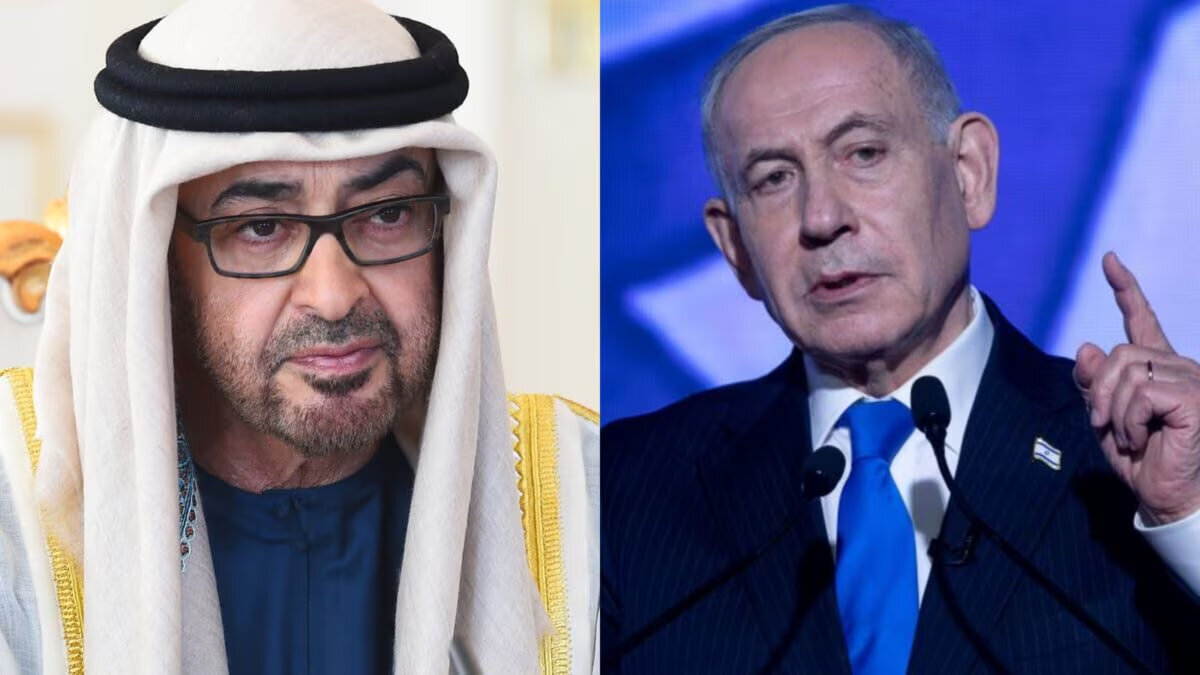
TEHRAN — On Sunday, a private jet carrying Benjamin Netanyahu took off from Israel, entered Jordanian airspace, crossed into Saudi Arabia, and touched down in Abu Dhabi. Gaza lies in ruins under years of relentless bombardment. The International Criminal Court had issued an arrest warrant for the Israeli prime minister. Yet two Arab states provided clear skies, and a third opened its airport tarmac and hosted Netanyahu for ominous talks with other regional actors.
Official channels described the unannounced visit as a routine discussion on “bilateral relations” and “regional stability.”
Flight records and intelligence reports reveal a different reality: a multi-state operational gathering that tied Netanyahu’s domestic political survival directly to the UAE’s apparent expanding role as a regional war center.
Radar tracks reveal a multi-state gathering
Netanyahu’s aircraft, tail number M-ULTI, landed at Al Bateen Executive Airport at 12:13 UTC. Within minutes, a series of linked aircraft arrived on the same tarmac, according to open-source data.
A plane associated with the family of eastern Libyan commander Khalifa Haftar, tail number P4-KH5I9, arrived at 12:40. A Qatari government aircraft landed at 12:18. A Moroccan Air Force C-130 had touched down hours earlier at 10:10. An Emirati-owned jet, A6-FAM, arrived at 12:10 after picking up passengers in Riyadh.
Reports in Hebrew-language media indicated that Mossad chief Roman Gofman organized a broader meeting alongside the primary bilateral session between Netanyahu and UAE President Mohamed bin Zayed Al Nahyan.
The Israeli intelligence chiefs, including Shin Bet director David Zini and former Mossad chief David Barnea, have frequented Abu Dhabi in recent months.
The synchronized arrivals in Abu Dhabi point to a coordinated gathering of regional military and intelligence partners rather than a simple diplomatic chat.
Safe passage for war criminals amid genocide
The passage of Netanyahu’s aircraft through Jordan and Saudi Arabia happened while Israeli strikes continued to devastate Gaza, pushing the Palestinian death toll past 74,000.
Both Amman and Riyadh regularly issue formal statements condemning Israeli military actions. Yet when Netanyahu needed to travel across West Asia, the corridor was open. Neither state scrambled jets or refused transit access.
This silent operational cooperation highlights the structural gap between public diplomatic rhetoric in Arab capitals and private military logistics.
For the states granting flight permissions, maintaining intelligence pipelines with Tel Aviv and Washington has taken priority over public solidarity with Gaza.
Netanyahu flew over millions of outraged Arab citizens without setting off a single diplomatic alarm.
Political lifelines and the October 7 warning
Netanyahu’s trip was driven by immediate domestic pressure. Israel faces elections on October 27, the first since the October 7, 2023 attacks.
Polls show a tight race, with Netanyahu’s Likud bloc tied with opposition forces led by former military chief Gadi Eisenkot.
Netanyahu remains trapped by ongoing corruption trials and intelligence failures surrounding the October 7 attack.
Haaretz reported that Emirati President Mohamed bin Zayed personally warned Netanyahu roughly ten days before October 7 that Yahya Sinwar was preparing a major military operation. Netanyahu denied the account and threatened legal action against domestic news outlets covering the claim.
During Sunday’s meeting in Abu Dhabi, Netanyahu reportedly asked Mohamed bin Zayed to issue an explicit public denial of the pre-attack warning. Facing an electorate focused on security lapses, Netanyahu sought a clean political defense from an Arab leader to blunt opposition attacks at home.
Abu Dhabi as launchpad for regional wars
The partnership between Israel and the UAE has shifted far beyond the economic framework of the 2020 Abraham Accords.
During the recent campaign of aggression against Iran, Israel deployed Iron Dome air defense batteries and military personnel directly inside Emirati territory.
The relationship is reciprocal. The UAE has allowed its territory, airfields, and maritime proximity to Iran to be integrated into Western and Israeli military planning.
This pattern of Emirati involvement extends well beyond the Persian Gulf into a broader web of transnational interventions.
United Nations investigative panels have confirmed that UAE-linked logistics networks supply weapons, foreign fighters, and heavy armor to the Rapid Support Forces in Sudan, fueling a catastrophic conflict that has displaced millions.
At the same time, Abu Dhabi provides steady financial, air, and logistical backing to Khalifa Haftar’s armed forces in eastern Libya, mirroring similar operational deployments such as supplying armed drones to government forces during the Tigray war in Ethiopia.
The presence of a Haftar-linked aircraft on the runway in Abu Dhabi while Netanyahu met with Emirati leadership fits this broader reality. The UAE appears to operate as a central hub for regional proxy warfare, financing, and air logistics.
Netanyahu departed Abu Dhabi without releasing a formal joint statement or a single official photograph.
The silence was deliberate. It allowed Netanyahu to present himself as being in control to his political base while letting his Emirati hosts avoid public accountability for hosting an indicted war criminal executing multiple campaigns of aggression against Muslims in the region.
Disclaimer : This story is auto aggregated by a computer programme and has not been created or edited by DOWNTHENEWS. Publisher: tehrantimes.com