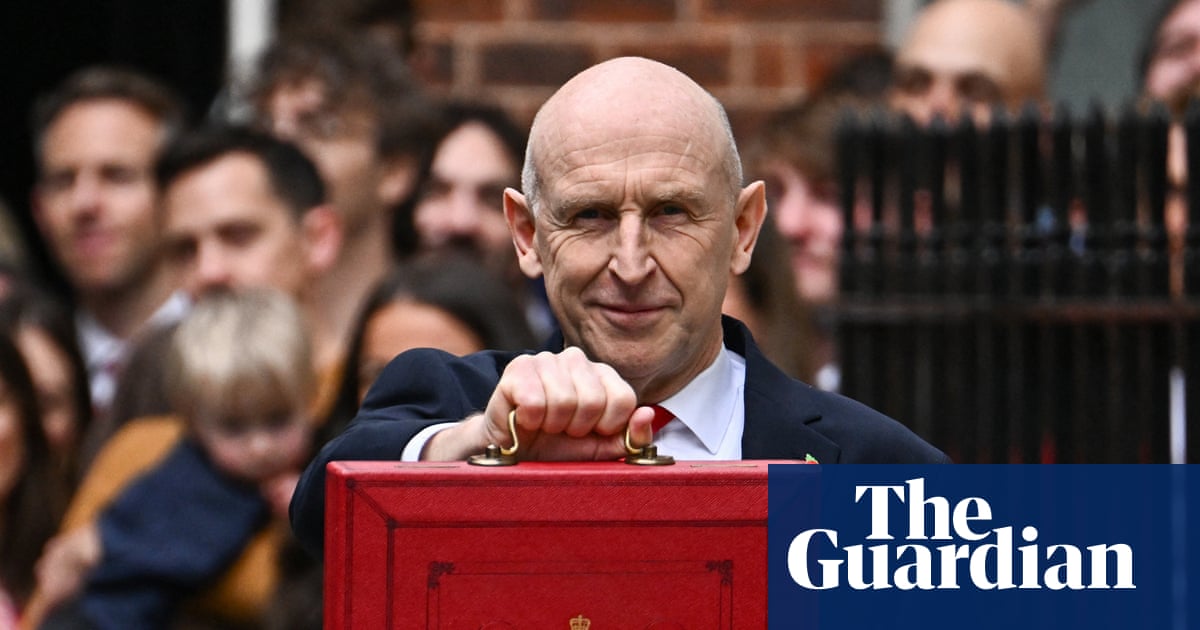
John Healey’s debut budget was far from a blockbuster, but it may come to be remembered for the birth of a plucky new character in the tax and spend universe – little PDEL.
It may not have the charm of Disney’s Wall-E, but PDEL (pronounced P-Del), Preventative Departmental Expenditure Limit, to give it its full name, marks a welcome, and potentially very consequential, addition.
The chancellor made clear that ahead of what the Institute for Fiscal Studies (IFS) has said will be a “brutal” spending review next year, the Treasury is prepared to ringfence the budget for preventive policies.
The impetus for the move came partly from No 10. Andy Burnham knows that to achieve some of the missions closest to his heart, such as tackling rough sleeping, he will have to make the argument that it’s worth spending more upfront to save the state in the longer term.
It’s an intuitive idea, yet it’s not how the government tends to think about spending – and it’s certainly not how the Treasury makes decisions.
In the cut and thrust of a spending review, a process in which the Treasury’s power over the public purse is at its most muscular, individual departments are under pressure to show how they will save money from their own budgets.
Yet many of society’s greatest challenges have impacts across several departments. The future savings made by spending on, say, Family Hubs, may show up years in the future, and across several other departments – in the welfare bill, the health budget, even the criminal justice system.
In a 2023 paper that introduced the idea of PDEL, thinktank Demos identified £22bn of costs to government that it claimed could have been averted by preventive programmes.
“For decades, governments have talked about the importance of prevention, but the system has consistently rewarded spending on dealing with crises rather than stopping them from happening in the first place,” said Demos’s chief executive Polly Curtis.
In the Treasury documents that accompany the spending review, and more importantly in the months of wrangling beforehand, PDEL will have its own storyline, alongside RDEL – day-to-day, or “resource” spending for each department, and CDEL – investment.
It sounds technical, and it is – but we have plenty of evidence that the way public spending is categorised changes the way it is debated and understood.
Before Labour came to power in 1997, day-to-day spending and investment were not formally separated in the public finances, but Gordon Brown was rightly keen for long-term investment and day-to-day spending to be considered separately.
Disaggregating RDEL and CDEL allowed him to set the “golden rule” – that it was fine for the government to borrow to invest, but current spending should be covered by taxation.
Separating out capital spending didn’t prevent the Tories raiding it repeatedly during the austerity years – and indeed, Whitehall departments have just been asked to cut back future capital budgets to fund the Defence Investment Plan.
But it does allow additional scrutiny, and a new kind of conversation about which areas of public spending are most important.
Demos’s argument is that some kinds of day-to-day spending, while not “investment,” in strict accounting terms, are worth protecting, because scrapping them might bring short-term cash benefits, but carry net costs to the government over time.
Gavin Kelly, chief executive of the Nuffield Foundation, which funds social research, says the shift to thinking about preventive spending makes sense now, because we have better data to inform policymakers.
He points to a series of IFS studies, funded by Nuffield, which showed Labour’s Sure Start centres boosted children’s education performance, increased their future wages, and even reduced hospital admissions, for example.
“Over the last decade, we’ve become more able to forensically link datasets across different aspects of services, illuminating how decisions in one public service can go on to impact other services and outcomes. That wasn’t possible in the same way in the past. The agility of decision-making about how and where we spend has not kept up with some of these data advances.”
Healey offered precious few details in the budget as to how PDEL will be defined but the Treasury says departments will have to make the argument for individual projects to be considered as preventive.
Rough sleeping is one area it highlights. Alan Milburn appears poised to make a similar argument in his soon-to-be-published review into young people not in education, employment or training, saying that money spent now on employment support potentially saves future costs on welfare, health and housing. Demos also highlights early mental health support and obesity prevention.
It does not seem beyond the bounds of possibility that, if defined tightly enough, preventive spending could even come to be considered “investment,” for the purposes of the fiscal rules, though the Treasury says that is not the plan.
That would mean the government being prepared to borrow today to fund projects it strongly believes would save money over time – a similar logic to the argument for investment in bridges or roads, but with a more social slant.
However, no amount of accounting tweaks can disguise the fact that, based on the figures Healey set out in the budget, next year’s spending review – which could take place as late as the autumn – looks impossibly tough.
He clearly hopes better news will come along, to ease the squeeze. But you can’t ringfence your way out of what the IFS reckons is £27bn-worth of spending pressures.
Against that bleak narrative arc, it remains to be seen if PDEL can play a starring role, or turns out to be just a side character. But perhaps it can at least help to bring some longer-term thinking to bear.
Disclaimer : This story is auto aggregated by a computer programme and has not been created or edited by DOWNTHENEWS. Publisher: theguardian.com