
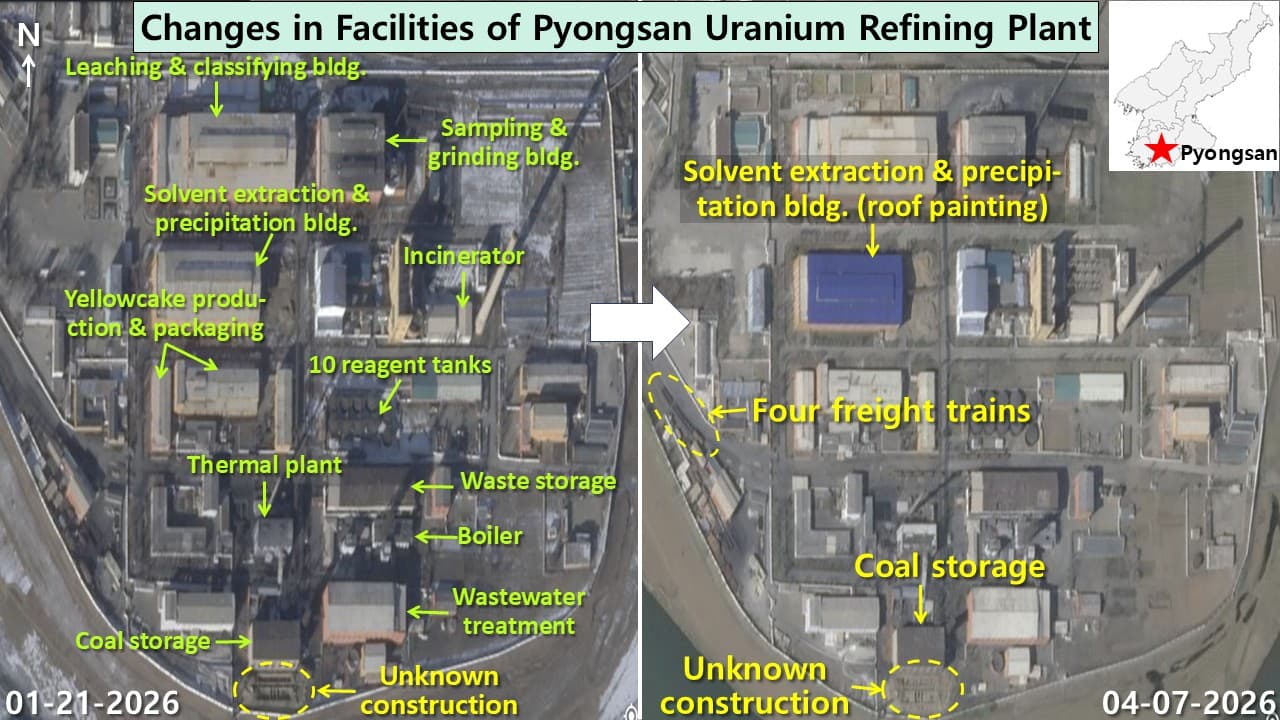
Satellite imagery of North Korea’s Pyongsan uranium refinery shows the facility continuing to operate and undergo upgrades, with new construction, freight activity, and expanding waste deposits all pointing to sustained production in support of the country’s nuclear weapons program.
The Pyongsan uranium refinery, located in Pyonghwa-ri, Pyongsan county, North Hwanghae province, is North Korea’s only known facility for producing uranium yellowcake — the milled uranium ore concentrate that serves as the starting material for highly enriched uranium used in nuclear weapons. Satellite images captured April 7 show the roof of the solvent extraction and precipitation building, a core processing structure within the facility, repainted in a noticeably brighter blue. The exterior renovation work suggests maintenance or waterproofing upgrades and signals that the processing line remains operational or in a state of readiness.
A freight train of approximately four cars was also observed stopped on the facility’s rail spur. The train’s presence suggests active logistics activity, either the delivery of chemical processing equipment or the outbound transport of finished yellowcake, most likely to the Yongbyon Nuclear Scientific Research Center — North Korea’s main nuclear complex, located roughly 100 kilometers to the north.
New construction near coal storage

Recent satellite imagery also reveals new construction on a previously empty plot south of the facility’s coal storage area. The site, which appeared undeveloped as recently as the summer of 2025, now shows rectangular grid structures and what appear to be foundation frames arranged at regular intervals, with the surrounding ground cleared and leveled. The nature of the construction suggests the installation of a small-scale facility rather than simple material storage. Given its proximity to the coal storage area, I assess the new structure may relate to coal processing equipment supporting the facility’s heat supply, or to waste handling infrastructure.
Taken together with the roof renovation and freight train activity, the new construction points to a facility operating beyond basic maintenance, with upgrades aimed at enhancing production capacity or operational efficiency in line with North Korea’s stated nuclear force expansion goals.
Waste ponds and environmental risk

The Pyongsan refinery’s tailings ponds collect radioactive wastewater and chemical byproducts generated during the uranium milling process. Solids settle at the bottom while liquids gradually separate — a standard but hazardous treatment method for uranium processing waste. The ponds, situated near the Yesong River, represent both an operational indicator and an environmental monitoring priority.
Satellite images from January through April show no clearly visible discharge of liquid wastewater from the ponds toward the Yesong River. Winter imagery from January showed the ponds and drainage channels covered in snow and ice, obscuring any flow. Spring images similarly show no definitive evidence of active discharge. However, within the ponds, dark gray and black sludge deposits have visibly expanded in the northern and central sections, with increasingly defined boundaries — consistent with the ongoing accumulation of waste byproducts from an active milling process.
As snowmelt gives way to North Korea’s summer rainy season, analysts warn that accumulated waste or contaminated leachate could migrate toward the Yesong River watershed. Continued satellite monitoring of the drainage channels and surrounding waterways is warranted.
The pattern of activity at Pyongsan, from facility upgrades and freight logistics to rising waste volumes, indicates the refinery is functioning as a key production node in North Korea’s nuclear weapons supply chain.
Disclaimer : This story is auto aggregated by a computer programme and has not been created or edited by DOWNTHENEWS. Publisher: dailynk.com








