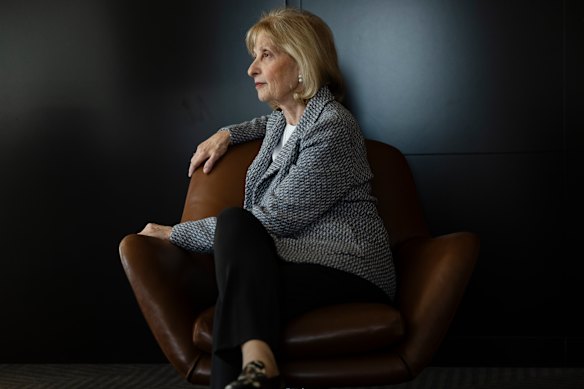

The most pervasive form of discrimination against Jewish Australians comes from progressives motivated by social justice who give antisemitism a “respectable veneer”, argues a new report from Australia’s Special Envoy to Combat Antisemitism (ASECA).
The report describes this mainstream group as combining the hostility of Islamist extremism with far-left ideology delivered through a progressive lens, singling them out for making antisemitism acceptable and even fashionable.
ASECA Priorities, a new road map report to be released on Friday, identifies evolving threats and progress in tackling antisemitism, with envoy Jillian Segal also levelling heavy criticism at universities and the ABC.
It includes recommendations for reforms across society, from health and the arts to migration and the digital world.
In an interview with this masthead before the report’s release, Segal acknowledged antisemitism has always come from the far-right, far-left and Islamist extremism, but pointed to a newer, more palatable form that gives it “intellectual and cultural credibility”.
“What we have is antisemitism that I describe as much more in the middle: well-intentioned people who are concerned about the policies of the state of Israel and feel critical of them,” she said. “And they transfer that criticism to Jewish members of society in Australia … through a lens of thinking that they are upholding progressive values and human rights.
“It’s really conflating criticism of policies of the government of Israel onto Jewish Australians. And actually, Jewish Australians have got no influence on the state of Israel. They may not support any of those policies, and yet, they are suffering.”
Impacts on Jewish people have ranged from hostility, online abuse and exclusion to doxxing, graffiti and violence, Segal said.
Zionism, or the belief in Israel’s right to exist as a Jewish state, has also become a proxy for antisemitism, according to the report, even though it doesn’t equate to excluding Palestinian self-determination or sovereignty.
“Increasingly, and often to avoid appearing transparently and obviously antisemitic, it has become common to vilify, target and ostracise ‘Zionists’ rather than ‘Jews’,” the report said.
“Jews, generally in Australia, are supportive of the existence of the state of Israel,” Segal said. “But not necessarily, of course, for all the policies.”
With caretaker prime minister Benjamin Netanyahu’s political future uncertain in the fallout of Israel’s deadlocked election this week, Segal said Israel and its government should be subject to scrutiny and criticism like any other democratic state.
Online environment
A febrile online environment, in which conspiracy theories and hate flourish, is also singled out in the report as “one of the most significant accelerators of contemporary antisemitism”.
The report comes amid renewed government focus on online hate and abuse, as Indi MP Helen Haines recovers after losing both legs in an alleged attack by a 43-year-old man outside her electorate office.
Segal said there’s been “an explosion of hate” online, which ramped up against Jews after Hamas’ October 7 terror attack.
“We saw a further increase after the Bondi terror attack,” she said. “And we saw all those absolutely terrible allegations online that Bondi was staged: it was not real, the people staged their own blood on their head.
“Not only was it incredibly traumatic for the people who were there, but even more traumatic then for that real experience to be trivialised and made fun of online.”
Media
One of the more controversial recommendations of the ASECA report is the call for an external, independent watchdog for the ABC and SBS to be installed by the federal government.
Segal reported significant concern in the Jewish community about the public broadcasters’ reporting on issues related to Israel and the Middle East, with allegations of “disproportionate, misleading or inaccurate” coverage.
“Jewish Australians have reported being abused, harassed and accused of being ‘baby killers’ or supporters of ‘genocide’ simply for their belief in the right of Israel to exist,” the report stated. “That perception of a link between coverage and hostility is itself a matter of public importance.”
While the ABC and SBS have internal ombudsmen, Segal argues more serious complaints should be handled externally to ensure accountability and public confidence.
“Many other industries – such as telecommunications, superannuation and financial services – have external complaints dealt with transparently and independently by ombudsman services,” she said. “And I think that should apply to the public broadcasters as well.”
The ABC and SBS defended their Middle East reporting and internal complaints processes at the Royal Commission on Antisemitism and Social Cohesion earlier this year.
Public funding cut
Taxpayer funding would be withheld or stripped from people or organisations that engage in or tolerate antisemitism, under several recommendations in the report.
This applied to arts, culture, sport and university research and included government grants. Previous proposals have been met with resistance on the grounds of freedom of artistic expression.
“My principle is that government money should not be used to foment hate in any sphere,” said Segal.
The report also calls for doxxed or excluded Jewish artists to be re-engaged by the arts sector.
Universities ‘slow to act’
Universities come under fire for “serious shortcomings”, including failing to act on antisemitism and adopt an agreed definition.
“University leaders have periodically expressed regret, but actions have been slow and inadequate on campus encampments, office invasions, activism in learning environments, and disruptive actions hostile to Jewish staff, students and visitors,” the report states.
While an agreed Universities Australia definition of antisemitism was endorsed by vice chancellors in 2025, this year it emerged that no university had adopted a uniform definition.
Western Sydney University chancellor Professor Jennifer Westacott said there was “a collective failure to address the escalating severity of antisemitism” by the sector and that more work was needed.
“Universities have to be places where ideas can be respectfully contested,” she said. “They have to be places of debate, and they can be places of peaceful protest, but they should never be places of hate or fear.”
Other recommendations include training for visa decision makers to recognise antisemitism, education and training in schools, the public sector and business, and the establishment of a national healthcare antisemitism taskforce.
Multicultural Affairs Minister Dr Anne Aly, who was the first Muslim woman elected to Australia’s parliament, said antisemitism was “a serious and deeply troubling challenge in Australia” and Jewish Australians have a right to feel safe.
“We must never allow international conflicts to become a licence for hatred here at home,” she said.
“Australians can hold different views, including on events overseas, without turning against one another. Multiculturalism is one of Australia’s greatest strengths, but it cannot be taken for granted.”
The royal commission will deliver its final report on December 18.
Start the day with a summary of the day’s most important and interesting stories, analysis and insights. Sign up for our Morning Edition newsletter.
 Clair Weaver is a senior writer at The Sydney Morning Herald.
From our partners
Disclaimer : This story is auto aggregated by a computer programme and has not been created or edited by DOWNTHENEWS. Publisher: www.smh.com.au