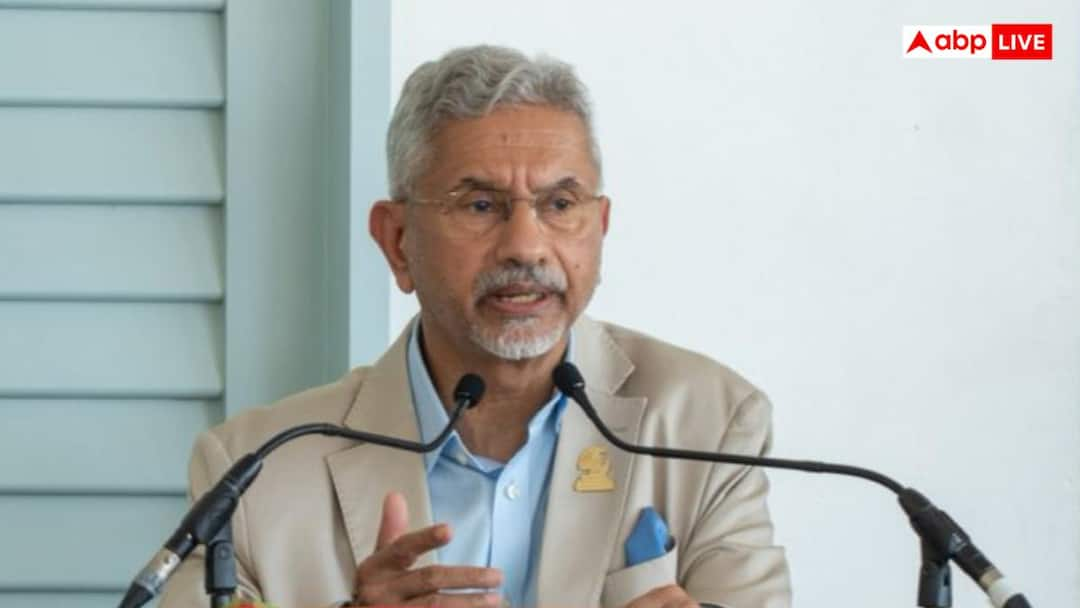
- Global order becomes multipolar, transactional, making world unstable.
- Conflicts in Ukraine, West Asia intensify global unpredictability.
- US-China rivalry reshapes world; India prioritizes national interests.
- India’s stronger global role requires boosting domestic capabilities.
External Affairs Minister S Jaishankar on Saturday said the emerging global order would be increasingly multipolar and transactional, with more countries making independent decisions. This, he warned, would make the world more complex, unpredictable and unstable, while intensifying competition among nations.
Speaking at the Hindustan Times Leadership Summit during a conversation with HT Editor-in-Chief R Sukumar, Jaishankar said the world was navigating “very stormy seas” amid multiple conflicts, economic disruptions and volatility in food and fuel supplies.
“The general acceptance is that the new order would be more multipolar, that there’d be many more centres of autonomous decision-making. Countries overall would be much more national in their choices and in their decisions,” he said.
“The alliances will be less cohesive because of national interests and more transactional, because they feed into each other — less cohesive, more transactional; more transactional, less cohesive.”
He said the emerging order would involve “more variables” and become “much more complex [and] less predictable” as the number of players increased and countries became more self-centred.
“That will be the culture or the ethos of the era that we are moving into. I don’t want you to get a sort of picture of an anarchy, but definitely sharper competition, more national assertions, and in that sense inherently more unstable,” Jaishankar said.
Ukraine, West Asia Conflicts Add To Global Turbulence
Jaishankar acknowledged that the world was in a difficult phase, with global developments having direct consequences for India. He cited the wars in Ukraine and West Asia, the situation in Sudan and Central Africa, fluctuations in food and fuel prices, and the continuing impact of the Covid-19 pandemic as factors adding to the uncertainty.
Referring to the Russia-Ukraine war, he said a major conflict of this scale would have been difficult to imagine five years ago, given the extent of globalisation and interdependence.
“Five years ago, it would have been inconceivable in this day and age, when everything is so globalised and interdependent, that we could have a major war. We’ve actually had that war now into its fifth year,” he said.
He also pointed to the escalation of tensions in the Gulf, where countries have been firing missiles at one another and targeting military bases, cities, forces and leadership.
“What you see in the Gulf — the idea that countries would actually be firing missiles at each other, targeting bases, cities, forces, leaderships — would have been something which people would have rated its chances as pretty near zero,” he said.
Jaishankar added that the situation in West Asia had become “much more bitter and intractable” since the Hamas terror attacks in October 2023.
He said disruptions to food exports from Ukraine and Russia through the Black Sea had affected global food prices, including in India, while interruptions to fuel supplies had also pushed up energy costs.
‘National Interest’ Will Guide India’s Response
The External Affairs Minister said navigating the uncertain global environment would require strong, steady and experienced leadership, guided by India’s national interest.
Tackling the challenges would depend on leadership that “knows how to get the country through this, because the compass for navigating it is our national interest”, he said.
“When we look at all these challenges, when people ask us where do you stand on Ukraine or where do you stand on the Gulf or what is your view on a particular challenge, we will view it understandably through the lens of our national interest. That’s the compass which will guide us,” he said.
Jaishankar added that the current phase of global turbulence was likely to manifest itself in different ways until the end of the decade.
US-China Rivalry Reshaping Global Order
Jaishankar identified competition between the US and China as a major factor behind the current global uncertainty. However, he said the disruption was also linked to Washington’s changing approach towards the world, including its traditional partners.
“One part of it is when countries get caught in between, but it’s also led to the US itself changing the manner in which it approaches the world,” he said.
He noted that the US-China rivalry had coincided with Washington’s efforts to reindustrialise and reduce excessive dependence on particular countries or regions. These changes, he said, had also created vulnerabilities.
“One part of it is to look at a US-China competition in a very orthodox way. But if you look at it more deeply…each one of these feeds into the other and a big part of it is really the changed approach of the US to the world, even to its friends and allies,” Jaishankar said.
He said the US had dominated the post-World War II global order because it was willing to support economic arrangements that served its interests. However, this approach began changing during former President Joe Biden’s tenure, as Washington concluded that the rules it had backed were being used to its disadvantage.
Jaishankar also pointed to the transformation in the US energy landscape. The country, once a major importer of energy from the Gulf, has now become self-sufficient and an energy exporter.
“The US, which was a big energy importer from the Gulf, today is self-sufficient and an energy exporter. If it were an energy importer today, I’m not sure many of the events which are happening in the Gulf would still be happening,” he said.
He added that changing energy dynamics, widening technology gaps and advances in warfare had contributed to a global environment in which countries were increasingly willing to take risks.
“It’s a more competitive world. It’s also a much more risk-taking world, and not limited to the US,” Jaishankar said. “Other players are also taking risks. Everybody is pushing the envelope [and] the more powerful are able to push the envelope much stronger and on many more issues.”
India Must Strengthen Domestic Capabilities
Against this backdrop, Jaishankar said the emerging global order was expected to give India a “much stronger role” and greater influence. However, he stressed that this would depend on the country’s ability to build domestic capabilities through initiatives such as Atmanirbhar Bharat, Make in India and Innovate in India.
He said India would also need to strengthen existing partnerships, forge new relationships, diversify its options and reduce vulnerabilities.
“In the last decade, we have laid a very solid foundation…with this very strong push for industrialisation because…we missed the manufacturing bus. That for us, [from] the 1960s to the end of the 1990s, we may have had reform, but these were really lost decades. Even the reform was only a correction and a partial correction of what were lost decades before 1992,” he said.
Jaishankar said India needed to establish itself as a manufacturing power and develop the technologies and capabilities required for the modern era. He cited the Production-Linked Incentives (PLI) initiative as one of the measures supporting this effort.
“We have to become economically competitive, which means much better infrastructure and logistics. We have to improve our talent, which means more educational institutions, more skilling. But we’ll also have to invest in semiconductors. We’ll have to invest in upgrading life sciences. We’ll have to look at preparing for the AI era,” he said.
“We’ll have to address multiple levels in order to navigate those stormy seas.”
ALSO READ: India-US Partnership ‘Essential’ For New Century, Says Antony Blinken; Backs Strategic Autonomy
Disclaimer : This story is auto aggregated by a computer programme and has not been created or edited by DOWNTHENEWS. Publisher: abplive.com