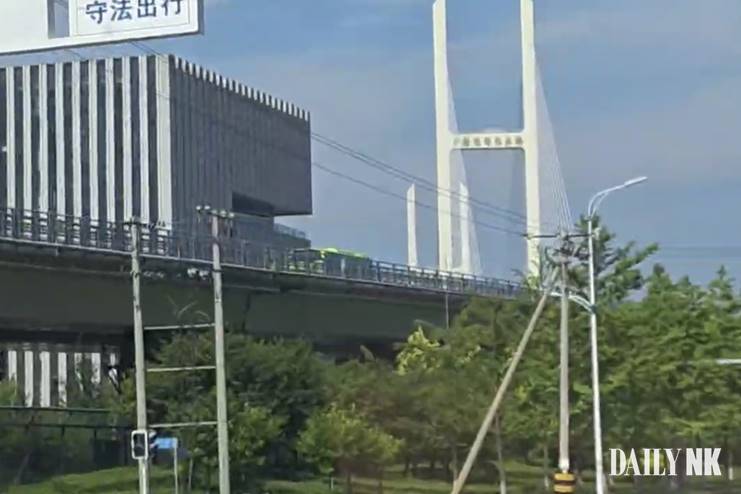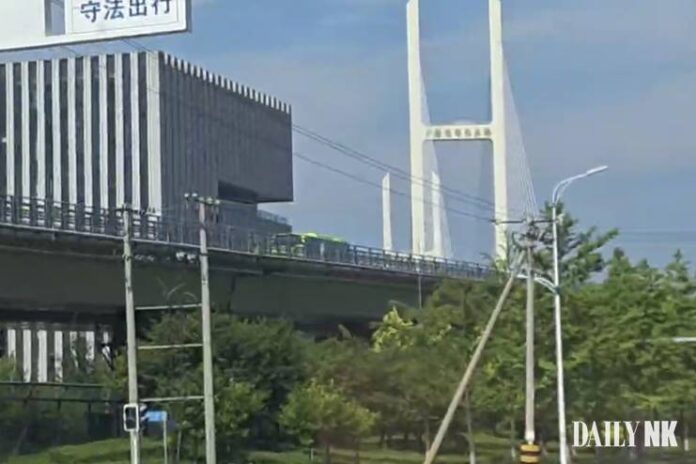
The New Yalu River Bridge between China and North Korea opened on Oct. 15, 2026, after 12 years of delays. Slow customs clearance on both sides, however, is leaving cargo truck drivers stuck for more than three hours.
The four-lane bridge links Sinuiju in North Pyongan province with Dandong in China’s Liaoning province. Many observers expected it to fuel a surge in North Korea China trade, but Chinese traders say little has changed so far.
Since the formal opening, drivers have waited in their trucks for more than three hours at a time, a source in China told Daily NK on Wednesday. Chinese customs inspections are taking far longer than expected, and North Korean customs has also struggled to keep vehicles moving.
At times, lines of trucks waiting for clearance have stretched a third of the way across the bridge. The span runs roughly 3 kilometers (1.9 miles) across the Yalu River.
According to the source, Chinese customs officers are checking shipments closely for goods banned under UN Security Council sanctions. Since 2006, the council has passed a series of resolutions in response to Pyongyang’s nuclear and missile tests. These measures restrict trade in items ranging from machinery and vehicles to coal, textiles and seafood.
On the North Korean side, a new administrative system launched with the bridge opening has yet to settle in. That has slowed paperwork at the Sinuiju customs office, the source added.
“Just because the bridge has opened doesn’t mean trucks are suddenly moving back and forth quickly,” the source said. “Both China and North Korea are conducting strict inspections and the paperwork isn’t going smoothly, so drivers end up waiting a long time.”
China finished building the bridge in 2014, but North Korea left its connecting roads and customs facilities unfinished for years. Work picked up again after Chinese President Xi Jinping visited Pyongyang in June for a summit with Kim Jong Un.
Sanctions cloud New Yalu River Bridge trade hopes
The new bridge can carry far more cargo than the Sino-Korean Friendship Bridge, the aging crossing that has long handled most Sinuiju-Dandong traffic. Built in 1943, the older road and rail bridge has a single vehicle lane, so trucks can only move one way at a time.
Chinese trade insiders say the new bridge alone does not mean conditions for cross-border trade have improved. Strict inspections and complex procedures will limit how fast cargo moves, they argue, no matter how good the infrastructure is.
With UN sanctions on North Korea still in force, observers also doubt the opening will quickly lead to a large expansion of trade.
“Traders care less about having a new bridge than about how quickly goods can actually get through,” the source said. “If customs clearance keeps taking this long, people are saying nothing has really changed, even with the bridge open.”
The opening ceremony itself produced an awkward moment over how each side planned to display its national flag. Chinese officials ended up making a last-minute switch on their own trucks, according to the source.
Chinese organizers had fitted their ceremonial cargo trucks with China’s five-star red flag on the right side. On the left side, they placed North Korea’s flag as a diplomatic gesture marking an occasion both countries were celebrating.
On the day of the ceremony, however, the North Korean trucks arrived flying only North Korean flags on both sides. Chinese officials hurriedly pulled the North Korean flags off their trucks and replaced them with Chinese ones.
In the end, the trucks from each country crossed the bridge during the ceremony displaying only their own national flags.
About This Translation
This article was originally written in Korean and translated with the help of generative AI tools. It was then edited by a native English-speaking editor. All AI-assisted translations are reviewed and refined by our newsroom.
Reporting from Inside North Korea
Daily NK operates networks of sources inside North Korea who document events in real-time and transmit information through secure channels. Unlike reporting based on state media, satellite imagery, or defector accounts from years past, our journalism comes directly from people currently living under the regime. We verify reports through multiple independent sources and cross-reference details before publication.
Our sources remain anonymous because contact with foreign media is treated as a capital offense in North Korea — discovery means imprisonment or execution. This network-based approach allows Daily NK to report on developments other outlets cannot access: market trends, policy implementation, public sentiment, and daily realities that never appear in official narratives.
Maintaining these secure communication channels and protecting source identities requires specialized protocols and constant vigilance. Daily NK serves as a bridge between North Koreans and the outside world, documenting what’s happening inside one of the world’s most closed societies.
Disclaimer : This story is auto aggregated by a computer programme and has not been created or edited by DOWNTHENEWS. Publisher: dailynk.com