The NFL season is always chock-full of surprises and disappointments. Despite a half-year of ranking and projecting and predicting how the NFL season will go from fans, media, and league personnel alike, the bullseye on the dartboard that we call a typical NFL season is nigh impossible to hit. And pulling a Luke Littler on those predictions is essentially unfathomable.
Now that we’re past the halfway point in the season (enjoy those sloppy island games while you can!), I wanted to give a few of the most pleasant surprises from this NFL season, with a few disappointments that have left us with a sour taste in our mouths, a week before Thanksgiving.
Advertisement
With apologies to units like the Vikings defense, Chiefs offense, or others at the top of the boards, I narrowed this down to units where the expectations weren’t that high or fell way below their projected status. So I excluded the Cowboys’ defense despite it falling short of its already reasonably low expectations.
Pleasant Surprises
Packers defense
Jonathan Gannon seemed like a shrug of the hire for plenty of people after his tenure in Arizona collapsed under a mountain of injuries, inconsistency and a brutally competitive division. While the Packers had an interesting safety trio and young talent on their defensive front, Micah Parsons was lined up to miss the first half of the season after his ACL injury in the 2025 season. It was hard to feel confident they would have enough to overcome their potential lack of needle-movers at cornerback and unproven talent in their front seven.
Advertisement
Ten weeks into this 2026 season, and the Packers’ defense has been not only surprisingly competent under Gannon, but outright good. The Packers’ defense ranks sixth in FTN’s defensive DVOA stat and ninth in EPA per play allowed. While their overall efficiency is more middle-of-the-pack and their run defense is definitely still a weakness, ranking 26th in rushing success rate allowed and 30th in EPA per rush (but 16th in DVOA, which adjusts for opponents), there is still plenty of good going on with this defense. And that sets the table nicely for Parsons’ return that’s currently projected for Thanksgiving eve.
Why has the defense leveled up? The young pass rushers have all had standout moments this season, with Lukas Van Ness making a huge leap that is forcing offenses to account for him in both the run game and pass protection. Van Ness has a 16.7% pressure rate, just above names like Aidan Hutchinson and Danielle Hunter, along with six sacks and nine stuffs in the run game. Rookie Dani Dennis-Sutton has not only been playable, but an impactful player at that. Dennis-Sutton has 30 pressures this year and his 18.2% pressure rate currently ranks eighth among all edge defenders with 100 or more pass rushes this season. Brenton Cox Jr. has had standout moments, too, and even Barryn Sorrell has held his own.
Both safeties, Xavier McKinney and Evan Williams, are playing at an All-Pro caliber level, with Williams truly emerging as a star by making impact plays in coverage and filling against the run.
Gannon has also been aggressive as a play designer and play-caller, too. Just look at the Williams interception in the play above, with Williams flying from the line of scrimmage to the back end to make the Troy Polamalu-esque play. The Packers blitz on 42.3% of late-down dropbacks, the fifth-highest rate in the NFL, per TruMedia. Gannon is constantly testing offensive lines and quarterbacks with pressure packages that are wildly different than the fairly vanilla scheme he ran in Philadelphia, which is a reminder that Gannon has a background under Mike Zimmer.
This defense has flaws, with a run unit that’s still a bit leaky against offenses that are willing to pound it on them, and that’s before getting to the issues with the Packers’ own offensive line and run game. But this defense is still markedly better than many projected going into the season, with a 250-pound-sized reinforcement soon arriving to add gasoline to the fire that Gannon is throwing at offenses.
Advertisement
Titans offensive line
So, the Titans aren’t very good. I don’t think that’s a big surprise in Robert Saleh’s first year. The Titans’ offensive line has been one of the underwhelming units in Tennessee over the past few seasons, and that’s putting it nicely, despite a substantial amount of resources allocated to that unit in the draft and free agency and long-time offensive line coach Bill Callahan previously overlooking the group.
But, through 10 weeks, the Titans’ offensive line has played like one of the most cohesive fronts in the league, using a sound scheme that has had actual results to go along with it.
Check out Austin Schlottmann (51), a new face at the pivot spot, pulling there!
Advertisement
Former first-rounder JC Latham has taken a big step forward this season under Carmen Bricillo, the Titans first-year offensive line coach who followed Brian Daboll to Nashville after their time together with the Giants. Latham has been a weapon in the run game, truly caving in the defense at the point of attack like a bouncer removing a rowdy patron and carving out clear lanes for Tony Pollard on the ground. Latham is just one example of the improvement the Titans front has had this year. Their run game has taken a step forward, going from a 35.1% success rate on running back carries in 2025, to a 38.3% rate this year. Explosives on designed runs, however, have jumped from 4.9% to 9.2% this season. They’ve gone from 28th in both categories in 2025 to 14th in success rate and fifth in explosive designed runs so far this season. Some of that is Pollard, sure, but explosives come in the run game when blockers are getting a hat on a hat on their assignments, something the Titans do, at the very least, an above-par rate.
Pass protection has improved this season, too. Dan Moore looks more solid than horrific, his pressure rates allowed dropping to more manageable levels. Moore was attributed with allowing 13.5 one-on-one sacks in 2025. Yes, 13.5. It’s down to just 2.5 this year, which has been notable.
That’s a combination of protections that are well thought-out and quarterback Cam Ward becoming a more decisive player as his second year has progressed. Ward was one of the most sacked players in the NFL last season and the Titans lost -109 total EPA to sacks alone last season. That’s nearly a full touchdown of expected points lost to just sacks per game. This season, the Titans are seventh in sack rate (which is sacks per pass attempt) after ranking 27th last year and have lost just -23 EPA to sacks this season, or -2.6 EPA per game. This section is all about pleasantness, and I have to say that the Titans’ offense has turned into one of those over the past few weeks or so. Pollard has been a joy to watch amid trade rumors. Ward has stacked together positive performances and looks closer to solidifying himself as the Titans quarterback of the future than relinquishing it, and how he’s cut down on the damage taken on sacks is a clear indicator of that. His throwing creativity and underrated pocket-navigation ability is only adding to his appeal. What has helped Ward’s feet calm down this year, which has only helped improve his consistency, is the competence he’s receiving up front. And Ward’s timing helps their jobs as well. It’s as Mac and Dennis from “It’s Always Sunny in Philadelphia” would say: a self-sustaining economy.
One disclaimer before I wrap up this part is how this unit might finish with Peter Skoronski heading to injured reserve, especially right before a matchup with Cowboys star Quinnen Williams. But so far the Titans’ offensive linemen have all played to their best abilities under Bricillo and Daboll, so it’ll be interesting to see how they navigate another new face along the interior.
Advertisement
Steelers run game
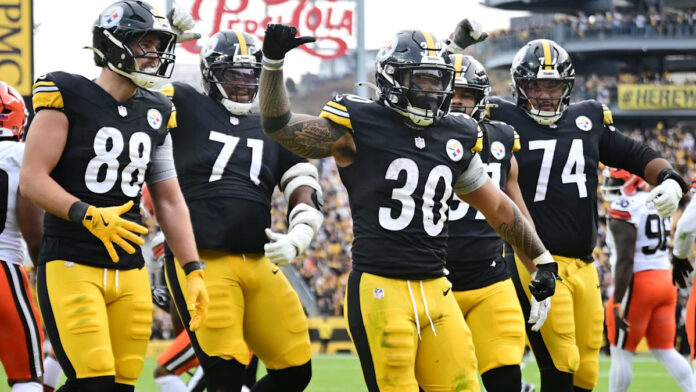
Aaron Rodgers still likes to have his moments of playing sheriff and attempting to beat modern defenses with quick passes and a few too many go balls on the outside to DK Metcalf, but the Steelers have successfully started to lean into their burly offensive line and jumbo-sized skill position players. After swapping out the right side of their offensive line with guard Brock Hoffman and first-round selection Max Iheanachor at tackle in Week 3, the Steelers’ ground attack started to overwhelm opponents. Particularly when using a duo run scheme.
The Steelers rank ninth in rushing success rate on running back runs, first in EPA per run play, and fourth in rushing DVOA. 10.6% of their designed runs have gone for an explosive gain (12 or more yards), the highest mark in the league. Jaylen Warren’s 719 rushing yards ranks seventh in the NFL (with only two touchdowns because of Rodgers’ tendency to opt for passing options in the red zone) and Rico Dowdle has done a nice job spelling him. Tight end Darnell Washington, aka “The Mountain That Rides,” is a weapon in the run game and the Steelers’ receivers are all strong and willing to scrap with defenders, and all have good size and strength to create a real advantage. Rookie Germie Bernard is going to be a favorite of coaches, quarterbacks and fans for a long time with his intelligence and sheer soundness in every aspect of playing the game, too.
Advertisement
I still have frustrations about how often the Steelers will get away from the run game at times, but when they embrace it it’s a really enjoyable unit, led by star center Zach Frazier, who’s playing like an All-Pro this season, and an emerging left side of Troy Fautanu and Mason McCormick (before he went to injured reserve with a dislocated ankle).
Buccaneers defense
The last time a Todd Bowles-led Buccaneers defense was in the top five in defensive DVOA was all the way back during the Buccaneers’ Super Bowl run in 2020. The Buccaneers’ defenses never bottomed out over that time period, consistently being tough to run on with Vita Vea in the middle and Bowles’ knuckleball game plans still giving offensive coordinators and quarterbacks fits from time-to-time. But they never felt like an upper echelon unit as long-time players aged out or left in free agency and injuries hit as well.
Advertisement
So far in 2026, the Buccaneers’ defense has been one of the needle-moving units so far this season. It’s a group helping the Buccaneers stay afloat along with a flourishing run game that has mitigated Baker Mayfield’s injury and overall sub-par quarterback play. Pick a metric, and the Buccaneers are on top. Tampa Bay ranks first in DVOA and EPA per play (including first against the pass and run). They have yielded just 79.1 rushing yards per game this season which, yes, is the fewest among all NFL defenses. They stuff the run game and have generated the most takeaways in the NFL this season, with 21. Success rate wise, offenses are only succeeding on 30.1% of running back runs so far this year, the second-lowest mark in the league. The Buccaneers have never been as efficient or dynamic against the pass under Bowles tenure, either, all while blitzing at their highest rate since 2019.
New faces and young talent improving have helped spark this improvement. Rookie Josiah Trotter has fit this defense like a glove and Alex Anzalone has also improved the linebacker unit. Zyon McCollum and Jacob Parrish have been a strong pair as outside cornerbacks. The Buccaneers have an island of misfit toys for their pass rushers (complimentary), even with rookie first-round pick Rueben Bain Jr. off to a slow start. Second-year player David Walker has been really flashing when he’s been on the field, so make sure to give him a gander when you check out the Bucs defense flying around.
Disappointing
Chargers offense and Justin Herbert
Really, there’s only one unit for this section. And this could be an entire article in itself. The formula for the Chargers’ offense being a needle-moving unit this season seemed simple: Justin Herbert + Mike McDaniel’s scheme + Jim Harbaugh overseeing the operation = profit.
Advertisement
And, well, instead of swimming in gold coins like Scrooge McDuck, the Chargers are instead having a season of Black Thursdays. The Chargers are dead last in points per drive (1.36) and the rate stats all paint a picture of a season from hell. The Chargers are bad on early downs (31st in first-down rate on early downs), bad on late downs (dead last in third-down conversion rate), situational football (29th in red zone efficiency), they turn the ball over on 3.4% of their plays (highest rate in the league), and to top it off Herbert has been hit or sacked on nearly a fifth of his dropbacks (18.3%, ranking 31st) this season. Which is actually something that feels more normal for the Chargers’ offensive operation over the past few seasons. Whether it’s efficiency or explosiveness, the Chargers have been outright poor this season. They rank 31st in overall success rate, only above the Eagles’ offense having its own season from hell, and are dead last in passing success rate. The Chargers have only racked up an explosive gain on 8.3% of their plays this season, which ranks 31st. All this makes for a team that ranks dead last in EPA per play.
I could keep going. It’s all bad, with nothing really to hang their hat on other than getting RB Omarion Hampton going a little bit recently, including a 105-yard performance in a Week 10 win over the Ravens.
Advertisement
Mistakes hit this unit and position group with such regularity, it feels like a small miracle when the Chargers are even able to execute a play properly. Receivers are often redirected on routes or just end up with improper spacing in the passing game, sometimes with multiple players ending up in the same spot like they’re about to play a game of red rover. Multiple blockers are too often going to the wrong assignment or to no assignment at all. For an offense that uses formational variety and tons of motion before the snap, Chargers players seem to be stretched too thin mentally, which has led to mistakes compounding any talent disadvantages they have (and boy do they have those).
And even when those things do go right, Herbert is making weirdly too aggressive and incorrect decisions — he ranks last among qualifying quarterbacks in turnover rate — or a Chargers pass-catcher just drops the ball, sometimes even giving the football a volleyball set to a defender (the Chargers have 15 drops this year, by the way, which ranks 26th). Herbert’s own spiraling this year has been a week-to-week car crash that is hard to look away from. His big arm and longer throwing motion haven’t mixed well with McDaniel’s preferred quick-hitters off play action, and the lack of spacing has compounded the forays he has tried down the field. For an offense that seeks explosives, something McDaniel was able to seemingly generate by the dozen in Miami, it feels very tight, static, and just slow. And with nothing to alleviate the lack of spacing and separation in the passing game, and a run game that ranks bottom 10 in success rate and explosives, a pressing Herbert has spiraled the Chargers’ offense into something like Charybdis.
Disclaimer : This story is auto aggregated by a computer programme and has not been created or edited by DOWNTHENEWS. Publisher: Sports.yahoo.com