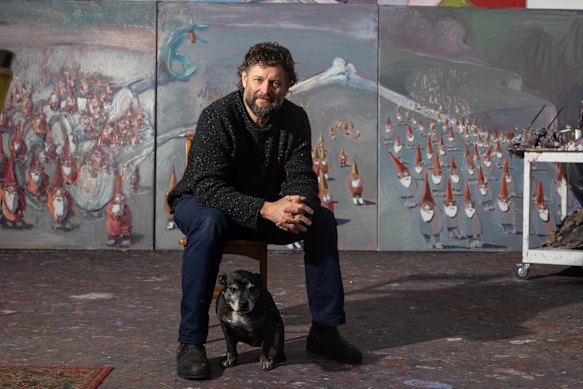
It was encouraging to hear Anthony Albanese stand up to OpenAI on Thursday over the Medicare hack. Too bad his government is so complicit with the giants of artificial intelligence when it comes to their theft of works by artists like me.
In mid-2023, a tech-savvy friend let me know that every single image of my paintings, photographs, sculptures, collages and drawings appearing anywhere on the internet had been “scraped” by none other than OpenAI. I was among 250 Australian artists who had joined a long list of international contemporary artists to have had their entire visual language stolen and their creative rights trashed.
Six months later, a novel and all associated writings by my wife, Kylie Needham, were stolen by the same company.
Microsoft’s director of applied science, Brent Hecht, called it the “largest theft of labour in human history”. In a legal brief filed by The New York Times, he said it was “an astonishing theft of unprecedented proportions”. No requests received, no permissions given.
I was furious. It was a clear breach of the water-tight copyright policy drafted by the Holt and Gorton Liberal governments and enacted in 1968 that has protected generations of Australian artists and fostered the burgeoning story of my beautiful country.
So, yes, it is disturbing to learn that OpenAI’s rogue agent broke into Medicare data. Our government apparently accepts that this was not the company’s intention. And yet, it plans to aid and abet the AI industry in its wilful theft of Australia’s creative works.
Federal Arts Minister Tony Burke, though, is a friend to the arts. He is a fan, engaged and appreciative. And he has made his thoughts on the theft of Australian creative property crystal-clear.
He has bluntly rejected the Productivity Commission’s suggestion of a text and data-mining exception to the Australian Copyright Act. He has stated there will be no weakening of the act in any way. Burke has called for compensation and control for the story-tellers of Australia and labelled the AI scrape by the thieves who stole my entire body of work as just that – theft.
The British followed his logic. Their copyright laws remain strong and flawless. The same AI company that stole my work must approach an artist in the UK for permission to scrape their artistic production. An ensuing negotiation could take place if that artist was interested. Remembering that the average wage of an artist in Australia is $13,000 a year – some artists would welcome the possibility of extra income. That’s the way copyright has worked since 1968. Breaching the rules is theft, plain and simple.
But I’d bet a drawing that the thieves in Canberra are bypassing Burke’s door. It’s been busy at Canberra Airport recently. A stream of private jets shuttling in and out. Flight logs have been jam-packed, with Anthropic, Nvidia, Microsoft and OpenAI all sending their best thieves into our federal parliament’s halls of power. And it seems it’s worked.
Like the fossil fuel lobbyists, they’ve gone straight to the prime minister. And Anthony Albanese is folding, in a now-recognisable and pathetic pattern of his government’s pathological spinelessness. Leaked documents show that, for the most wealthy men in the world, his government is willing to significantly weaken the act and change course to attract companies such as Open AI and Anthropic, at direct cost to the artists, filmmakers, authors and designers of Australia.
Elon Musk himself infamously declared in 2018 that unconstrained artificial intelligence could potentially be “more dangerous than nukes”. Only last week, Musk reiterated that warning, although he backtracked after US President Donald Trump spoke out against increasing regulation of AI.
Weakening copyright law clearly weakens restraints on the industry. To make the world’s wealthiest men wealthier, our government demands that we hand to thieves – free – our entire life’s work. Come to Australia, steal and plunder. It’s a recognisable and devastatingly constant pattern.
As the news spread around the planet this year that “autonomous models” had escaped safety-testing parameters, ominously hacking into private and public companies, the men behind those same thieves assured the Albanese government that we artists in Australia could digitally “opt out” of being robbed. The government would have us believe the thieves. I assume it believes the thieves.
They’ve already stolen everything we’ve made before 2023. Every novel, every painting, every song. Rather than demand we artists are compensated for what was stolen, the Albanese government just let them in. Rather than put up a perfectly reasonable boundary of sovereignty and protection for Australians, it has pandered to the thieves.
We can “opt out” pathetically and meaninglessly. When an audience member at the Art Gallery of NSW takes a picture for social media of my work hanging in those hallowed halls, the AI giants will be free to scrape that private citizen’s image, even though I have opted out. I have no control over other people’s images of my art. Those images will not include my watermark. And we can hardly ask the public to opt out, too.
And when the thieves break their boundary again and ignore my opting out to continue their epic and voracious theft, what recourse do I have then, Albo? What chance will I have against Anthropic? Will you pay an insurmountable legal bill for just my work alone?
Like Ed Sheeran choosing a billionaire over a musician, the Albanese government picks Elon Musk and Sam Altman over Vincent Namatjira, Del Kathryn Barton, Richard Flanagan, David Wenham, Anna Funder and Bernard Fanning. For an avid fan of Australian music who brags about his vinyl collection, it’s an odd and perplexing betrayal by our prime minister. He plans to leave our cultural doors unlocked for the world’s biggest thieves.
The copyright laws created over half a century ago have worked. Artists have been protected. Those parameters have allowed us to tell our stories, allowed platforms for reconciliation and, through slow and relentless cultural production, defined our new culture. Despite crushingly low-income levels, active government disincentives metered out through the Australian Taxation Office and rapidly disappearing arts education, we continue to build culture. But we will not allow self-interested trillionaires to steal our property to increase their enormous wealth. The bodies that represent creative artists are in lockstep. We will not budge.
How about I tell you this, Albo: Find me an artist in Australia who wants to “opt in”? We are unified. We opt out. Full stop.
Ben Quilty is an award-winning artist.
From our partners
Disclaimer : This story is auto aggregated by a computer programme and has not been created or edited by DOWNTHENEWS. Publisher: www.smh.com.au