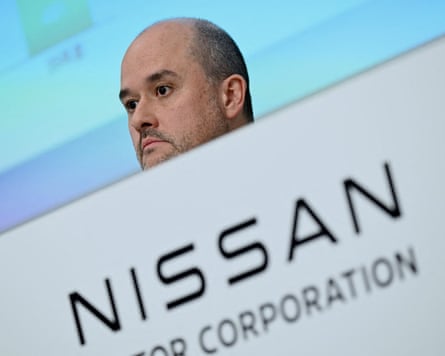
Nissan’s chief executive has confirmed he would consider building cars for other manufacturers at the UK’s largest car factory in Sunderland, amid talks with China’s Chery.
Ivan Espinosa said Nissan was “looking at options” for Sunderland and its 6,000 workers as the struggling Japanese carmaker on Wednesday reported steep losses for the year to March.
Nissan announced last week it was closing one of its two production lines at Sunderland, in north-east England, because of faltering demand for its vehicles. However, it has held talks to produce vehicles on behalf of Chery, according to industry sources. Chery is pushing aggressively into the UK and Europe with its Chery, Jaecoo and Omoda brands.
Asked about the Chery talks on Sunderland, Espinosa said: “The plant is operating well, is a viable plant. The problem that we have at this location is the volume. So if we can find a smart way of bringing more volume in, we might consider doing something.”
Espinosa added that there was “nothing specific about any partner to announce today, or any options, but this is something that we would likely look into considering”.
Several carmakers in Europe have discussed sharing factory space with Chinese manufacturers. Ford has reportedly held talks with Geely over the sale of part of a plant in Valencia, Spain, while Stellantis – the owner of brands including Fiat, Peugeot and Vauxhall – announced last week it would build cars for Leapmotor at its factories in Madrid and Zaragoza.
BYD, the world’s largest maker of electric cars, is negotiating with Stellantis and other European carmakers over potentially taking over underused factories, Stella Li, the Chinese firm’s executive vice-president, told Bloomberg on Wednesday.
“We are talking to not only Stellantis, we’re talking to other companies too,” Li said at a Financial Times conference in London. “We are looking for any available plant in Europe because we do want to utilise this kind of spare capacity.”
Sales of Chinese-made cars in Europe have soared in recent months, with China’s manufacturers able to undercut European rivals because of lower costs. Several European firms have concluded that it is better to take the money on offer from Chinese competitors for underused plants as they try to reduce their own manufacturing costs.
Nissan’s European operations are a relatively minor part of its global business, but the Sunderland plant has nevertheless been caught up in its global struggles. Last week, it announced the merger of two lines producing the Juke, Leaf and Qashqai models and 900 job cuts across Europe, including a small number of UK office roles.
On Wednesday, Nissan posted a net loss of ¥533bn (£2.5bn) for the last financial year. Operating profits fell nearly 12% on the previous year to ¥58bn, with that figure expected to reach ¥200bn next year.
Espinosa was made Nissan chief executive a year ago with a mandate to cut costs and help return the company to profitability.
Espinosa said he wanted Nissan to become capable of collaboration with external partners, “because this is what the environment is asking us to do”.
Nissan was battered during the last year by Donald Trump’s tariffs on imports to the US, as well as tough competition in China, in particular. Nevertheless, Espinosa said the company’s “progress has been steady, despite an uncertain operating environment”.
Disclaimer : This story is auto aggregated by a computer programme and has not been created or edited by DOWNTHENEWS. Publisher: theguardian.com