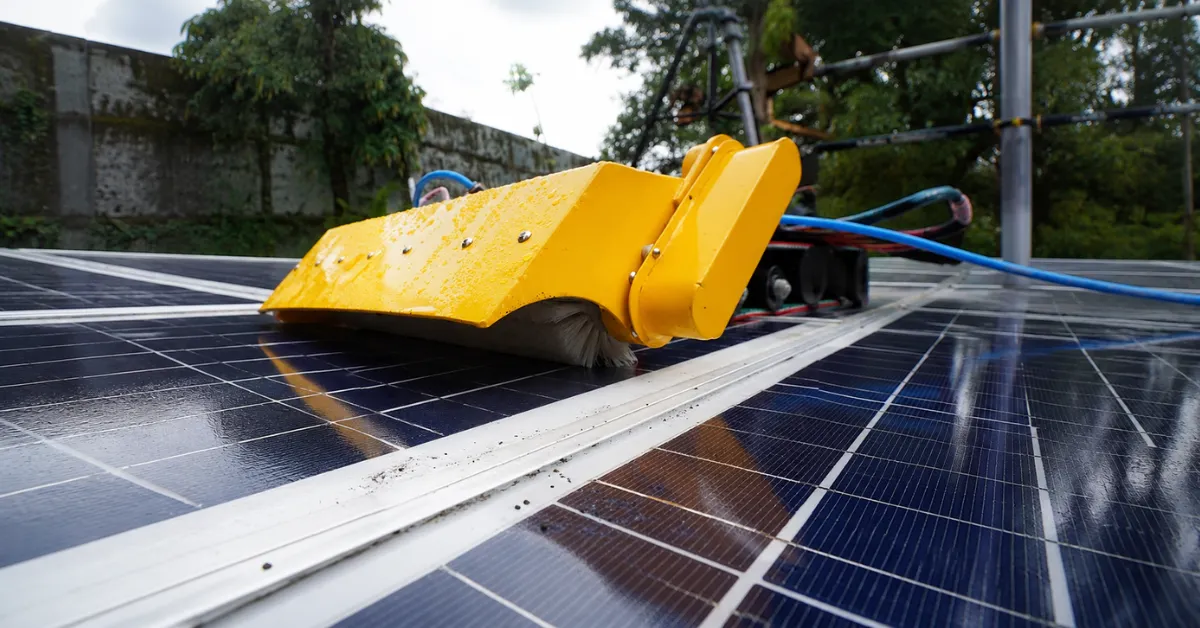
Solar panels need sunlight to work well. But in many parts of India, dust, bird droppings and pollution can quickly build up on their surface and block that sunlight.
For large solar farms in dry and dusty regions, keeping thousands of panels clean is a constant task. Dirt can reduce the amount of electricity the panels generate, while regular cleaning can use large amounts of water and require significant manpower.
Researchers at the National Institute of Technology (NIT) Rourkela have now developed an Artificial Intelligence-powered system that could make this process far more targeted.
The system can monitor solar panels, identify which ones need cleaning and focus only on those areas. This could help solar plants use less water and labour while keeping panels working efficiently.
An AI system that knows when cleaning is needed
The technology has been developed by Prof. Arun Kumar, Assistant Professor, Prof. Bibhudatta Sahoo, Professor, and research graduates Dr Lopamudra Hota and Dr Biraja Prasad Nayak from the Department of Computer Science and Engineering at NIT Rourkela.
The team has secured an Indian patent titled “Federated Learning-based Autonomous System and Method for Monitoring and Cleaning Solar Plant”.
Photograph: (Nevron Express)
The problem they are trying to solve is becoming increasingly important as India adds more solar power capacity.
According to the researchers, solar farms in dry and dusty areas can lose up to 40% of their energy generation because of dust, bird droppings, industrial pollutants and other material settling on the panels.
Cleaning these panels regularly brings its own challenges.
Many existing systems depend heavily on labour and water. Solar farms also often clean panels according to a fixed schedule, whether every panel needs cleaning or not.
This can mean spending time, money and water cleaning panels that are already working well.
So, how does the system work?
The NIT Rourkela team has developed a system that uses Artificial Intelligence to continuously check the condition of solar panels.
It can detect faults, study real-time conditions and recommend which panels actually need cleaning.
So instead of cleaning an entire solar farm at fixed intervals, operators could focus only on the panels that need attention.
The system uses a type of AI called Federated Learning, or FL.
In simple terms, Federated Learning allows different devices or systems to learn from data without sending all the original information to one central server.
/filters:format(webp)/english-betterindia/media/media_files/2026/08/07/nit-rourkela-2026-08-07-16-01-18.png)
The technology has so far been tested through simulations and is currently at Technology Readiness Level 3, or TRL-3. This means the basic idea has been demonstrated as a proof of concept under controlled experimental conditions.
Keeping solar plant data protected
Another important part of the system is the way it handles data.
Many conventional AI systems collect raw information from different locations and send it to a central server for processing.
The NIT Rourkela system follows a different approach. It uses a privacy-preserving Federated Learning architecture, where encrypted information is shared instead of raw operational data.
The researchers say this approach can reduce concerns around data privacy, cybersecurity and the amount of internet bandwidth required. It could also make the technology easier to scale across larger solar installations.
Speaking about the technology, Dr Arun Kumar, Assistant Professor at NIT Rourkela, said, “The patented system combines federated learning, edge computing, artificial intelligence, autonomous cleaning, and predictive maintenance into a single integrated sandbox platform.”
He added that features such as real-time intelligence, automatic fault detection, selective cleaning, lower water use and reduced maintenance costs make the system unique.
Where could this technology be used?
The researchers say the system could work across many different types of solar installations.
These include large utility-scale solar power plants, floating solar farms, rooftop solar systems, industrial solar parks, smart city energy infrastructure, defence installations and remote off-grid renewable energy systems.
/filters:format(webp)/english-betterindia/media/media_files/2026/08/07/nit-rourkela-2026-08-07-16-04-36.png)
This means the technology could eventually be useful for both large energy producers and smaller renewable energy networks looking to reduce the effort and cost involved in maintaining solar panels.
Could it make solar cleaning cheaper too?
The researchers also believe the technology could significantly reduce the cost of maintaining solar panels.
Prof. Bibhudatta Sahoo of NIT Rourkela says many existing solutions come with high upfront costs and offer limited intelligence.
Their system, he says, brings several AI-based functions together so that monitoring, decision-making and cleaning can happen more automatically.
“While current market solutions suffer from high capital costs and limited intelligence, our developed system integrates advanced AI capabilities for autonomous operation,” he said.
Once developed for large-scale field use, the researchers expect the system to offer its features at around 10% of the cost of existing systems.
/filters:format(webp)/english-betterindia/media/media_files/2026/08/07/nit-rourkela-2026-08-07-16-05-46.png)
What happens next?
So far, the system has been tested through simulations.
The team’s next step is to build a physical hardware prototype and connect it with Internet of Things, or IoT, sensors.
These sensors would help collect information directly from solar installations and allow the researchers to test how the system performs outside the laboratory.
The team plans to move from simulation-based testing to pilot projects in real-world conditions.
They are also looking to work with government agencies and industry partners to support field testing and eventually transfer the technology for wider use.
Future versions of the system could include drones for inspecting solar panels, multiple cleaning machines working together and AI tools that can predict how much energy a solar plant is likely to generate.
Helping solar farms get more from every panel
India is expanding its solar energy infrastructure as part of its National Solar Mission and its larger Net Zero goals.
As more solar farms are built, keeping them efficient without using excessive water, labour and money will become an important part of the challenge.
The NIT Rourkela team’s system aims to make that maintenance more intelligent by checking which panels need attention and focusing cleaning where it is actually required.
If the technology performs successfully in real-world trials and is eventually used at scale, it could help solar plants generate more power while using fewer resources.
Disclaimer : This story is auto aggregated by a computer programme and has not been created or edited by DOWNTHENEWS. Publisher: thebetterindia.com