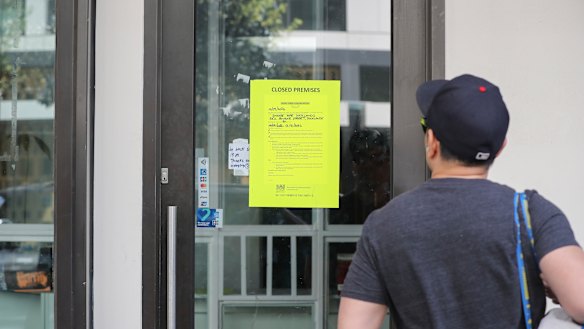
Black-market tobacco shops are scrambling to come to grips with a new crackdown by state licensing authorities, which can now shut down operators for up to 90 days, with the crime syndicates forced in some areas to sell illicit cigarettes only outside business hours when inspectors are rostered off.
Victoria’s illicit tobacco market – long regarded as the largest, most lucrative and most violent in the country – is now experiencing its first significant shocks after the state government implemented long-delayed “shut-down” powers that came into effect on September 9.
Tobacco Licensing Victoria has issued closure orders to 48 stores in the past fortnight following raids in the CBD, inner suburbs and in the city’s west.
Nearly a quarter of those targeted have been in and around Chapel Street, which has become notorious for the number of shops slinging illicit tobacco. It has also been a major focal point for the firebombings that have plagued the market during the more than three-year-old “tobacco war”.
More than a dozen stores have been shuttered in the CBD, mainly around Swanston and Elizabeth streets.
“Since closure powers came into effect, TLV has wasted no time using their new strong powers to disrupt the illicit tobacco trade,” a TLV spokesperson said.
“Our enforcement activity is making it clear to illicit operators that if you break the rules, you will be shut down.”
There are estimated to be 8000 retailers selling tobacco across the state, of which close to 20 per cent – about 1600 – are black-market operations.
Victoria is one of the last states in Australia to issue closure powers to regulators despite persistent lobbying by law enforcement and legitimate retailers and its undisputed position as the most deeply infiltrated market by organised crime in the country.
While TLV’s inspection blitz has only scratched the surface of Victoria’s multibillion-dollar market, word has spread rapidly among operators and the crime gangs that back them that a new crackdown has begun.
Social media has also been lighting up with reports of the raids as smokers and vapers look for alternative supplies.
It took only minutes for a TLV blitz launched in the Geelong area on Tuesday to be announced on a local crime watch Facebook page.
One local in South Yarra, who requested anonymity for fear of reprisals, said the Chapel Street operators that are still in business “looked very nervous”. “At least four of my vape shops have been closed down in the last two weeks,” she told The Age.
Illicit distributors and retailers have been bracing for the action for some time and have already begun to adapt with new strategies designed to keep the product flowing to market and avoiding the inspections.
Some outlets in the zones that have been targeted are only selling illicit packets after business hours or on weekends in the belief that TLV inspectors do not operate outside the standard working week.
“No cigarettes Monday to Friday. Only weekends now,” one CBD operator told The Age.
There have been other reports of operators telling smokers that packets were only available daily after 3pm or 5pm.
“These guys [inspectors] normally work nine to five, and not on weekends. So what they’re doing now is just opening up after hours and selling it,” said an underworld source, who cannot be identified publicly.
Other shops have shifted their illicit stockpiles to the boots of vehicles or keep them in boxes disguised to look like refuse in order to avoid detection during inspections. Phone calls or messages are sent to runners outside, who bring the product in at the point of sale.
Supply deliveries are also being cut back to avoid piles of stock ahead of potential raids.
TLV said inspectors were now finding smaller quantities of illicit tobacco in shops, while others were known to have pre-emptively closed.
Dr James Martin, a criminologist at Deakin University who specialises in mapping out the dynamics of illicit markets, said the rapid change in behaviour by the shop operators was “classic black-market adaptation”.
“Bureaucracies are slow, and these black-market operations learn very quickly. By the time TLV begins to implement a plan, organised crime is already making adjustments – coming up with a way to get around them. It’s a multibillion-dollar market in Victoria alone, so they are not going to stop.”
Martin said the same measures were put in place in other states when closure powers were implemented much earlier.
“Customers are still finding suppliers and vice versa. We’re not seeing a slowdown in the trade, it’s just finding alternate routes to market. They’ve always got the initiative.”
The illicit tobacco market is worth more than $8.5 billion nationwide. Black-market products now account for 80 per cent of nicotine consumed in the country, according to the Australian Bureau of Statistics. Illicit vapes make up nearly 96 per cent of the market.
Despite the looming crackdown, prices for packets of the top-selling but illicit cigarette brand in Australia, Manchester, have so far remained stable or even fallen in some areas.
A packet purchased by The Age in the northern suburbs on Wednesday cost just $16, nearly the lowest price point for 2026. A packet of legal cigarettes costs at least $39.
The TLV had been struggling to get traction on the massive scale of the black market after the agency was belatedly created earlier this year. It has been plagued by a limited number of inspectors, a refusal to target shops with known organised crime links due to safety concerns, and allegations of a lack of co-operation with police and internal cultural problems.
Inspectors have previously focused much of their attention on allegedly “low-hanging fruit” like supermarkets and petrol stations.
No criminal prosecutions have been launched to date by TLV, according to court records, despite pledges by government and the regulator to hold illegal operators to the full account of the law. The agency said about $11.4 million worth of illicit tobacco had been seized to date.
It comes as new funding has tripled the number of inspectors to about 45.
The Age has previously reported that syndicate operators in Victoria were preparing for the crackdown by removing tobacco branding from store signs, converting shops into what appear on the surface to be cafes, and shifting to selling through encrypted apps and online websites.
It has also become increasingly common in Victoria for other businesses like laundromats, cafes, takeaways, barbershops and car washes to begin selling tobacco under the counter.
“Look at Queensland. The market hasn’t stopped, it’s just shifted,” an underworld source said. “There’s a pizza shop doing $250,000 a week [in tobacco] now.”
The shift is now also playing out in the types of venues being targeted by law enforcement.
Earlier this month, regulators and the Australian Border Force staged a series of tobacco raids in and around Adelaide that included targeting delicatessens and a hairdresser along with unlicensed tobacco shops.
With a number of syndicate operators also currently facing investigation or prosecution for money-laundering offences, some operators have been taking proactive new measures to cover up the telltale illicit money trail.
This has included shop operators using a rotating series of corporate entities to mask the destination of funds from point-of-sale terminals.
Financial records obtained by The Age show one major illicit retailer in Melbourne’s northern suburbs has posed on paper as three different milk bars and convenience stores and a cleaning company over the past year.
Start the day with a summary of the day’s most important and interesting stories, analysis and insights. Sign up for our Morning Edition newsletter.
From our partners
Disclaimer : This story is auto aggregated by a computer programme and has not been created or edited by DOWNTHENEWS. Publisher: www.smh.com.au