
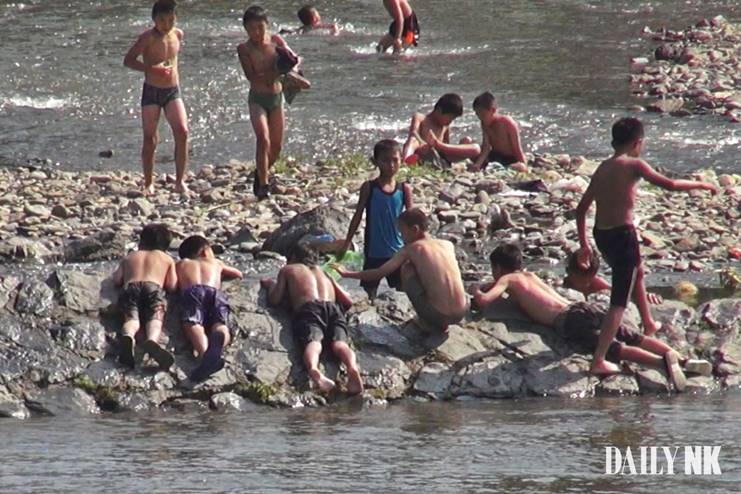
North Korean children are flocking to rivers and streams to cool off during the summer heat, even on rainy days. Almost no safety personnel or rescue equipment is on hand at these sites.
A Daily NK source in North Pyongan province said Wednesday that a heat wave has continued across Ryongchon, Phihyon and Yomju counties. Daily rain has added to residents’ discomfort. “In the past, rain at least brought the temperature down and offered some relief,” the source said. “These days, it’s hot and humid even when it rains.”
Clothes and bedding do not dry properly in the damp weather, the source said. Many people end up wearing clothes that never fully dried, which adds to strain on people. Even indoors, the air stays sticky, causing damp clothing and bedding to smell. Some people now say they wish the weather would settle on being either rainy or hot, rather than both at once.
Children struggle to stay indoors under these conditions, the source said, with many heading to the water even during heavy downpours.
No lifeguards, no rescue gear at swimming spots
Children in Ryongchon county are currently seeking out rivers, streams, reservoirs and puddles near their homes to beat the heat. The trouble, the source said, is that almost no one watches over children at these sites. Almost no one is ready to respond if something goes wrong either. Basic rescue equipment, such as tubes, is also largely absent.
Parents want to keep their children away from the water, the source said, while electricity is too unreliable to run cooling devices at home. Children grow exhausted and irritable in the heat and humidity and many parents feel they have no real alternative to letting their children go swimming.
The danger grows sharper during heavy rain. River currents speed up and water suddenly deepens, the source said, adding that there are no markers for dangerous areas. There are no measures to keep children away from them either, which deepens parents’ anxiety.
Schools do provide summer water safety education, the source said. But parents say posting staff at the sites where children actually swim would do more good than formal classroom lessons. Patrol and security teams usually focus on cracking down on locals. Some parents say those teams could instead watch over swimming areas for the summer to help prevent accidents.
“Parents worry every day while they’re out working, afraid something might happen to their children,” the source said. “Many say they wish schools or local authorities would identify the spots children go to swim.” The source added that parents want even one or two people stationed there to help with safety and rescue.
A safer environment for children to play in would ease that burden, the source said. Working parents could focus on their jobs with more peace of mind. “Right now, parents can’t stop their children from going to play in the water, and there’s no guarantee of safety either,” the source said. “That’s why they say they can’t fully concentrate on their work.”
Reporting from inside North Korea
Daily NK operates networks of sources inside North Korea who document events in real-time and transmit information through secure channels. Unlike reporting based on state media, satellite imagery, or defector accounts from years past, our journalism comes directly from people currently living under the regime. We verify reports through multiple independent sources and cross-reference details before publication.
Our sources remain anonymous because contact with foreign media is treated as a capital offense in North Korea — discovery means imprisonment or execution. This network-based approach allows Daily NK to report on developments other outlets cannot access: market trends, policy implementation, public sentiment, and daily realities that never appear in official narratives.
Maintaining these secure communication channels and protecting source identities requires specialized protocols and constant vigilance. Daily NK serves as a bridge between North Koreans and the outside world, documenting what’s happening inside one of the world’s most closed societies.
Disclaimer : This story is auto aggregated by a computer programme and has not been created or edited by DOWNTHENEWS. Publisher: dailynk.com


