

″That’s not corruption, that’s inflation.” That’s Victorian Premier Jacinta Allan’s repeated attempt to assure her state’s taxpayers, and voters, that the infiltration of her government’s signature Big Build program had not added meaningfully to its $100 billion price tag.
It is a line she, and her ministers, have deployed reflexively as they have resisted rising calls for a royal commission into the construction industry amid mounting evidence of union misconduct and the sector’s infiltration by organised crime.
The argument is that, while the culture in Victoria’s building industry might have been “rotten”, to use another of Allan’s catchphrases, and the revelations in this masthead’s Building Bad were, again, in her words “shocking”, there was no systemic-level dollar cost to the projects that employed the bikies, paid the corrupt contractors and were dominated by a bent union.
Many economists knew immediately the state’s embattled leader was being disingenuous.
Supporting her narrative, the Premier, who faces an election in November including a fierce battle to retain her own regional electorate of Bendigo East, has particularly leaned into work from two respected economists, one being Saul Eslake.
“Economists like Saul Eslake, for example, have pointed to the fact that the inflationary rates here in Victoria have been less than those experienced in other states,” she said at a press conference.
Allan’s ministers have also pointed to it in parliamentary debates, the logic being that if Victoria’s industrial relations problems made it an outlier, then that would show up in the cost of doing business in this state.
Eslake’s work, along with that of respected academic David Hayward, was subsequently deployed by building unions as they also try to head off a royal commission, and to dispute the estimated multibillion-dollar cost of CFMEU misconduct.
Hayward, who concluded blowouts on projects were not the result of widespread corruption but rather changes in scope and other conditions, still believes an inquiry would be worth holding to get to the bottom of these questions.
“The trouble is this: however you cut it, we are talking about a lot of public money ending up in the wrong hands,” Hayward wrote in a piece for this masthead.
The union-backed Check the Maths website used Eslake and Hayward to critique estimates by corruption expert Geoffrey Watson, SC, that Big Build wrongdoing by union bosses and gangland figures could have cost Victorian taxpayers as much as $15 billion.
The debate is something of a straw man as no credible voice would dispute there was inflationary pressure from global events such as the end of the pandemic and the conflicts in Ukraine and the Middle East.
Untangling where those pressures end and the price of worksite graft begins is fiendishly difficult.
Eslake, stuck in the middle of a brouhaha he didn’t see coming, told this masthead that he was never asked in his March work for PICAC to probe the price of union misconduct and had not even read Watson’s report.
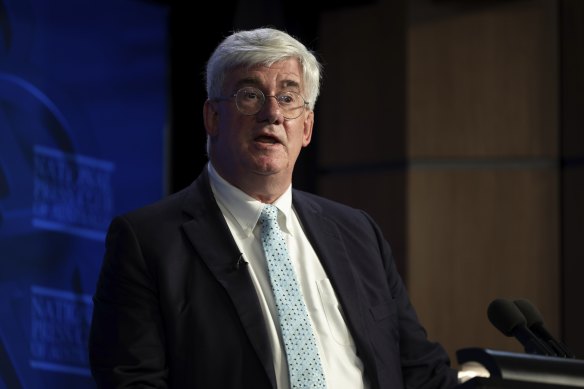
“Frankly I had no idea it would be used in that way,” the economist said. “I don’t think what I wrote proves or disproves anything about corruption. It doesn’t tell you anything about who benefited from the increase in prices.”
“I was not asked to make any judgment about the Big Build, and I didn’t make any.”
What Eslake’s work did find was that on average, engineering construction inflation in Victoria “over the past 11 years … rose at a slower rate in Victoria than in the rest of Australia”.
Economists contacted by this masthead agreed with Eslake that non-residential construction sector inflation numbers themselves shed little light on the nature or extent of corruption in the building industry.
“The fact that (inflation) is lower is no evidence that there hasn’t been corruption,” a leading national economist told this masthead, but who declined to be named given the nature of the players alleged to have acted corruptly in the sector.
“To the extent that corruption has added cost onto these things, that would already be baked into that (inflation). That figure (could) already include any additional charge for corruption.”
The way the Australian Bureau of Statistics calculates inflation in the non-residential construction sector is a complex process.
While the Consumer Price Index, which measures how much the price of everyday items goes up or down, uses a simple representative basket of goods and services that households purchase to track the cost of living, in the construction sector inflation is represented by the Producer Price Index for Non-Residential Construction.
For the ABS, construction inflation is driven by five core factors: material supply costs, labour shortages and wage pressures, energy and fuel volatility, financing expenses and sustained high demand.
In the March quarter, prices for non-residential building construction nationally rose 1 per cent, driven by rises in Victoria, New South Wales, and Queensland. In Victoria, in the three months to March 31, prices rose 1.3 per cent for an annual change of 4.5 per cent. The national annual rate of increase was 4.3 per cent.
In contrast to the readily understood CPI calculation, the ABS number for construction inflation is calculated by tracking the change in the prices of goods and services as they leave the place of production, that is, what a contractor charges to sell a product.
“The fact that (inflation) has gone up less in Victoria than other states isn’t evidence that there has not been corruption at all because there are a lot of different things contributing to that (inflation figure),” said another economist who declined to be named.
“There is no practical way you could actually disentangle them. The ABS survey doesn’t ask ‘oh, you put your prices up 10 per cent this year, how much of that was wages and how much was kickbacks to the Bandidos?’, it’s just not measured in that way.
“There is nothing that the ABS publishes that could get to the bottom of that question of how much Victorian non-residential build cost is due to wages, components, materials, regulation or corruption.”
Industry experts warned that productivity-reducing and cost-increasing provisions in union-backed enterprise agreements make it considerably more expensive to deliver construction projects – ultimately driving higher inflation across the economy.
“Whenever enterprise agreement provisions increase costs, reduce productivity and magnify inefficiencies, creating new homes and infrastructure becomes more expensive,” Master Builders Australia chief economist Shane Garrett told this masthead. “This puts upward pressure on inflation right across the spectrum.”
A few days after Allan blamed Big Build cost blowouts on inflation, not corruption, Watson, who is also a director of The Centre for Public Integrity, described her comments as “nonsense”.
He reiterated his calls for a royal commission, saying it was the only way to address the corruption. “It’s time to stop making excuses and to address the issue,” he said.
Watson’s Rotting from the Top report, tabled in the Queensland inquiry, contains insightful examples that show how corruption adds to costs in ways that might not be caught by the ABS.
He cites a builder who had historically let traffic management contracts to companies for $70 to $80-an-hour.
A CFMEU representative then came on the scene and explained that the CFMEU would now be controlling these contracts, adding that if the builders did not acquiesce to CFMEU demands the sites would be closed.
“The builders had no choice,” Watson wrote.
The hourly rates for traffic control were increased to $110 to $120-an-hour at an estimated cost to the Victorian taxpayer of $50 million to $60 million on the North East Link alone.
In a second example, Watson cites an executive who explained how on a level
crossings removal project, contractors not aligned with the CFMEU simply gave up trying to get and keep the work.
“Prices were only received from CFMEU-aligned contractors, immediately forcing up labour costs by 20 per cent – and this was on a labour-intensive $360 million project, costing the taxpayer another $50 million plus,” Watson wrote.
The Building Bad investigation has reported similar inflationary pressures because of corruption, with infrastructure companies repeatedly warning the Victorian government between 2022 and 2024 that CFMEU demands had inflated labour costs on the Metro Tunnel.
The leaked consortium’s report warned the state government about cost blowouts by 22 per cent above what would be required under existing industry norms in Victoria.
It estimated $196.4 million of its labour costs were driven wholly by union-backed staffing and outlined how contractors were forced to add on additional non-productive workers.
These inflated costs would feed directly into the inflation calculation. The consortium also claimed that hyper-escalation of materials had also affected its ability to constrain costs.
Interestingly, its claim for those aspects, such as concrete, steel and electrical supplies, came in at $193 million or roughly the same as its accounting for its industrial strife.
According to a report by Transparency International, An Overview of Corruption and Anti-Corruption in Infrastructure Development, corruption in infrastructure projects can have serious inflationary consequences.
“Corruption in infrastructure provision is likely to increase prices and inflate project costs,” the report said.
“Price inflation can manifest itself in wages or material costs in the awarded contract, as well as later during contract implementation. Corruption can cause delays in project completion.
“Corrupt practices often lead to the award of contracts to entities that may not have the capacity to complete the project within the agreed timelines. Delays in project completion may lead to cost overruns.”
Other ways corruption can drive inflation in construction include the likes of collusion, bid rigging, extortion and bribes, all of which would also be captured in official inflation statistics.
The alternative reality being painted by Jacinta Allan when she asserts that inflation, not corruption, is to blame for the Big Build cost blowout isn’t one Victorians should be too comfortable with either, economists warn.
“A denial of corruption would strike me as an endorsement of bureaucratic and government gross negligence of managing (projects),” the economist said. “That’s very important for the state because you are borrowing so much money to pay for it.”
And that, the economist warns, will impact all Australians into the future.
“It’s a significant issue for the whole industry, the whole country – the federal government guarantees Victoria’s debt so the whole country is on the hook for it.”
Corruption, inflation or a murky chicken-and-egg mix of both, we all pay.
Disclaimer : This story is auto aggregated by a computer programme and has not been created or edited by DOWNTHENEWS. Publisher: www.smh.com.au


