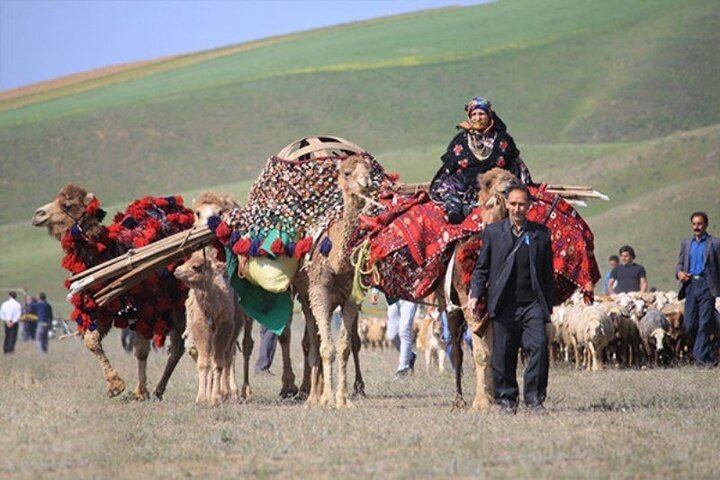
TEHRAN – Some 2,300 nomadic Kurdish households from North Khorasan and Razavi Khorasan provinces have begun their seasonal migration to winter pastures in northeastern Iran’s Golestan province, where they will stay until mid-May.
The families are settling in seasonal grazing areas across the counties of Maraveh Tappeh, Kalaleh and Gonbad-e Kavus, covering approximately 350,000 hectares, according to the provincial Department of Nomadic Affairs.
The annual autumn migration, which takes place between November 6 and May 5, brings nomadic communities and their livestock to the milder winter grazing grounds of eastern Golestan.
Mohammad-Sadeq Arab-Qaeini, director general of Golestan’s Department of Nomadic Affairs, identified the Khashtali, Qazanqayeh and Shalmi routes as the three main traditional migration corridors into the province.
He said arrangements had been made with local governorates, military and law enforcement authorities, veterinary services and natural resources departments to ensure the safety of migrating families and facilitate services along the routes and at their winter settlements.
Recent torrential rains have damaged a substantial section of the province’s nomadic road network, Arab-Qaeini said. Of the 350 kilometers of roads used by nomadic communities, 180 kilometers have sustained damage.
He added that arrangements had been made with construction contractors to repair the affected routes.
Support for the nomadic households will continue after their arrival, with several government agencies, including health centers, the education department, the National Iranian Oil Products Distribution Company, the provincial grain administration, the road maintenance department and the agriculture organization, involved in providing essential services.
Arab-Qaeini said the main provisions included drinking water, flour, kerosene, liquefied petroleum gas and livestock feed. Animal feed supplies include concentrated fodder, barley, dry forage and bran.
One nomadic union, eight cooperative companies and 12 retail outlets are involved in supplying and distributing essential goods, he added.
A centuries-old tradition of seasonal migration
Seasonal migration is an integral part of Iran’s nomadic way of life, shaped by the country’s varied climate, mountain ranges and extensive grazing lands. For generations, pastoral communities have moved between yeilaq (summer quarters) in cooler mountainous areas and qeshlaq (winter quarters) in warmer lowlands to find suitable pastures for their livestock.
These movements, traditionally undertaken on foot with herds of sheep and goats, follow established migration routes known as il-rah. The timing and direction of migration depend largely on seasonal weather conditions, pasture availability and access to water.
Among Iran’s well-known nomadic communities are the Qashqai, Bakhtiari, Shahsevan and Kurdish tribes, whose seasonal movements have helped preserve distinctive traditions of pastoralism, traditional crafts, music, food and social organization.
In northeastern Iran, Kurdish nomadic households from North Khorasan and Razavi Khorasan travel towards the winter grazing grounds of Golestan, particularly its eastern counties. Located southeast of the Caspian Sea and bordering Turkmenistan to the north, Golestan provides access to extensive lowland pastures that serve as seasonal destinations for migrating livestock herders.
Beyond its economic importance for livestock raising, nomadic migration remains a living expression of Iran’s cultural heritage, reflecting generations of accumulated knowledge about landscapes, climate, animal husbandry and the sustainable use of natural resources.
AM
Disclaimer : This story is auto aggregated by a computer programme and has not been created or edited by DOWNTHENEWS. Publisher: tehrantimes.com