
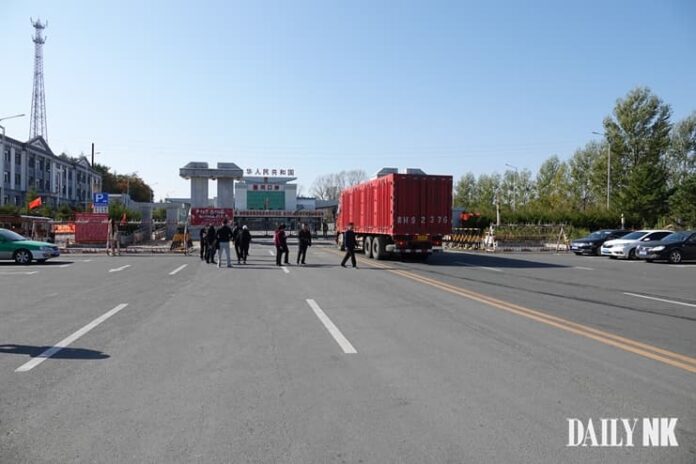
North Korea is expanding a minerals-for-investment arrangement with Chinese partners, offering raw tungsten and molybdenum ore as payment for mining equipment and capital. Trading companies in the Rason Special Economic Zone, a jointly designated free-trade area on North Korea’s northeastern coast bordering China and Russia, are leading the push, structuring deals that fall outside the scope of U.N. Security Council sanctions.
“Recently, some trading units in the Rason area have been holding investment talks with Chinese investors regarding mine development and the introduction of equipment,” a source in Rason told Daily NK recently. “In the process, they are offering raw minerals, including tungsten and molybdenum, as payment in exchange for investment.”
According to the source, trading companies including Wolmyong Trading Company have obtained permits for processing trade and are establishing joint ventures with Chinese partners in Rason. While the deals are formally structured as processing trade arrangements, they function in practice as barter transactions: Chinese investors supply mining equipment, and North Korean trading firms repay them in raw ore.
The trading companies have reportedly provided Chinese investors with detailed lists of required equipment, including excavators, slurry transport vehicles, heavy-duty freight trucks, and gold-processing machinery. In each case, raw minerals are offered in lieu of cash payment.
“What’s happening in Rason is that trade companies are setting up nominal processing firms, importing equipment and materials, and then repaying the investment in minerals,” the source said. “Rather than processed goods, which Chinese investors don’t favor, they are structuring deals around raw mineral ore that can be sold immediately.”
Sanctions gap fueling mineral trade
The arrangement appears to be gaining traction because of specific gaps in the U.N. sanctions architecture. Unlike coal and iron ore, which the U.N. Security Council banned North Korea from exporting in 2017, tungsten and molybdenum are not listed among the prohibited commodities under existing resolutions. Both metals are critical inputs for advanced industrial manufacturing and defense applications, making them attractive to Chinese buyers. North Korea has previously been identified as holding significant deposits of tungsten, one of the world’s largest.
“Chinese investors have shown strong interest in these minerals,” the source noted, explaining that Rason’s trade units are capitalizing on that demand by aligning deal terms with buyer preferences.
This pattern may be a deliberate strategy to generate foreign currency within the constraints of the sanctions environment. By keeping transactions at the raw ore stage, trading companies also reduce processing complexity and make the flows harder to trace.
Compared with other border trade hubs such as Dandong and Changbai, Rason appears to be operating with greater flexibility and more aggressive investor outreach. The source attributed this partly to the zone’s administrative structure, which allows for more straightforward company registration.
“Rason’s company establishment procedures are relatively easy compared to other areas, and there is a strong atmosphere of trying to flexibly adjust deal terms to meet investor demands,” the source said. “Most trading units are short on processing equipment, so the demand for investment is high, and they are trying to close deals quickly by accepting investor conditions as much as possible.”
Reporting from inside North Korea
Daily NK operates networks of sources inside North Korea who document events in real-time and transmit information through secure channels. Unlike reporting based on state media, satellite imagery, or defector accounts from years past, our journalism comes directly from people currently living under the regime. We verify reports through multiple independent sources and cross-reference details before publication.
Our sources remain anonymous because contact with foreign media is treated as a capital offense in North Korea — discovery means imprisonment or execution. This network-based approach allows Daily NK to report on developments other outlets cannot access: market trends, policy implementation, public sentiment, and daily realities that never appear in official narratives.
Maintaining these secure communication channels and protecting source identities requires specialized protocols and constant vigilance. Daily NK serves as a bridge between North Koreans and the outside world, documenting what’s happening inside one of the world’s most closed societies.
Disclaimer : This story is auto aggregated by a computer programme and has not been created or edited by DOWNTHENEWS. Publisher: dailynk.com




