
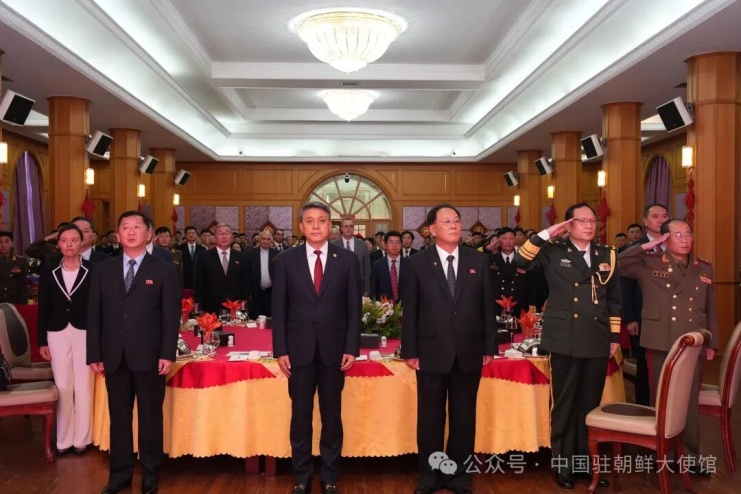
The Chinese Embassy in North Korea held a banquet on July 28, 2026. The event marked the 99th anniversary of the founding of the Chinese People’s Liberation Army. North Korean military officials, including Minister of National Defense No Kwang Chol, turned out in large numbers to showcase friendly ties between the two countries.
North Korea has since reportedly conducted political study sessions for party and administrative officials, stressing the countries’ “blood alliance.”
A source in Ryanggang province told Daily NK on Tuesday that a large-scale lecture series followed immediately after the July 28 banquet aimed at provincial party and people’s committee officials. The lectures centered on the theme of “carrying forward and developing the traditional friendship forged in blood.”
According to the source, the lectures were meant to showcase the traditional North Korea-China blood alliance and tighten internal unity. This comes at a time when North Korea faces international sanctions and strengthening security cooperation among South Korea, the United States, and Japan.
The lectures reportedly went beyond simply emphasizing friendship with China, however. They also included a stern warning to focus on stamping out smuggling and other “deviant behavior” in border areas.
Speakers pointed out that non-socialist elements, such as smuggling along the border with China, could undermine the stability of North Korea-China relations, the source said. They instructed that border areas maintain the highest level of vigilance.
As border controls tighten further, local officials are reportedly reacting with a mix of complicated feelings and tension. They feel relief that solidarity with China, a traditional ally, is strengthening, but they also worry about internal unrest. Many North Korean people rely on smuggling for their livelihoods, and tighter border controls and crackdowns are making that harder.
A blood alliance with tighter chains
The source said that channels for the inflow of outside goods are being more thoroughly cut off, which is expected to deepen the North Korean people’s economic hardship as a result. At the same time, the authorities’ ideological control and enforcement systems are growing more entrenched. Even officials are lamenting this contrast. Leaders proclaim a blood alliance at banquets in Pyongyang, but for the North Korean people who live along the border, it only means tighter chains.
According to the Chinese Embassy in North Korea, about 150 people attended the July 28 banquet. Attendees included diplomats and military attaches based in North Korea, as well as senior North Korean party, government, and military officials. Chinese attendees included Ambassador Wang Yajun, Minister-Counselor Qi Han, and Defense Attache Wang Yicheng.
Attendees on the North Korean side included Minister of National Defense No Kwang Chol. Workers’ Party of Korea International Department Deputy Director Mun Song Hyok also attended. Korean People’s Army General Political Bureau Deputy Director Pak Yong Il and Vice Foreign Minister Kim Myong Su were also present.
Rounding out the North Korean delegation were Ministry of Social Security Vice Minister Ri Chol U and Diplomatic Corps Affairs Bureau Director General Kim Ik Song. Navy Deputy Commander Kwon Hyok Song and Air Force Deputy Commander Choe Kwang Sik completed the delegation.
Last year, at the 98th anniversary banquet, North Korea sent only a vice minister of national defense. This year’s attendance by the minister himself marked a step up in rank, and some have interpreted the shift as reflecting the recent improvement in North Korea-China relations.
Reporting from inside North Korea
Daily NK operates networks of sources inside North Korea who document events in real-time and transmit information through secure channels. Unlike reporting based on state media, satellite imagery, or defector accounts from years past, our journalism comes directly from people currently living under the regime. We verify reports through multiple independent sources and cross-reference details before publication.
Our sources remain anonymous because contact with foreign media is treated as a capital offense in North Korea — discovery means imprisonment or execution. This network-based approach allows Daily NK to report on developments other outlets cannot access: market trends, policy implementation, public sentiment, and daily realities that never appear in official narratives.
Maintaining these secure communication channels and protecting source identities requires specialized protocols and constant vigilance. Daily NK serves as a bridge between North Koreans and the outside world, documenting what’s happening inside one of the world’s most closed societies.
Disclaimer : This story is auto aggregated by a computer programme and has not been created or edited by DOWNTHENEWS. Publisher: dailynk.com




