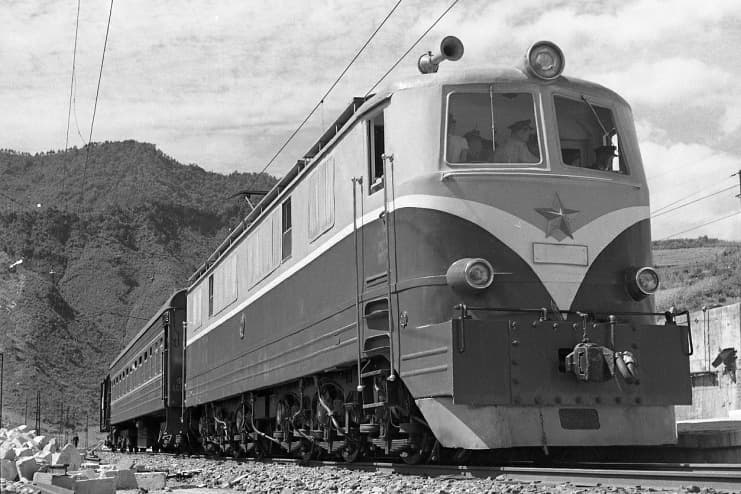
A North Korea train corruption scheme came to light on June 6, 2026, after two security officers clashed over a train compartment built to carry criminals under police escort. According to a source in Ryanggang province, a mountainous region in the country’s far north bordering China, the compartment had for years instead been used to smuggle merchants and their goods in exchange for bribes paid to railway officials.
The source, who spoke to Daily NK on Wednesday, said the dispute broke out between an officer escorting a criminal from South Hamgyong province to Ryanggang province and a security officer assigned to the train. The confrontation exposed how the compartment, known as the control car, had effectively been turned into a way to move merchants’ cargo.
North Korean trains set aside a separate compartment, the control car, for transporting criminals and others under surveillance, the source said. The officers who staff it are members of North Korea’s police force, the Ministry of Social Security, which is distinct from the country’s intelligence services. But the dispute revealed that the compartment has long served as a way to carry merchants and their goods instead.
Trains are a vital means of transportation for North Korean merchants, who face tight restrictions on travel between regions. That has entrenched a practice in which railway officials accept bribes to secretly transport merchants and their cargo, a practice that eventually extended even to the compartment officially reserved for escorting criminals, the source explained.
“It’s an open secret that train attendants and other railway officials accept money to move goods,” the source said. “On days when there’s no criminal to transport, merchants and their cargo fill the control car, and even on days when there is one, it’s common for merchants to ride along in the same compartment.”
The source added that escort officers are generally aware of the practice and tend not to make an issue of it, but the latest dispute brought the matter into the open.
Train corruption dispute erupts at Hamhung station
The clash began at Hamhung station in South Hamgyong province, when the escort officer, who had boarded the train with the criminal in custody, saw that the control car was packed with merchants and their cargo and asked the train attendant to clear space.
At the time, the compartment was so full that there was no room to seat the criminal. Rather than comply, the train attendant refused and instead demanded to see the escort officer’s travel permit, a document North Koreans must carry to travel between regions. The exchange escalated into an argument.
Even though the escort officer was accompanied by a handcuffed criminal with a shaved head, a common feature of those held in North Korean detention, the train attendant kept demanding documentation. The escort officer, angered, reported the matter to superiors, and the train attendant who had been using the control car as a side business was reprimanded, the source said.
“There have been complaints before that railway officials loading merchants and cargo into the control car has gotten in the way of its actual purpose of escorting criminals,” the source said. “North Korean people have long joked sarcastically that they can’t tell whether it’s a criminal escort car or a merchant car, or that there are more merchants than criminals on it. Many people are saying this issue should have come out much sooner.”
The train attendant involved was punished for managerial negligence and abuse of authority, the source said. But skepticism is widespread among North Korean people that disciplining one individual will be enough to end a practice that has persisted for years.
“This time, the issue came out because two security officers clashed, but people expect things will eventually go back to normal,” the source said. “Unless authorities introduce a fundamental fix to root out railway officials taking bribes to load merchants and cargo into the control car, this kind of thing will keep happening.”
Reporting from inside North Korea
Daily NK operates networks of sources inside North Korea who document events in real-time and transmit information through secure channels. Unlike reporting based on state media, satellite imagery, or defector accounts from years past, our journalism comes directly from people currently living under the regime. We verify reports through multiple independent sources and cross-reference details before publication.
Our sources remain anonymous because contact with foreign media is treated as a capital offense in North Korea — discovery means imprisonment or execution. This network-based approach allows Daily NK to report on developments other outlets cannot access: market trends, policy implementation, public sentiment, and daily realities that never appear in official narratives.
Maintaining these secure communication channels and protecting source identities requires specialized protocols and constant vigilance. Daily NK serves as a bridge between North Koreans and the outside world, documenting what’s happening inside one of the world’s most closed societies.
Disclaimer : This story is auto aggregated by a computer programme and has not been created or edited by DOWNTHENEWS. Publisher: dailynk.com