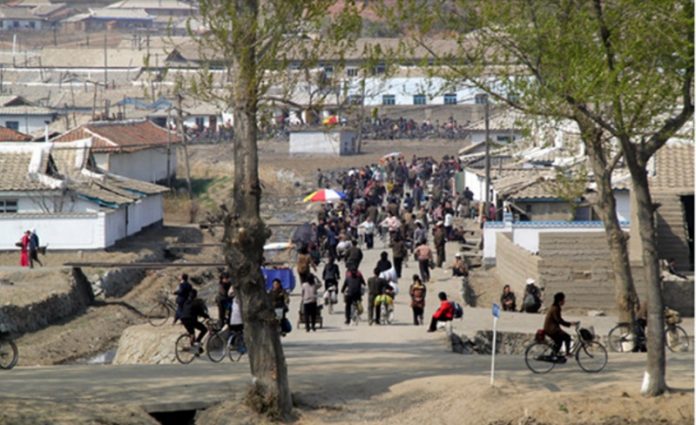
Growing numbers of North Koreans are turning to informal day-labor markets to earn a living as tightened controls on jangmadang (the semi-official street markets that form the backbone of North Korea’s informal economy) during the rice-planting season make everyday trading increasingly untenable. Rising exchange rates and price instability have already squeezed profit margins for small traders, and the added pressure of farm mobilization restrictions is pushing more people toward selling their labor rather than goods.
A source in South Pyongan province told Daily NK on Friday that the number of people showing up to informal labor markets in Anju and other inland cities has risen noticeably in recent weeks. Workers begin gathering before dawn to compete for available jobs. The state reduces jangmadang operating hours during rice-planting season and steps up enforcement against people moving freely through public spaces, as authorities prioritize channeling labor into the agricultural mobilization campaign. In practice, however, the source said the mobilization order is widely circumvented, with those who can find ways to avoid it doing so, while others who actually work the fields are a separate group altogether.
Labor markets fill the gap left by struggling traders
The shift toward day labor reflects a broader deterioration in market conditions. Currency exchange rate volatility has made it difficult for small traders to manage costs: buying goods at one rate and selling them later at a different rate can produce losses rather than profits. Consumer spending has also weakened as prices rise, further reducing the appeal of market trading as a livelihood strategy.
By contrast, informal labor markets offer a lower barrier to entry. No startup capital is required, and even older workers or those without specialized skills can find paying work. The available jobs have diversified beyond the skilled trades that once dominated these markets, such as carpentry, plastering, and electrical repair. Demand has grown for unskilled labor including construction site hauling, caregiving, domestic cleaning, and other general work.
The source noted that many people who previously traded at the jangmadang are now instead sitting at labor market gathering points looking for day jobs. The informal labor market, the source explained, appeals to the most economically vulnerable: even picking up a single simple job in a day covers the cost of a meal, and showing up costs nothing if no work is found.
Illegal but entrenched
North Korean authorities have long classified informal labor markets as illegal and have periodically moved to shut them down. Despite this, the markets have persisted through successive crackdown cycles. With jangmadang trade in a prolonged slump, informal labor markets appear to be consolidating their role as a primary survival mechanism for working-age North Koreans with limited options.
The source predicted that demand for informal labor markets will continue to grow, reflecting a spreading attitude among ordinary North Koreans that hard physical work, however exhausting, at least guarantees some income.
Reporting from inside North Korea
Daily NK operates networks of sources inside North Korea who document events in real-time and transmit information through secure channels. Unlike reporting based on state media, satellite imagery, or defector accounts from years past, our journalism comes directly from people currently living under the regime. We verify reports through multiple independent sources and cross-reference details before publication.
Our sources remain anonymous because contact with foreign media is treated as a capital offense in North Korea — discovery means imprisonment or execution. This network-based approach allows Daily NK to report on developments other outlets cannot access: market trends, policy implementation, public sentiment, and daily realities that never appear in official narratives.
Maintaining these secure communication channels and protecting source identities requires specialized protocols and constant vigilance. Daily NK serves as a bridge between North Koreans and the outside world, documenting what’s happening inside one of the world’s most closed societies.
Disclaimer : This story is auto aggregated by a computer programme and has not been created or edited by DOWNTHENEWS. Publisher: dailynk.com