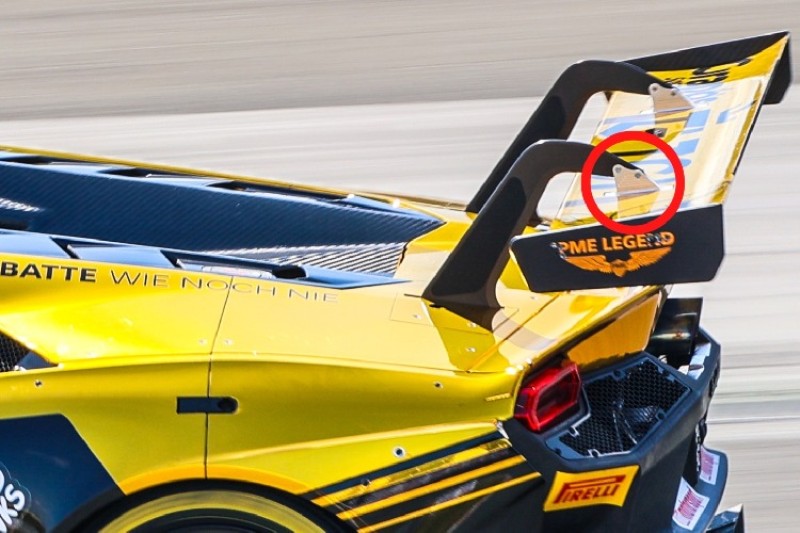
Was the criticism of the Lamborghini Temerario GT3 premature? After the catastrophic start in Spielberg, where the Lamborghini drivers languished at the back of the pack, Abt driver Luca Engstler managed an eighth and a sixth place at Zandvoort. “It can’t be such a handful if we’re on the second row,” Lamborghini factory driver Engstler defended his car on Sunday at ran.de after a strong third place on the grid.
But what role did the DTM additional homologation play in this upward trend, which allowed the Lamborghini teams for the first time to run with a rear wing configuration not homologated by the FIA? “It’s a combination of things, but of course the rear wing helps us,” clarified team principal Gottfried Grasser.
“The downforce from the rear wing mainly helps with driveability, because you can push more at the corner entry and the car is better to drive in that area. It also makes it a bit easier to set up the car,” he explained.
The specifics of the Lamborghini special regulation
What changed for the Temerario GT3 through the additional homologation? Shortly before the DTM weekend at Zandvoort, the DTM GT Committee decided that the Lamborghini teams Grasser and Abt – despite opposition from other manufacturers manufacturer pushback, the DTM approved a special solution for Lamborghini – would be allowed to run a rear wing setting that generates more downforce and is not covered by the car’s FIA homologation.
In the updated Balance of Performance (BoP), it stated that the rear wing could be set three degrees steeper. This meant the minimum allowed angle of attack was no longer five, but eight degrees.
This would not have been possible without a hardware change: With the help of the DTM additional homologation, the maximum achievable angle of attack was increased from seven to twelve degrees, enabled by a new bracket. This is the connecting piece between the L-mount, which is fixed to the chassis, and the rear wing blade.
Steeper rear wing than previously possible even at Monza
From the outside, the difference is barely visible, as only the mount was slightly adjusted and the rear wing is now set steeper than in the past. How desperately the Temerario needed the change was evident during the GT World Challenge Europe weekend at Monza, where the car was also allowed to use the change thanks to SRO additional homologation.
Because even on the high-speed track, the Temerario headed out with an angle of attack of eight degrees – something that would not have been possible with the FIA homologation.
Abt tested with special solution before Zandvoort
While the Grasser team ran the modified configuration for the first time during DTM free practice at Zandvoort, the Abt team had a slight head start: According to information from Motorsport-Total.com, the Lamborghini team had already tried the change two weeks before the Zandvoort weekend during their single private test day per season, which Abt utilized at Zandvoort on May 8.
The change primarily has a positive effect in high-speed corners, as it makes the car aerodynamically more stable. Furthermore, it helps the balance, as the Temerario GT3 previously generated far too little downforce at the rear axle, making the car unstable, especially in fast corners.
Since the car now generates a few more kilograms of downforce at the rear axle, the top speed of the vehicle decreases. To compensate for this, the Temerario received up to 0.1 bar more boost pressure in the high RPM range at Zandvoort, which means DTM and SRO are once again operating outside the FIA’s homologation window.
“You have to work with the car in a completely different way”
For the Grasser team, the change at Zandvoort meant a major adjustment. “We were searching a bit at the beginning,” Grasser explained. “In terms of philosophy, you now have to work with the car in a completely different way. And that needs driving experience. The two practice sessions are almost not enough for that. Therefore, the first part of the weekend was like a test.”
Whether it felt like a new car? “Yes and no, that would be an exaggeration,” he replied. “But it is a major impact where you now have to learn step by step.” This is why they made a big leap from Saturday to Sunday, which was also demonstrated by Mirko Bortolotti’s fourth place on the grid.
Whether Grasser believes the progress at Zandvoort was also related to the abrasive asphalt and the high temperatures? “No, I believe it will generally go better,” he said. “The high energy from the track and the higher temperatures certainly helped us, but that also applies to other tracks when it’s warm.”
We want your opinion!
What would you like to see on Motorsport.com?
– The Motorsport.com Team
Disclaimer : This story is auto aggregated by a computer programme and has not been created or edited by DOWNTHENEWS. Publisher: motorsport.com