
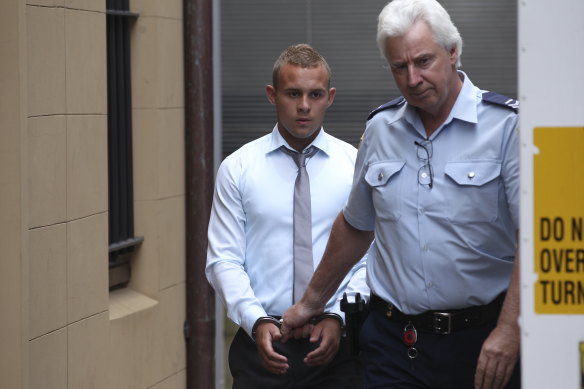

Infamous one-punch killer Kieran Loveridge has been charged with drug possession after a court rejected extended state monitoring, days after he entered a detox facility.
The 32-year-old spent more than a decade behind bars for the 2012 killing of 18-year-old Thomas Kelly in Kings Cross while highly intoxicated.
The tragedy sparked Sydney’s lockout laws and prompted mandatory sentencing for alcohol-fuelled killings.
Loveridge will face court on Wednesday for drug possession.
This follows an April court-ordered apprehended domestic violence order (ADVO) which bans him from threatening or harassing his partner, though he can still see her.
Loveridge was granted parole two years ago, which expired in May, ending his 13-year, eight-month sentence and all supervision.
NSW sought a two-year Extended Supervision Order (ESO) to continue monitoring, citing a drug relapse and risk assessment report which considered him at “high risk” of violent reoffending.
An ESO subjects high-risk offenders to community surveillance and rehabilitation for up to five years for public protection, with the severity and number of conditions varying.
Three days before his preliminary ESO hearing in May, Loveridge entered a drug detox facility at Nepean Hospital, intending to start long-term residential rehab. The court heard his prospects were uncertain.
His lawyers opposed the ESO, noting the time since Thomas’ death, Loveridge’s lack of physical violence convictions since a 2018 prison incident, and his post-release family responsibilities.
Justice Natalie Adams dismissed the application, ruling that while Loveridge was at risk of further violence, it did not meet the legal threshold of a “serious violence offence” required for supervision.
“Mr Loveridge had a very promising start to adjusting to life in the community after being incarcerated from the age of 18 to 30, but he then lapsed into drug use, which is a significant risk factor for further offending,” the NSW Supreme Court judgment read.
“Despite this, the index offence occurred 14 years ago, and he has committed no serious violence offences since that date.”
Thomas’ parents, Kathy and Ralph Kelly, previously told the State Parole Authority they hoped their son’s killer would “live a lawful life”, and expressed concern that he was drunk and violent in prison.
“Mr Loveridge had a very promising start to adjusting to life in the community after being incarcerated from the age of 18 to 30 years old, but he then lapsed into drug use.”
Justice Natalie Adams
Loveridge’s life beyond bars began well, his psychiatrist noted. He abstained from alcohol, worked as a painter full-time and took part in the Violent Offender Treatment Program (VOTP).
However, he turned to drugs when his employer’s business folded and his first child was born, triggering psychological stress – including, the judgment noted, guilt that Thomas would never be a father.
He was arrested three days before Christmas Day last year over a domestic disturbance and released with a temporary apprehended domestic violence order (ADVO) preventing contact with his partner.
Later that morning, he was charged with breaching the order when he was with his partner at Sydney Airport. He said he was retrieving his electronic monitoring charger.
Two connected assault charges were withdrawn, and no penalty was given for the non-violent breach which Loveridge admitted to, though parole was temporarily revoked.
Corrective Services also reported several technical parole breaches.
He repeatedly tested positive for – or admitted using – cocaine, ice, heroin, non-prescribed Valium, and Tramadol, while also breaching curfews, entering exclusion zones and mingling with bikies.
Loveridge’s prison history was riddled with controversies.
He was convicted of assaulting two inmates in 2015 and 2018, including a Rebels bikie president.
An “improper relationship” with a guard sparked his move to the high-security Goulburn Correctional Centre.
Initially sentenced to four years for the attack on Kelly, this minimum term was increased to a decade on appeal.
He recently failed in an attempt to protect his identity from media coverage for two years, arguing it would help him rehabilitate.
The state must now pay his ESO legal costs.
Start the day with a summary of the day’s most important and interesting stories, analysis and insights. Sign up for our Morning Edition newsletter.
From our partners
Disclaimer : This story is auto aggregated by a computer programme and has not been created or edited by DOWNTHENEWS. Publisher: www.smh.com.au


