
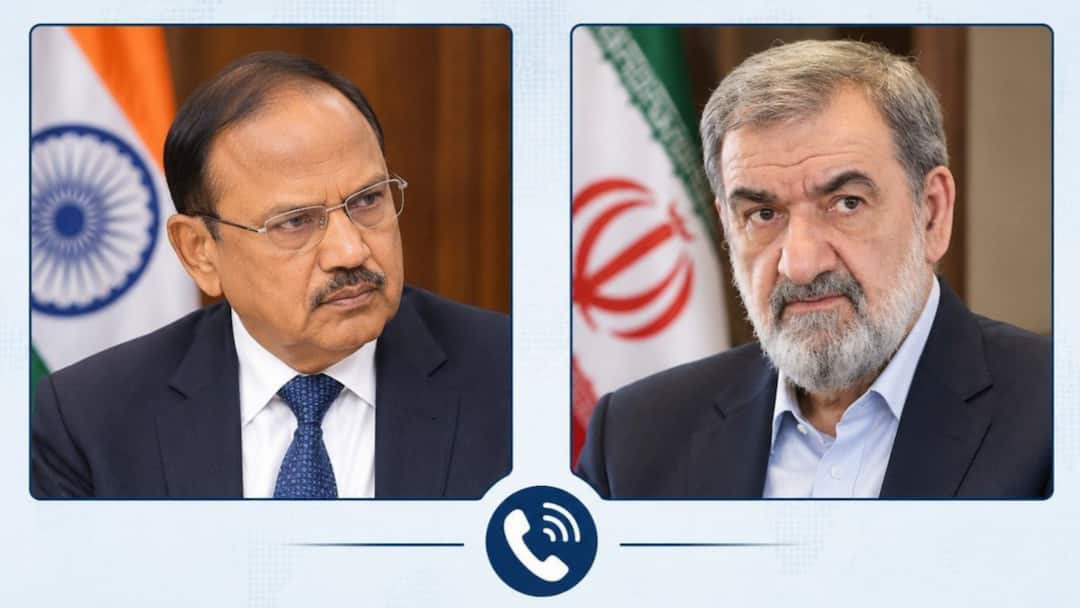
- Doval spoke with Iranian security chief regarding Middle East tensions.
- Officials discussed regional developments, mutual interests, post-BRICS meeting.
- Strait of Hormuz critical amidst conflict; Iran links reopening.
India’s National Security Adviser (NSA) Ajit Doval spoke with Iran’s Supreme National Security Council Secretary, Dr Mohsen Rezaei, over the phone on Monday evening, as tensions in the Middle East continue to affect regional security, energy supplies and maritime trade. The Iranian Embassy in New Delhi confirmed the conversation, saying the two officials discussed recent regional and international developments and exchanged views on matters of mutual interest to both countries. However, the embassy did not disclose specific details of the discussions.
The conversation comes amid the continuing conflict involving Iran, the United States and Israel, with the Strait of Hormuz emerging as a key point of concern for global energy supplies and shipping. India and Iran have maintained diplomatic ties and pursued cooperation in several areas, although the ongoing conflict has disrupted trade.
Iran Confirms Doval-Rezaei Call
In a post on social media platform X, the Iranian Embassy in New Delhi announced that Rezaei and Doval had spoken over the phone on Monday evening.
The embassy wrote, ‘Dr. Mohsen Rezai, Secretary of Iran’s Supreme National Security Council, held a telephone conversation with India’s National Security Advisor Ajit Doval this evening, in which views were shared on matters of mutual interest between the two countries and the latest regional and international developments.’
Dr. Mohsen Rezaei, Secretary of the Supreme National Security Council of the Islamic Republic of Iran, held a telephone conversation this evening with Shri Ajit Doval, National Security Adviser of the Republic of India, during which they exchanged views on the latest regional and international developments and issues of mutual interest to the two countries.
— Iran in India (@Iran_in_India) October 12, 2026
ALSO READ: Rs 220 Fee Shortfall, Missing Docs: SC Flags 14 Errors In Rahul Gandhi’s Plea Against Gyanesh Kumar
The statement confirmed that the conversation covered bilateral interests and developments beyond the two countries.
Follow-Up To Modi-Pezeshkian Meeting
The latest conversation comes days after Iran’s Ambassador to India, Mohammad Fathali, said Tehran was working on issues agreed upon during the BRICS summit meeting between Prime Minister Narendra Modi and Iranian President Masoud Pezeshkian. Responding to a question about progress on cooperation following the meeting between Modi and Pezeshkian last month, Fathali told news agency IANS that the Iranian President had taken immediate action on the matters discussed.
His remarks indicated that Iran was pursuing follow-up measures on the understandings reached between the two leaders. However, the ambassador’s statement did not provide a detailed account of the steps taken or specify a timeline for implementing the agreed measures.
The latest engagement between the two national security officials comes against this backdrop of continuing diplomatic contact between New Delhi and Tehran.
ALSO READ: Delhi Traffic Advisory: 23 Roads, Junctions Likely To Be Affected Amid CEC Gyanesh Kumar Protests
Strait Of Hormuz At Centre Of Crisis
The phone conversation took place at a critical juncture for the Middle East, where tensions involving Iran, the US and Israel have raised concerns about regional stability and international commerce.
The Strait of Hormuz is particularly significant because a substantial share of the world’s oil and liquefied natural gas shipments normally passes through the narrow waterway. Any prolonged disruption to traffic through the strait can affect energy markets, shipping operations and countries dependent on supplies from the region.
For India, developments affecting maritime trade and energy flows through the Gulf are of particular importance. The continuing conflict has also affected trade between India and Iran, adding to the challenges facing bilateral economic engagement.
Iran has maintained that the Strait of Hormuz will not reopen until Washington addresses Tehran’s conditions for ending the conflict. The position has kept the waterway at the centre of the wider confrontation and added to uncertainty over the resumption of normal maritime movement.
Tehran Calls US Response ‘Insufficient’
Rezaei said on Sunday that Washington’s response to Iran’s proposal was “insufficient”, underlining the differences that continue to separate the two sides.
The remark came amid ongoing tensions over the conditions for ending the conflict and the future of maritime movement through the Strait of Hormuz. Tehran’s position on the waterway and its assessment of the US response suggest that key disagreements remain unresolved.
Disclaimer : This story is auto aggregated by a computer programme and has not been created or edited by DOWNTHENEWS. Publisher: abplive.com




