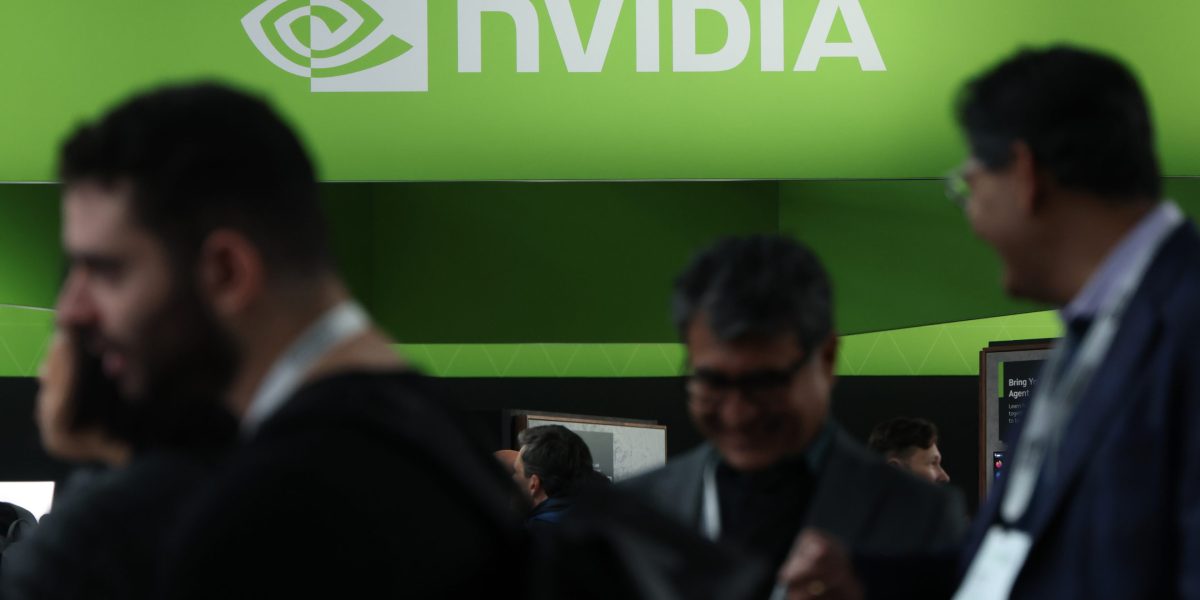
Morgan Chittum here. Nvidia posted quarterly results late Tuesday that handily beat earnings and revenue expectations—just days after Jensen Huang resigned as CEO following reports of extramarital affairs. The upheaval sent the stock to its lowest level in well over a year. The better-than-expected fiscal third quarter may give public-market investors a reprieve. But a massive question still hangs over the AI-pilled private markets, where Nvidia poured billions into investments and financing under Huang’s leadership: Will Colette Kress, the longtime CFO now serving as interim CEO, match his appetite for bankrolling the AI boom?
Before we get to that, the numbers deserve their due: Nvidia had a very good quarter. Revenue for the three months ended October 25 came in at $115.8 billion, more than double the $57 billion recorded a year earlier and above analysts’ expectations of around $109 billion. Adjusted earnings per share were $2.68, topping estimates of $2.48. The company forecasted fourth-quarter revenue of $130 billion, plus or minus 3%—a range that clears analysts’ $125 billion estimate even at the low end. Management also raised its growth forecast for the fiscal year ending in January 2028 to 75%, from 70%.
Stratospheric revenue growth, insatiable demand for chips. It’s almost business as usual for the world’s leading AI chipmaker. “Our momentum is real. Our demand is accelerating. Our supply is growing. Our customers and our partners are with us, and employees are committed. We’ve got this,” Kress said.
There’s more to the Nvidia story than blowout earnings, though. Over 33 years as CEO, Huang turned Nvidia into what some have characterized as the “central bank of AI.” It gets at the idea that Allie explored last week: Huang is AI’s ultimate key man. Under his leadership, Nvidia’s share of the global market for AI and data center GPUs swelled to north of 80%. The company also invested in 126 startups this year alone, including heavyweights like Anthropic and OpenAI. Not to mention its announced $13 billion acquisition of leading open-source repository Hugging Face.
And that’s before you get to all the financing Huang has championed. In August, Nvidia announced a memorandum of understanding—essentially a preliminary agreement—with some of Wall Street’s biggest firms: Apollo, BlackRock, Blackstone, Brookfield Asset Management, Goldman Sachs and KKR. The goal is to raise more than $500 billion in third-party capital for AI infrastructure. Those talks are still underway, Reuters reported Monday, with no indication from Nvidia of a pause. But with its chief dealmaker gone, will Kress keep the money moving?
Although earnings didn’t give us an explicit answer, Kress hinted at a more measured approach than Huang’s. The ex-CFO, who held the job for more than 13 years, said she was proud of Nvidia’s role in supporting the broader AI ecosystem. But she also said the company would “remain thoughtful” and “disciplined” in committing capital, adding that Nvidia is “rigorously evaluating” future guarantees, investments and commitments. Last week, The Wall Street Journal reported, citing people familiar with the matter, that Kress had questioned some of Nvidia’s dealmaking under Huang.
One thing Kress won’t have to worry about, however, is Huang returning to the top job.
Hours before Nvidia reported Tuesday, Huang said he’d love to have his old job back if the board asked. Board chair Harvey Jones said on the earnings call that there were no plans to reinstate him. So Huang won’t be taking the helm anytime soon—at Nvidia, at least.
See you tomorrow,
Morgan Chittum
X: @morgan_chittum
Email: morgan.chittum@fortune.com
Submit a deal for the Term Sheet newsletter here.
Joey Abrams curated the deals section of today’s newsletter.
VENTURE CAPITAL
– Isomorphic Labs, a London, U.K.-based AI-powered drug discovery company, raised $5 billion in Series C funding. Greenoaks and Sequoia Capital led the round and was joined by Andreessen Horowitz, Alphabet, Thrive Capital, and others.
– Genesis AI, a Paris- and San Carlos, Calif.-based developer of general-purpose robots, raised $500 million in Series A funding. Premji Invest, Khosla Ventures and Eclipse 1led the round and were joined by Durable Capital Partners and others.
– Payhawk, a London, U.K.-based provider of AI-powered spend management and finance software, raised $280 million in Series C funding. Growth Equity at Goldman Sachs Alternatives led the round and was joined by existing investors QED, Greenoaks, Lightspeed, and others.
– Model ML, a London-based provider of AI agents for financial and professional services, raised $250 million in Series B funding. General Atlantic and QED Investors led the round and were joined by Evolution Equity Partners, Airtree, Forestay Capital, and others.
– Hone Health, a New York-based physician-led longevity care platform, raised $228 million in funding. The funding comprises $28 million in Series A equity led by MarcyPen Capital Partners, joined by Pentland Ventures, Kinship Ventures, Hanwha, Gannet Capital and humbition, and $200 million in growth financing from General Catalyst’s Customer Value Fund.
– Ramon.Space, a provider of space computing infrastructure, raised $124 million in Series B funding. PSG led the round, joined by Micron Technology, Senvest, and others.
– Remedy Robotics, a San Francisco-based developer of AI-enabled robotic systems for cardiovascular interventions, raised $62 million in Series B funding. DCVC led the round and was joined by UC Investments, Skip Capital, and others.
– Aevius, a Boston, Mass.-based clinical intelligence company developing AI models to make medical data actionable for healthcare, payer and life sciences organizations, raised $22 million in funding. Insight Partners led the round.
– Darcy Geothermal, a New Brighton, Minn.-based provider of geothermal heating and cooling systems for commercial buildings, campuses and thermal networks, raised $15 million in Series B funding. Aligned Climate Capital and Büetigen led the round.
– Fermat, a Barcelona, Spain-based AI platform for fashion design and production, raised $8 million in seed funding. Kibo Ventures and Lunar Ventures led the round.
– MountAIn, a Grenoble, France-based developer of software that runs AI applications on low-cost, low-power chips, raised €7.3 million ($8.03 million) in seed funding from 360 Capital and others.
– Pretxt, an Aspen, Colo.- and Dublin-based developer of runtime supervision software for enterprise AI agents, emerged from stealth with $5 million in seed funding from Deciens Capital, Howdy Partners, NSV Wolf Capital, and Service Provider Capital.
– AstraNu, a Murray Hill, N.J.-based developer of chip-scale optical coherence tomography imaging technology for medical devices, raised $3.5 million in seed funding. Celesta Capital led the round.
– Treat, a Helsinki-based provider of AI-assisted intake and digital doctor consultations, raised €3 million ($3.3 million) in pre-seed funding. byFounders and Illusian led the round.
– Sqwish Labs, a Cambridge, U.K.-based developer of AI decision models, raised $3 million in pre-seed funding. Cambridge Enterprise Ventures led the round.
– Mulga, an Austin- and Brisbane-based developer of an open-source, AWS-compatible cloud platform, raised $1.77 million in pre-seed funding. Rally Ventures and backtrace led the round.
EXITS
– EQT Transition Infrastructure agreed to acquire Flatiron Energy, a developer and operator of utility-scale battery storage projects across the Eastern U.S., from Hull Street Energy. Financial terms were not disclosed.
– Funds managed by Centerbridge Partners acquired Amplix, a Norwood, Mass.-based provider of technology advisory, consulting, implementation and managed services, from Gemspring Capital. Financial terms were not disclosed.
IPOs
– Core Specialty Insurance, a Cincinnati, Ohio-based provider of specialty insurance to small and midsize businesses, filed to go public on the New York Stock Exchange. SkyKnight Capital, Dragoneer, Enstar, Aquiline Capital Partners, and Dave and Tim Delaney back the company.
FUNDS + FUNDS OF FUNDS
– Argonaut Private Equity, a Tulsa, Okla.-based private equity firm, closed its sixth fund at $606 million focused on industrial businesses in Middle America.
PEOPLE
– Lovell Minnick, a New York City-based private equity firm, promoted Jason Barg to co-managing partner; Trevor Rich and Brad Armstrong to senior partners; and Spencer Hurst, Tom Hutchins and Jason Klein to partners.
– Tapestry VC, a London, U.K.-based venture capital firm, hired Mandeep Singh as general partner.
Disclaimer : This story is auto aggregated by a computer programme and has not been created or edited by DOWNTHENEWS. Publisher: fortune.com