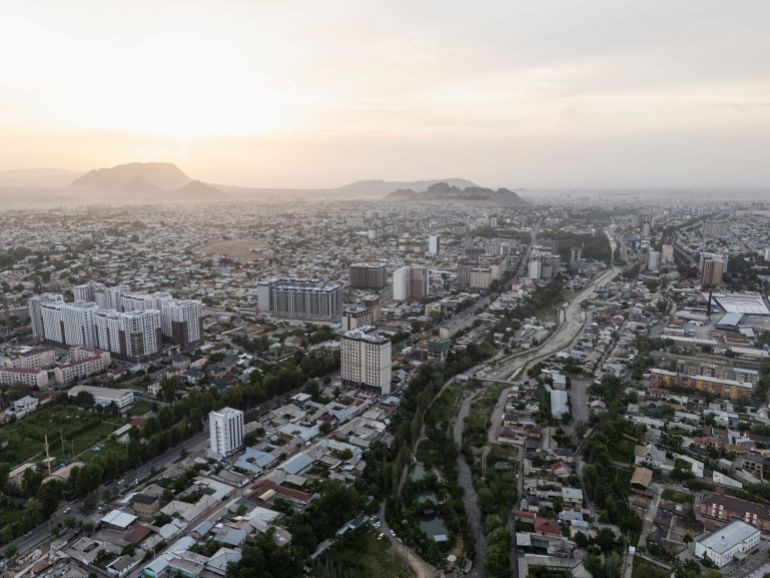
Osh, Kyrgyzstan – Kyrgyzstan’s second-largest city is in the throes of a major regeneration programme.
New IT hubs are planned for Osh, as well as apartments, schools and nurseries. Transport projects, a waste-to-energy plant and a livestock complex are being worked on too. A “modern school” for 530 children, kitted out with solar panels, was completed in 10 months and will open in the coming days, the government announced last week.
Recommended Stories
list of 4 itemsend of list
But several hundred homes have been demolished to make way for new infrastructure, stirring fears about the future and the character of the old city.
The fast-paced campaign to modernise could also affect Osh’s mountain of Sulaiman-Too – a UNESCO World Heritage site.
Osh lies just 5km from the border with Uzbekistan and is home to about 470,000 people – about 40 percent are Uzbek.
Kyrgyz authorities in the town “want to erase us from the history of this city”, said 84-year-old Mogamed Kambarow, an Uzbek with a white beard and sun-bronzed face. In March, about a third of his home was destroyed as municipal authorities worked to widen Alisher Navoi Street.
“They sent bulldozers, pulled down the walls and left,” said Kambarow, who was at home at the time. He received no compensation and lives in the remaining parts.
Neighbours alerted each other when the demolition began. An 11-year-old girl was injured by falling bricks and taken to hospital, he said.
Kambarow’s memories haunt him. He was around when violence engulfed the city before.
In 2010, inter-communal tensions spilled over into violence. More than 400 people were killed and thousands of homes were destroyed. Most of the victims were ethnic Uzbeks.
Advertisement
In 1990, shortly before the collapse of the Soviet Union, as Uzbeks demanded more autonomy and as land disputes raged, fighting and riots broke out between the two groups and hundreds were killed.
‘It isn’t only Uzbek property that is damaged’
But Gulgaky Mamasalieva, head of the International Centre Interbilim, an organisation in Osh that provides legal help to residents today, says the current redevelopment affects everyone.
“It isn’t only Uzbek property that is damaged,” she told Al Jazeera, adding that more than 750 households were affected by the latest demolitions, including many Kyrgyz families.
According to a report by Interbilim, 65 percent of households first learned that their homes were going to be demolished when city workers painted the Russian word snos, meaning “demolition”, on their walls.
Some residents received letters telling them to leave within three days. Others, like those on Navoi Street, were visited by the mayor, who announced the plans himself.
“But people expected that there would be some paperwork done first,” said Mamasalieva.
Osh sits at the eastern end of the Ferghana Valley, the agricultural heart of Central Asia. The area is divided between three former Soviet republics: Kyrgyzstan, Uzbekistan and Tajikistan.
Historically, the city was predominantly Uzbek, but when the borders of the Soviet republics were drawn up in 1924-27, Moscow gave it to the Kyrgyz.
In those days, the whole city used to look like the quarters along Navoi Street, where flat-roofed houses hide behind high fences and yards full of grapevines offer some shade from the scorching sun. These areas are known as “mahallas” – an old word for an administrative and community unit.
As the years passed, a university was established, factories built, and the population grew.
Just behind Kambarow’s house, a path leads up Sulaiman-Too. The mountain is a holy site for Muslims and has been a UNESCO World Heritage Site since 2009.
It is believed that the ancient Greek geographer Ptolemy mentioned the mountain in his book Geography. Babur, who was born in the Ferghana Valley and later founded the Mughal Empire, built a house of prayer on its summit.
The building was destroyed during a Soviet campaign against religion in the 1960s, but rebuilt in the late 1980s. Some Muslims believe that visiting Sulaiman-Too three times is equal to making one pilgrimage to Mecca.
Advertisement
There are also three cemeteries on the mountain where old gravestones rise from the long grass.
Retired pilot Abduraim Amanbaev, 73, climbs Sulaiman-Too every Friday, after prayers. He takes a shortcut through the cemetery to avoid paying the entrance fee, as the mountain is also a tourist attraction.
“The oldest grave dates back to the 14th century,” Amanbaev said.
His family home has been destroyed three times during his lifetime. The first time was in the 1960s, when the Soviet authorities modernised the city. The second was in 2010, during the ethnic violence. Now, it is happening again. “People are tired,” he said. Half of his house was destroyed. He lives in the other half and has not been compensated.
Mamasalieva from Interbilim told Al Jazeera that the city was supposed to agree on compensation with each household before demolishing their property. Disputes should have gone to court. While they received guarantee papers signed electronically by the vice-mayor, the documents did not detail compensation packages, she said.
Only families whose houses were completely destroyed were offered new flats. More than 100 households were moved to Ene-Say, a residential area 10km (6 miles) outside Osh. Another 64 families were given flats in an apartment block in the city.
But for some, relocation has caused further problems.
“We still haven’t been given the deeds for this flat,” said a 37-year-old woman who now lives in Ene-Say, who requested anonymity.
Without official ownership, her family cannot register their new address or access free healthcare and other services. Some families said they have also been asked to pay the government the difference between the value of their old homes and their new flats.
Interbilim said it is ready to help residents take the authorities to court, but so far nobody has been willing to do so.
“The city promised that anyone who wanted to open a business along Navoi Street would be given permission,” said Mamasalieva.
Osh’s debts total up to 3 billion soms ($34m), according to Kyrgyz media. City authorities rejected that figure when contacted by Al Jazeera, saying the budget for this year is 5.2 billion soms ($57m). Officials did not respond to questions regarding the backlash over the development plans.

Sulaiman-Too is a key source of tourism income. It attracts about 370,000 visitors each year, according to Hairullo Ibaydullaev, a deputy director of the National Historical and Archaeological Museum Complex Sulayman, which is carved inside the mountain.
Renovation across the mountain began in October. The plans include improving the footpaths, replacing lighting and building a car park. The $12m project is being funded by the World Bank and is expected to take one year.
But Ibaydullaev said the mountain is under pressure from developers who want to use the surrounding land, even though it is protected by UNESCO. The mountain has a buffer zone covering 4,788 hectares (11,830 acres), which includes Navoi Street.
Advertisement
City officials say these restrictions make it harder to develop Osh.
Sabira Soltongeldieva, head of the National Commission of the Kyrgyz Republic for UNESCO, said that Bishkek has asked to reconsider how the buffer zone is used.
The former mayor, Jenishbek Toktorboev, asked the Ministry of Culture to release some of the protected land for new projects. He earned the nickname “Demolition Uncle” among some after he ordered the destruction of the old Jayma Bazaar, once the city’s main trading centres.
“The vendors were given 15 days to disappear,” said a knife-maker, whose stall was one of those allowed to remain.
Toktorboev also began building apartment blocks at the foot of the mountain, taller than the rules for the buffer zone allowed. He wanted to remove one of the three cemeteries and build a leisure park in its place. This project failed. Kyrgyz President Sadyr Japarov dismissed him in February.
The new mayor, Janar Akaev, has continued to propose new developments.
In August, Akaev announced plans to build a cable car to the top of the mountain, comparing it to those in Switzerland.
He also announced a plan to remove the mountain from the UNESCO World Heritage list – a proposal rejected by the culture ministry.
“This is the most complete example of a sacred mountain in Central Asia,” said Ibaydullaev.
Disclaimer : This story is auto aggregated by a computer programme and has not been created or edited by DOWNTHENEWS. Publisher: aljazeera.com