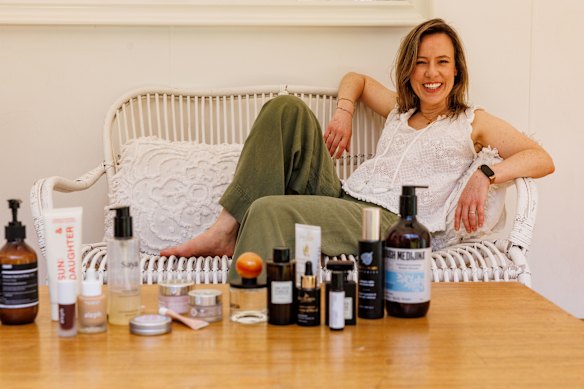

Emily Fletcher lists the products she uses on a typical day. There’s body wash and face cleanser, shampoo and conditioner, toothpaste, vitamin C serum, facial moisturiser, body lotion and sunscreen, foundation, concealer, blush, mascara, lip liner, lip gloss, deodorant, hand soap and a natural fragrance.
At 18 different items, it’s only slightly more than the average person, who uses about 14.5 personal care products a day, from soap and toothpaste to cosmetics, fragrances and hairstyling products.
But a paper published in the Journal of Exposure Science & Environmental Epidemiology says these 14.5 products expose a person to an estimated 100 or more unique ingredients each day, “many of which are known or suspected allergens, carcinogens, endocrine disruptors or neurotoxicants”.
Teenagers who are exposed to beauty and skincare content on social media use more products than their peers and the average adult, the research found. This is a “critical window of susceptibility”, alongside pregnancy, says Yousuf Mohammed, an associate professor in the school of pharmacy and pharmaceutical sciences at the University of Queensland.
Most of us use personal care products on the assumption that they will help us or, at the very least, not harm us. But this may not be the case.
“Inactive ingredients found in personal care products act as the vehicle, preservative or texture enhancer for a formula,” Mohammed says. “While they do not directly treat a specific skin condition – a job reserved for active ingredients – their impact on your body and health can be profound.”
He cites new research that found 98 per cent of tested personal care items contained undisclosed chemicals, many carrying hidden health hazards.
‘I wouldn’t put this in someone’s eye’
When Fletcher, 41, gave birth to her first child 11 years ago, she began thinking about the products she was buying for her newborn daughter.
Women in her mum’s group recommended this cream or that wipe. But, when the optometrist looked more closely at them, she found ingredients they wouldn’t use in eye drops because they can cause allergic reactions.
“I wouldn’t put this in someone’s eye, so why am I wiping it over a large surface area of a baby’s skin,” she wondered.
Fletcher didn’t think it was fair that someone should need a science degree to identify the products that don’t contain harmful ingredients. So, she began blogging. As her blog gained traction, it evolved into a directory and annual Clean + Conscious Awards to “highlight those brands who are actually doing the right thing”.
Today, the global beauty and personal care market – worth $US698.38 billion ($992 billion) is home to tens of thousands of brands and hundreds of thousands of products.
What we apply can be absorbed by the skins, says Dr Jacinta Martin, a reproductive and developmental biologist at the University of Newcastle.
“But also potentially through mucosal surfaces, such as the lips and mouth, inside the nose, around the eyes or through genital and vaginal tissues, depending on the product being used – important when we consider period products,” she says. “There is also the potential for inadvertent ingestion, particularly with products applied to or around the lips and mouth.”
Such exposure is relatively new.
What impact are these ingredients having on us?
Until the middle of the 19th century, many people stayed stinky all day. The bubonic plague outbreak sparked widespread fear of washing with water; soap was primarily for clothes, not bodies; and commercial toothpaste, deodorant and shampoo came to market only between 1873 and 1903.
Few people used cosmetics, which were associated with immoral behaviours, and in 1916, only one in five Americans used toiletries at all.
Now, as Martin says: “We are potentially applying many different products, containing many different chemicals, to our skin, hair and lips every day, and doing that repeatedly over many years – including during important periods of growth and development.”
People who use more products tend to have higher levels of chemicals such as phthalates, phenols and parabens circulating in their bodies, said lead author of the new study, Emily Barrett, a professor in the Department of Biostatistics and Epidemiology at Rutgers School of Public Health.
Those chemicals have been linked to a wide range of outcomes, including preterm birth, asthma and reproductive issues, Barrett says by email. “Complementary studies in animals also show that those chemicals can interfere with important biological processes that can then contribute to disease.”
Yet direct causation between personal care products themselves and these health issues has not been established.
“I think concern is warranted, but not panic,” Martin says. “I don’t think we know enough yet.”
Specifically, there are questions about the concentrations and combinations of different chemicals, how much actually enters the body, how frequently we’re exposed, when in our lives that exposure occurs, and what happens when exposures occur repeatedly or in combination over long periods of time.
So, what action should we take?
It’s not just down to the consumer, experts say. Brands need to be more transparent about ingredients, and governments need to tighten regulation around the chemicals used.
But you can still reduce your exposure.
In Barrett’s study, a three-day health product intervention where participants’ standard products were replaced with “cleaner” products (selected to be free of phthalates, parabens, triclosan and benzophenone-3), urinary concentrations of many (but not all) of the chemicals declined by up to 45 per cent.
Here’s how to overhaul your routine.
- Go fragrance-free: Phthalates are used in fragrances to make the scent last longer. So the first step is to use fragrance-free products or only those scented with essential oils. “Avoid ‘unscented’, as these often use masking chemicals to hide smells,” Mohammed says. Additionally, he says, because blends are legally protected as proprietary trade secrets, a single listing of the word “fragrance” or “parfum” can mean dozens of undisclosed chemicals, including petrochemical derivatives and neurotoxins.
- Simplify your routine: Consider how many products you need to use. “Fewer products generally means fewer opportunities for exposure to unnecessary chemicals,” Martin says. “I wouldn’t tell people to throw out everything in their bathroom cabinet. My advice would be to take a sensible approach to reducing unnecessary exposure.”
- Swap sunscreens: Particularly during vulnerable periods such as childhood and pregnancy, Mohammed suggests switching from chemical filters to physical mineral sunscreens utilising zinc oxide or titanium dioxide, which sit safely on top of the skin rather than potentially absorbing into the bloodstream.
- Avoid forever chemicals: PFAS is widely used in personal care products to make them longer-lasting or waterproof. To reduce PFAS exposure, avoid products with ingredients such as PTFE or the terms “perfluoro-” or “polyfluoro-” .
- Get advice: It can be difficult to navigate ingredient lists, Barrett says: “But, luckily, there are a lot of great user-friendly (and free) apps and websites such as Skindeep, Clearya, Yuka and more that can help you choose safer products.”
- Reconsider your hair care: Hair care products often contain hormone-disruptors and carcinogens, says Barrett. “I’d recommend doing your homework when shopping for hair oils, crèmes, relaxers and chemical straighteners (or skip them altogether).”
- Control what you can and relax about the rest: “You have to keep balance,” Fletcher says. “Ultimately, stress could be more damaging than anything. So what I do is I tend to just control what I can at home and then, anything that’s an external exposure, I don’t worry about.”
Make the most of your health, relationships, fitness and nutrition with our Live Well newsletter. Get it in your inbox every Monday.
 Sarah Berry is a lifestyle and health writer at The Sydney Morning Herald and The Age.Connect via X or email.
From our partners
Disclaimer : This story is auto aggregated by a computer programme and has not been created or edited by DOWNTHENEWS. Publisher: www.smh.com.au