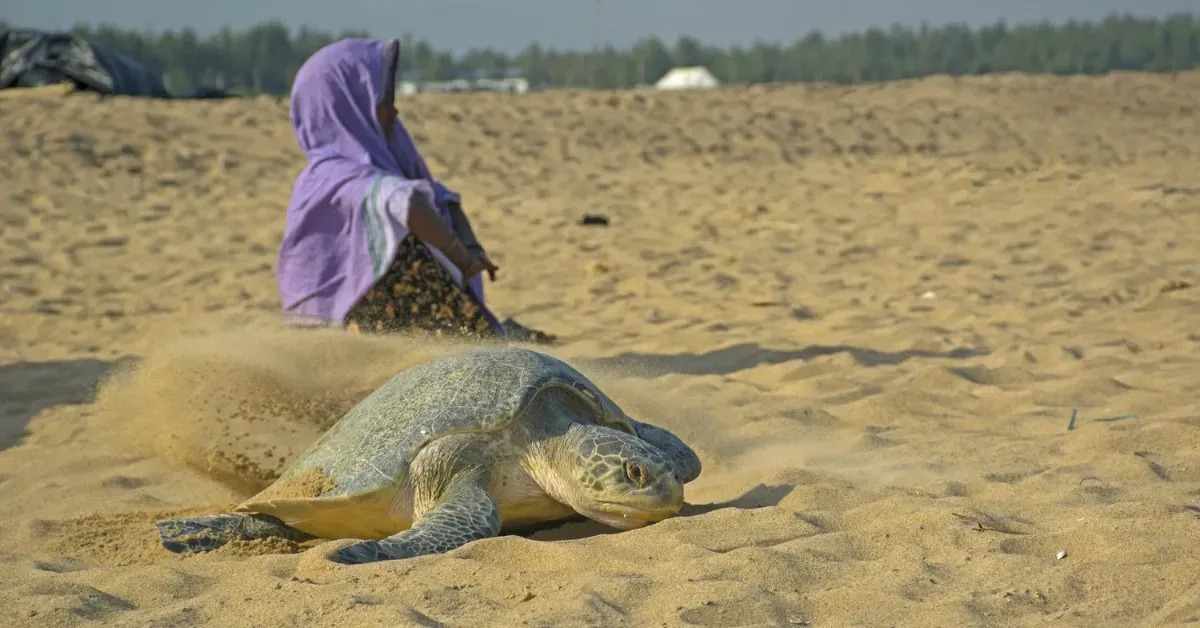
Every year, Olive Ridley turtles return to Odisha’s coast to mate, feed and nest. By the time thousands of them appear on the sand, however, much of their journey has already happened offshore.
What they do before reaching the beach is harder to see.
Where do they travel? How long do they stay close to the coast? Do males and females use the same waters? And which stretches of the Bay of Bengal do they depend on before arriving at one of Odisha’s mass-nesting beaches?
A three-year research initiative led by the Dehradun-based Wildlife Institute of India (WII) is beginning to answer some of these questions by following the turtles beyond the shoreline.
The first-year report of the study, released by Ganesh Ram Singh Khuntia, Minister of State for Forest, Environment & Climate Change, Labour & ESI, combines satellite telemetry with boat-based surveys and shoreline analysis to understand how Olive Ridleys use Odisha’s coastal waters and nesting habitats.
Following the turtles offshore
Satellite telemetry allows researchers to track an animal’s movements after a transmitter is attached to it. For Olive Ridleys, this offers a glimpse into habitats that cannot be observed from the shore.
The initial fieldwork focused on the Gahirmatha rookery in Kendrapada district, while satellite tagging was carried out at both Gahirmatha and Rushikulya in Ganjam district.
The results already suggest that Olive Ridleys do not all follow the same movement patterns.
Male turtles began their offshore migration earlier, while females spent longer periods in nearshore waters. The tracking data also indicated possible foraging stopovers along the continental shelf and across the Bay of Bengal.
Their routes through coastal waters, feeding areas and the stretches of sea they use before nesting can all help inform how their habitats are protected.
6,719 km across the sea
The satellite tags have also revealed just how far an individual turtle can travel.
One female covered 6,719 km over 271 days, eventually reaching waters east of Sri Lanka.
Another turtle travelled nearly 200 km from Gahirmatha to Rushikulya and then returned. This shows that Olive Ridleys can move between different parts of Odisha’s coastline rather than remaining tied to a single nesting site.
These movements suggest that the coastline is more connected than separate nesting beaches might make it seem.
Imagine swimming 6,719 km across the ocean without a map or compass!! A female Olive Ridley turtle tagged off Odisha travelled this incredible distance in just 271 days, reaching waters near Sri Lanka, according to a WII telemetry study. A remarkable journey that offers new insights into the migration routes of Olive Ridleys and the importance of protecting their ocean habitats. Nature never stops amazing us. #OliveRidley #Odisha #Wildlife
— Manas Muduli (@manas_muduli) October 5, 2026
A turtle seen at one rookery may have spent weeks or months using waters elsewhere along the coast.
For conservation planners, understanding this connection is important. Protecting nesting beaches alone may not account for the habitats turtles depend on before they arrive.
What happens close to shore
The satellite data is being supplemented by observations from the water.
During the 2025-26 nesting season, boat-based surveys recorded 1,390 individual Olive Ridleys and 67 mating pairs. Most sightings were within two kilometres of the coastline.
These observations offer another piece of the puzzle: nearshore waters appear to be an important part of how the turtles use Odisha’s coast, particularly in the period leading up to nesting.
The research is therefore looking beyond the spectacle of mass nesting to understand the movements that happen before the turtles reach the beach.
Before the turtles reach the sand
Odisha is home to two of India’s best-known Olive Ridley mass-nesting sites, Gahirmatha and Rushikulya. The species is protected under Schedule I of the Wildlife Protection Act, 1972, which gives it the highest level of legal protection in the country.
But legal protection alone cannot show where turtles spend their time at sea.
That is where the three-year WII study could prove useful. By combining individual tracking with boat surveys and shoreline analysis, researchers are building a broader picture of the habitats Olive Ridleys use along the coast and beyond it.
The first year has already shown that males and females do not necessarily follow the same timetable, that some turtles travel thousands of kilometres, and that individuals may move between Odisha’s major nesting areas.
The next time an Olive Ridley emerges from the sea to nest on Odisha’s sand, its journey will not have begun there. Satellite tracking is helping researchers trace the route that brought it home.
Sources:
‘Female Olive Ridley travels 6,719 km in 271 days to reach Lanka waters, reveals WII telemetry study’: By Express News Service, Published on 4 October 2026
‘Spatial Dynamics and Drivers of Nearshore Aggregations in Olive Ridley Sea Turtles along the Gahirmatha Coast’: By Wildlife Institute Of India, Published IN 2024
Disclaimer : This story is auto aggregated by a computer programme and has not been created or edited by DOWNTHENEWS. Publisher: thebetterindia.com