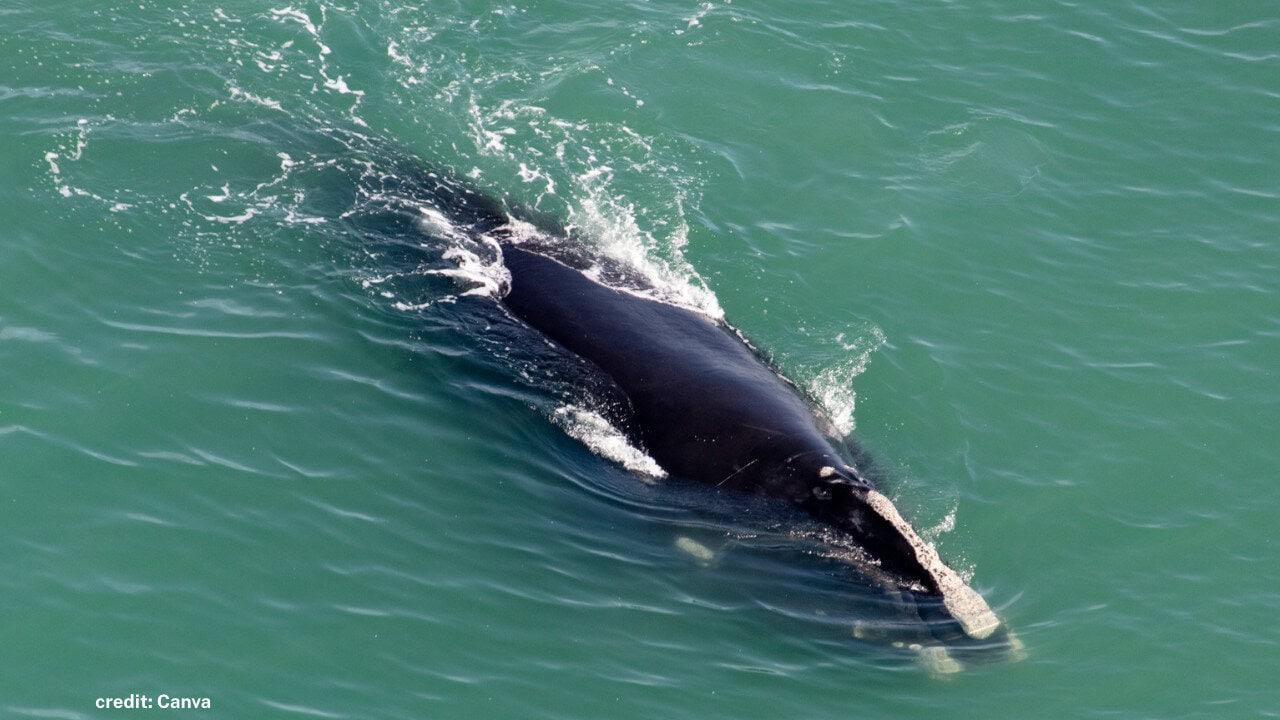
There are only about 382 North Atlantic right whales left in the world. A new count shows that the population went down again in 2025, after four years of slow growth. Scientists say the whales are not safe from extinction.
The new estimate was published on Monday by the North Atlantic Right Whale Consortium, a group of scientists and organisations from the United States and Canada. It was shared at the group’s yearly meeting in Halifax, Canada.
Scientists counted about 382 whales at the end of 2025. One year earlier, the number was 389. The number of females that can have babies stayed the same, at about 73.
The population is now about 20% smaller than in 2011, when there were 483 whales.
– Advertisement –
Good news: a baby boom
There is some good news. During the 2025–26 season, 24 baby whales, called calves, were born. This is the highest number since 2009.
The last calf was a surprise. Scientists only found him in September 2026, near Anticosti Island in Quebec, Canada. His mother is a 38-year-old whale called Silt. She had managed to hide her calf from researchers for months.
Right whales give birth in warm waters off the southeast coast of the United States in winter. In spring, they swim north to feed in the waters of New England and Canada.
Why are right whales in danger?
Right whales face two big dangers from humans: fishing gear and ships. Ropes from lobster and crab traps can wrap around a whale’s mouth, fins and tail. The ropes make it hard for the whale to swim, eat and have babies.
They can also cut deep into the whale’s body. More than 85% of North Atlantic right whales have scars from being caught in fishing gear at least once.
North Atlantic right whales swim slowly and often stay close to the surface. They are dark and have no fin on their back, so they are very hard to see. Fast ships can hit and kill a whale.
In early 2026, two young right whales were found dead. One of them, a four-year-old male called Division, died after a serious entanglement. Scientists traced the rope to snow crab fishing gear from Canada.
Researchers also recorded eight new injuries caused by humans, seven from fishing gear and one from a ship.
– Advertisement –
A long history
Right whales were once hunted in large numbers. They were easy targets because they swim slowly, stay near the coast and float when they die. By the 1920s, there were very few left.
Hunting them was banned in 1935, and the population slowly started to grow again. But in the 2010s, deaths from ships and fishing gear pushed the numbers down again.
Conservation groups say that governments need to do more. The ocean group Oceana wants the United States and Canada to make stronger rules, such as slower speed limits for ships and safer fishing gear without long ropes.
Disclaimer : This story is auto aggregated by a computer programme and has not been created or edited by DOWNTHENEWS. Publisher: theanimalreader.com